Broadcast switchers are essential components of modern live production environments, enabling broadcasters and production teams to manage multiple video sources, camera feeds, graphics, and program outputs. The transition toward IP-based workflows, UHD production, automated studios, and streaming distribution is increasing demand for flexible and high-performance switching solutions.
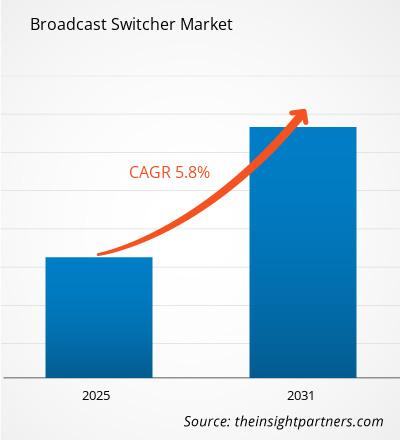
According to The Insight Partners, the Broadcast Switcher Market was valued at US$ 2.59 Billion in 2025 and is projected to reach US$ 3.98 Billion by 2034, registering a CAGR of 4.19% during 2026–2034. Modernization of broadcast control rooms, growing multi-camera production, expansion of live sports content, and increasing convergence between traditional broadcasting and streaming are expected to support market growth.
Key Market Insights
- Market Size in 2025: US$ 2.59 Billion
- Projected Market Size by 2034: US$ 3.98 Billion
- CAGR (2026–2034): 4.19%
- Total Addressable Market: Not provided in the supplied data
- Key Product: Production Switchers, Routing Switchers, Master Control Switchers
- Key Applications: Sports Broadcasting, Studio Production, Production Trucks, News Production, Post-production
- Forecast Period: 2026–2034
Get a Sample PDF of the Report: https://www.theinsightpartners.com/sample/TIPRE00007963
Modernization of Broadcast Infrastructure Supports Growth
The modernization of television stations, production studios, sports facilities, and outside broadcast operations is a major factor supporting demand for broadcast switchers. Broadcasters are upgrading legacy systems to handle increasingly complex production environments involving HD, 4K, HDR, IP, and cloud-based workflows.
Modern switchers provide operators with greater flexibility when managing multiple sources and formats. Their integration with routers, multiviewers, graphics engines, replay servers, audio systems, and remote contribution platforms is also increasing their importance within integrated production environments.
IP-Based Production Creates New Opportunities
The migration from traditional SDI infrastructure toward IP-based production is transforming broadcast workflows. Uncompressed IP technologies can provide scalable signal management, flexible routing, and low-latency connectivity across modern control rooms.
Broadcasters are increasingly adopting hybrid SDI/IP architectures to modernize facilities without completely replacing existing infrastructure. This transition is creating opportunities for manufacturers that offer switchers capable of supporting multiple connectivity standards and gradual technology migration.
Live Sports and Multi-Camera Production Drive Demand
Sports broadcasting remains a significant application for advanced broadcast switchers. Live sporting events require rapid switching between multiple camera feeds, replay systems, graphics, commentary sources, and other production elements.
The growing production of UHD sports content is further encouraging broadcasters and production companies to invest in high-performance switching equipment. Production trucks also require compact systems with extensive I/O capabilities and reliable operation in demanding environments.
Streaming Expands the Broadcast Switcher Opportunity
The convergence of traditional broadcasting and streaming is creating additional demand for flexible production infrastructure. Broadcasters increasingly distribute the same content across linear television, websites, streaming platforms, social media, and other digital channels.
This trend is encouraging production teams to adopt switchers capable of supporting multiple output formats and integrated workflows. Automated studios, remote production, and cloud-adjacent workflows are expected to further influence product development.
Get the Premium Research Report: https://www.theinsightpartners.com/buy/TIPRE00007963
Broadcast Switcher Market Segmentation
By product, the market includes Production Switchers, Routing Switchers, and Master Control Switchers. Production switchers are widely used for live events and studio production, routing switchers support signal distribution across facilities, and master control switchers support channel continuity and playout operations.
By resolution, the market covers High Definition, 4K, and Standard Definition. HD remains widely deployed, while 4K adoption is increasing across premium sports and entertainment production.
By port, the market includes Coaxial, Uncompressed IP, and Compressed IP. Coaxial connectivity remains important across legacy SDI infrastructure, while IP-based connectivity is gaining importance in modern broadcast facilities.
By application, the market is segmented into Sports Broadcasting, Studio Production, Production Trucks, News Production, and Post-production.
Regional Outlook
North America represents a leading regional market, supported by television station upgrades, sports broadcasting, production trucks, automated studios, and the transition toward IP-based control rooms. The United States accounts for a substantial portion of regional demand, driven by network studios, live event production, and digital broadcasting.
Europe is supported by investments in broadcasting infrastructure and the transition from HD to UHD production. The UK, Germany, France, Italy, and Spain are contributing to demand through studio modernization, sports content production, and streaming-oriented workflows.
Asia Pacific is expected to experience strong growth through 2034. China, Japan, South Korea, India, and Australia are investing in digital broadcasting, local content production, sports coverage, and streaming infrastructure. Increasing demand for compact and flexible production systems is supporting regional opportunities.
The Middle East and Africa region is also expected to present growth opportunities. Investments in media infrastructure, sports events, entertainment production, satellite broadcasting, and tourism-related events are supporting demand for studio and mobile production technologies.
Competitive Landscape
Competition in the Broadcast Switcher Market is focused on interoperability, format flexibility, I/O capacity, automation, IP connectivity, UHD support, reliability, and workflow integration. Vendors are increasingly developing solutions that support hybrid SDI/IP environments and enable broadcasters to transition toward modern production architectures.
Key companies analyzed in the report include:
- Blackmagic Design Pty. Ltd.
- Broadcast Pix, Inc.
- Evertz Microsystems Ltd.
- FOR-A Company Limited
- Grass Valley USA, LLC
- Harris Broadcast
- Ikegami Electronics U.S.A. Inc.
- Panasonic Corporation
- Ross Video Ltd.
- Sony Electronics Inc.
Future Outlook
The Broadcast Switcher Market is expected to maintain steady growth through 2034 as broadcasters modernize control rooms and adopt IP-based, UHD, automated, and streaming-enabled production workflows. Demand for flexible switching across SDI, IP, cloud contribution, and multiple video formats is expected to influence future product development.
The increasing use of live sports production, multi-camera broadcasting, remote production, e-sports, local-language content, and OTT distribution will create additional opportunities. Vendors that combine reliable switching performance with modular I/O, software-based upgrades, automation, IP interoperability, and simplified migration from legacy infrastructure are expected to strengthen their competitive position.
Related Market Research Reports
Gunshot Detection System Market Share and Growth by 2031
Agricultural Lighting Market Size, Trends & Demand by 2034
Power Supply Unit (PSU) Market Growth, Size & Forecast by 2034
Pool Cleaning Robots Market Size, Growth & Trends by 2034
About The Partners
The Insight Partners is a Insight global leader in market research, delivering comprehensive analysis and actionable insights across diverse industries. The company empowers decision-makers with data-driven intelligence to navigate evolving markets and accelerate growth.
Contact Us:
