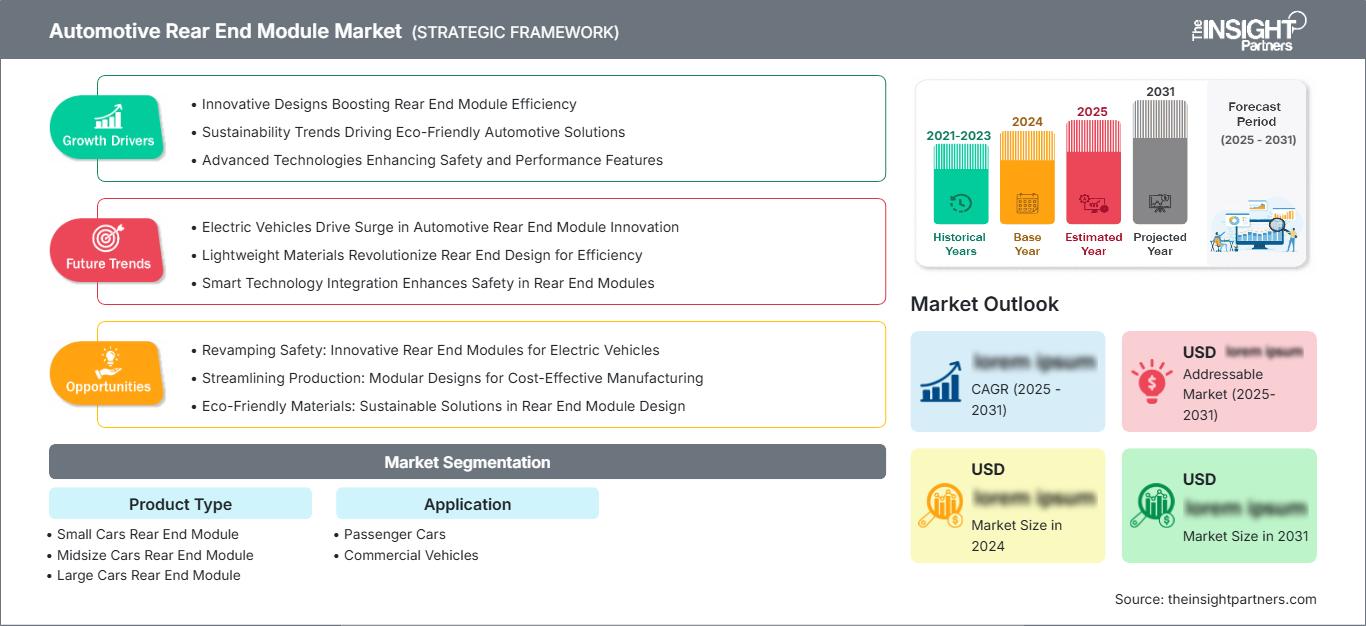
The global automotive industry is undergoing a significant transformation driven by advancements in lightweight materials, modular assembly techniques, and the rapid electrification of passenger and commercial vehicles. Among the critical components driving efficiency and structural integration in modern vehicle architecture is the automotive rear end module (REM). Rear end modules integrate multiple rear-vehicle components including structural members, bumpers, tail lamps, trunk lids, wiring harnesses, and energy absorption units into a single, pre-assembled structural system. This modular approach enables Original Equipment Manufacturers (OEMs) to streamline assembly processes, reduce vehicle weight, lower production costs, and enhance overall vehicle design flexibility.
Get a PDF Sample- https://www.theinsightpartners.com/sample/TIPRE00020722
North America Automotive Rear End Module Market
The North America Automotive Rear End Module Market is experiencing robust growth fueled by high vehicle production rates and a rapid transition toward electric mobility across the United States and Canada. Regional automotive OEMs are increasingly implementing lightweight composite modular systems in SUVs, pickup trucks, and electric crossovers to enhance structural integrity and crash safety while maximizing driving efficiency. Furthermore, strong regulatory emphasis on passenger safety standards and carbon emission reduction continues to accelerate the adoption of advanced modular designs in the region. Strong collaborative partnerships between key component manufacturers and North American automakers are expected to keep the regional market highly dynamic and competitive throughout the forecast period.
Market Dynamics and Growth Drivers
The modern automotive rear end module is no longer a simple structural frame; it has evolved into a highly complex, multifunctional component. A key growth driver for the global market is the rising pressure on automakers to adhere to stringent fuel efficiency standards and carbon emission regulations established by global authorities. Integrating lightweight composite materials, aluminum alloys, and high-strength plastics into rear end modules directly contributes to vehicle weight reduction, which is essential for maximizing fuel efficiency in internal combustion engine (ICE) vehicles and extending driving range in electric vehicles (EVs).
Furthermore, vehicle design trends are increasingly leaning toward advanced safety features, aerodynamic aesthetics, and integrated sensor technologies. Modern rear end modules frequently house advanced driver-assistance systems (ADAS) sensors, blind-spot monitoring radar units, ultrasonic parking sensors, and rear-view cameras. As modern vehicles incorporate higher levels of automation, the demand for modular rear structures capable of seamlessly housing and protecting delicate electronic components continues to surge globally.
Market Forecast
The Automotive Rear End Module Market size is expected to reach US$ 31.49 Billion by 2034 from US$ 19.7 Billion in 2025. The market is estimated to record a CAGR of 5.35% from 2026 to 2034.
This sustained growth trajectory reflects increasing vehicle production volumes globally, coupled with a higher adoption rate of pre-assembled modular systems by major automotive manufacturers seeking to optimize supply chain logistics and assembly line speeds.
Strategic Modularization and EV Integration
The fast-paced expansion of the global electric vehicle ecosystem presents unprecedented opportunities for the rear end module market. EV architectures demand re-engineered rear modular layouts to accommodate heavy battery packs, rear electric powertrains, regenerative braking components, and specialized thermal management routing. OEMs are shifting toward integrated rear body structures to optimize space utilization, maximize crash protection for battery enclosures, and reduce vehicle assembly complexity. Modular manufacturing allows automotive producers to assemble these intricate multi-material rear systems off-line, reducing cycle times and capital expenditure on factory assembly lines.
Key Players
The global market features a blend of established tier-1 automotive suppliers, modular engineering specialists, and component integrators operating globally. Key players shaping the competitive landscape of the automotive rear end module market include:
ATM Automation
Denso Corporation
Faurecia SA
HELLA
Hyundai MOBIS
HBPO Group
Magna International
Miwa Seisakusho
MarkLines Co.
Plastic Omnium Group
These industry leaders continuously invest in research and development, smart material engineering, advanced molding techniques, and strategic collaborations with automotive OEMs to strengthen their market footprint and deliver lightweight, sensor-ready rear end module solutions.
Get Full Copy of This Report- https://www.theinsightpartners.com/buy/TIPRE00020722
Future Outlook
The future outlook for the automotive rear end module market remains highly promising as the automotive sector pushes toward total vehicle electrification, autonomous driving integration, and sustainable manufacturing practices. The future generation of rear end modules will likely see a deeper convergence of smart lighting technologies, fully hidden sensor suites, active aerodynamics, and bio-based composite materials to further drive down vehicle weight and environmental impact. As high-volume automotive manufacturers continue transitioning to megacasting and ultra-modular chassis platforms, rear end module suppliers that innovate in multi-material joining, protective sensor housing, and automated assembly solutions will be uniquely positioned to lead the market into its next phase of global growth.
Related Reports-
About Us
The Insight Partners is a one-stop industry research provider of actionable intelligence. We help our clients in getting solutions to their research requirements through our syndicated and consulting research services. We specialize in industries such as Semiconductor and Electronics, Aerospace and Defense, Automotive and Transportation, Biotechnology, Healthcare IT, Manufacturing and Construction, Medical Devices, Technology, Media, and Telecommunications, as well as chemicals and Materials.
Contact Us
If you have any queries about this report or if you would like further information, don’t hesitate to get in touch with us:
Contact Person: Ankit Mathur
E-mail: ankit.mathur@theinsightpartners.com
