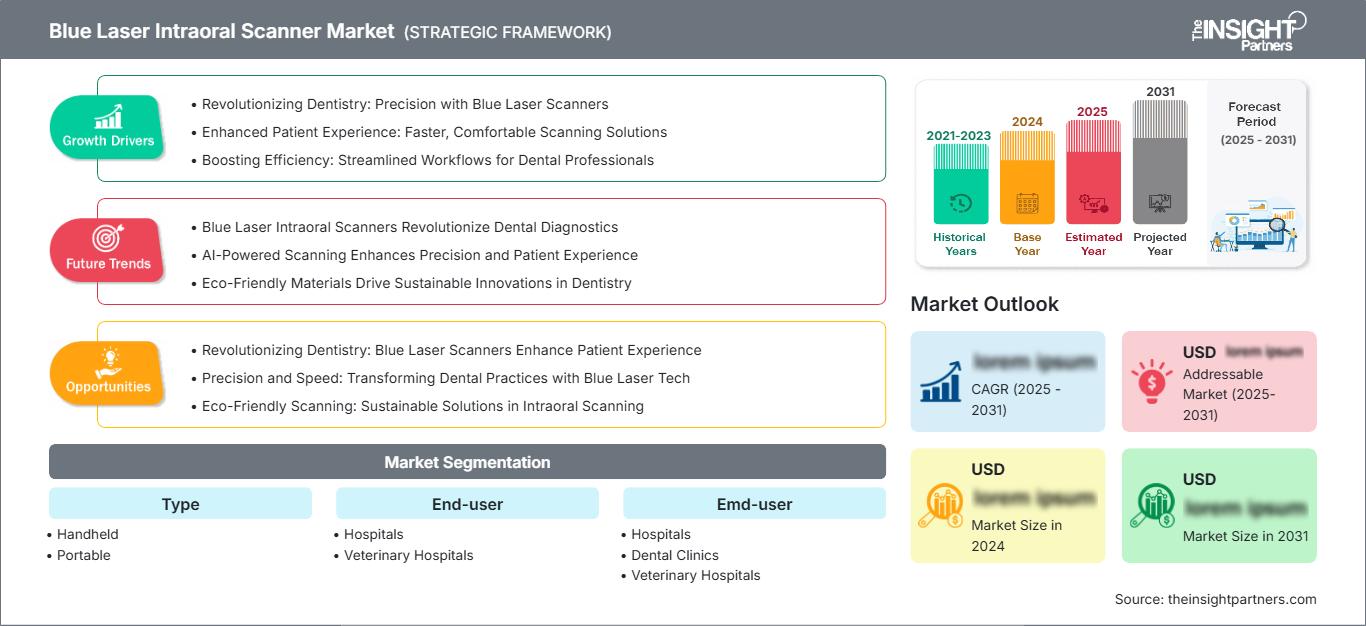
The Blue Laser Intraoral Scanner Market size is expected to grow from US$ 507.38 Million in 2025 to US$ 1,214.4 Million by 2034, representing a CAGR of 10.18% for the period 2026–2034.
The market’s strong growth trajectory reflects the increasing transition from conventional dental impressions toward digital scanning technologies. Blue laser intraoral scanners provide dental professionals with digital representations of oral structures, supporting efficient treatment planning and improving communication between dental practices and laboratories. The growing adoption of computer-aided design and manufacturing (CAD/CAM) workflows is also contributing to market expansion.
Get Sample PDF – https://www.theinsightpartners.com/sample/TIPRE00029317
Growing Shift Toward Digital Dentistry
Digitalization is transforming dental practices by enabling faster data acquisition, streamlined treatment planning, and improved integration between clinical and laboratory workflows. Traditional impression techniques can require multiple steps and may cause discomfort for patients. Intraoral scanning provides an alternative by capturing digital information directly from the oral cavity.
Blue laser technology is gaining attention within this transition because scanners can capture detailed information required for digital dental workflows. As dental professionals increasingly seek technologies that improve efficiency and patient experience, the adoption of advanced intraoral scanning solutions is expected to increase.
Increasing Demand for Accurate Digital Impressions
Accuracy is a major consideration in dental procedures involving crowns, bridges, implants, aligners, and other restorations. Digital scanning technologies can support the acquisition of detailed oral information that can be used throughout the treatment process.
The availability of digital impressions also reduces reliance on physical impression materials and facilitates the electronic transfer of patient data. Dental laboratories can receive digital files directly, potentially reducing processing time and improving coordination between dentists and technicians. This streamlined workflow is encouraging dental professionals to invest in advanced intraoral scanning equipment.
Applications Across Restorative and Orthodontic Dentistry
Blue laser intraoral scanners have applications across multiple areas of dentistry. In restorative procedures, digital scans can support the design and fabrication of dental restorations. In orthodontics, digital impressions can contribute to treatment planning and the development of customized appliances.
The growing adoption of digital orthodontic workflows is particularly important as dental professionals increasingly use computer-based treatment planning. Digital scanning can help create three-dimensional representations of dental structures that can be incorporated into broader digital workflows. This versatility supports demand across different dental specialties.
Benefits for Dental Professionals and Patients
One of the key advantages of intraoral scanning is the potential to improve the patient experience. Conventional impressions may be uncomfortable for some patients, while digital scanning can provide a more convenient approach to capturing oral information.
For dental professionals, digital scanning can support faster data sharing, easier storage, and integration with other digital systems. Digital files can also be reviewed and transferred without the physical handling and transportation associated with conventional impressions. These operational benefits can encourage practices to incorporate scanners into their daily workflows.
Technological Advancements Strengthen Market Opportunities
Continuous improvements in scanning technology are creating opportunities for manufacturers to enhance scanner performance and usability. Developments in optical technologies, scanning speed, software capabilities, and digital workflow integration are helping improve the overall functionality of intraoral scanning systems.
The integration of scanning systems with CAD/CAM platforms and other digital dentistry technologies is also strengthening their value within dental practices. As users seek solutions that can fit seamlessly into existing workflows, manufacturers are focusing on interoperability, intuitive software, and efficient digital data management.
Competitive Landscape and Top Players
The blue laser intraoral scanner market includes several established dental technology and medical-device companies competing through product innovation, digital workflow integration, and advanced scanning capabilities. Key players include:
- I2S SA
- 3Shape A/S
- Planmeca Oy
- Align Technology Inc.
- EM Dental
- Dental Wings Inc.
- Densys Ltd.
- 3M Company
- Dentsply Sirona Inc.
- Condor Technologies NV
These companies contribute to market development by advancing digital dentistry technologies and expanding solutions designed to meet the requirements of dental professionals and laboratories.
Growing Adoption of CAD/CAM-Based Dental Workflows
The increasing use of CAD/CAM technology is closely connected with demand for intraoral scanners. Digital scans can serve as inputs for computer-aided design, enabling dental professionals and laboratories to develop customized restorations and appliances. This creates a more connected workflow from data capture to manufacturing.
Get Full Copy of This Report @ https://www.theinsightpartners.com/buy/TIPRE00029317
The combination of intraoral scanning, digital design, and computer-aided manufacturing is expected to remain an important driver of dental technology adoption. Dental practices seeking greater workflow efficiency can benefit from reducing manual steps and improving digital communication throughout treatment planning and restoration production.
Future Outlook
The future of the blue laser intraoral scanner market is expected to be shaped by continued digitalization across dentistry, increasing adoption of CAD/CAM workflows, and ongoing technological improvements. Demand for accurate and efficient digital impressions is likely to increase as dental practices move away from conventional workflows and adopt integrated digital solutions.
Further developments in scanning speed, accuracy, software integration, and user experience could create additional opportunities for market participants. Integration with orthodontic planning, restorative dentistry, dental laboratories, and other digital applications can further expand the role of intraoral scanners in clinical workflows. With the market projected to reach US$ 1,214.4 million by 2034, continued innovation and adoption of digital dental technologies are expected to support sustained market growth through the forecast period.
Related Reports @
Digital Dental X-ray Market Size, Growth & Trends by 2034
Dental Implants Market Size, Share & Forecast by 2034
About Us –
The Insight Partners provides comprehensive syndicated and tailored market research services in the healthcare, technology, and industrial domains. Renowned for delivering strategic intelligence and practical insights, the firm empowers businesses to remain competitive in ever-evolving global markets.
Contact Us:
Contact Person: Ankit Mathur
E-mail: ankit.mathur@theinsightpartners.com
Phone: +1-646-491-9876
Also Available in : Korean German Japanese French Chinese Italian Spanish
