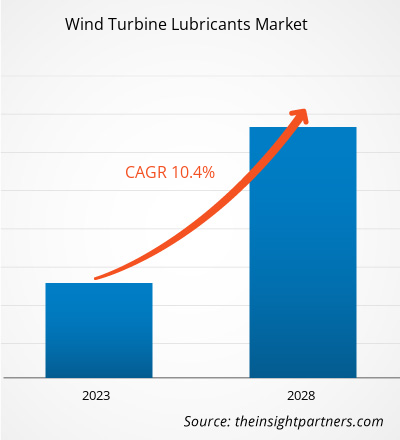
The Wind Turbine Lubricants Market is expanding as wind farm operators, turbine OEMs, and maintenance providers adopt specialized formulations that extend component life, reduce unplanned downtime, and withstand extreme mechanical and environmental stress. Growth is supported by expanding onshore and offshore wind capacity, turbine upscaling, repowering of aging fleets, and demand for longer drain intervals.
The global wind turbine lubricants market size is projected to reach US$ 605.64 million by 2034 from US$ 244.58 million in 2025. The market is anticipated to register a CAGR of 10.6% during the forecast period 2026–2034.
What is driving the market?
Rapid expansion of global wind power installations, stricter operational efficiency targets, and the shift toward larger, higher-torque turbines are the principal growth drivers. Wind operators are increasingly focused on lowering the levelized cost of energy (LCOE) by preventing costly gearbox, bearing, and pitch/yaw system failures. Offshore wind expansion where turbines face high salinity, humidity, heavy loads, and difficult maintenance access is accelerating demand for high-durability synthetic and corrosion-resistant lubricants.
The transition is moving beyond conventional mineral oils toward advanced synthetic and bio-based formulations with superior thermal stability, micropitting resistance, and water tolerance. Suppliers are investing in nano-additives, extended-drain chemistries, and compatibility with automated lubrication systems. However, volatility in base oil and additive raw material costs, strict OEM certification requirements, and environmental compliance risks from lubricant leakage in marine and forested habitats remain key constraints.
Which region leads?
Asia Pacific leads the market, accounting for an estimated 34.15% revenue share in 2025. Growth is supported by large-scale onshore and offshore wind installations, government clean-energy targets, and expanding domestic turbine manufacturing across China, India, Japan, and South Korea. China and India present major volume opportunities as utility-scale wind additions drive high demand for both initial factory fills and ongoing maintenance refills.
North America is projected to be the fastest-growing region, registering an estimated CAGR of 9.15% from 2026 to 2034, driven by offshore wind developments, repowering of aging wind farms, and operator preference for premium synthetic lubricants across the U.S. and Canada. Europe remains a major, innovation-driven market supported by mature offshore wind capacity, strict environmental standards, and high adoption of biodegradable marine lubricants.
Which segment leads?
Gear Oils is the leading product segment, representing an estimated 46.3% of market revenue in 2025. Its position is supported by the high mechanical stress, fluctuating wind loads, and continuous torque experienced by turbine gearboxes, which require specialized synthetic gear oils to prevent wear and micropitting. Grease and Hydraulic Oils also represent essential segments for main bearings, blade pitch and yaw systems, and braking mechanisms.
By base oil, Synthetic Lubricants dominate modern high-capacity turbines due to superior viscosity stability across extreme temperature ranges and extended service intervals, while Bio-Based Lubricants represent a fast-growing niche driven by ecological regulations in offshore and sensitive onshore sites. By application, Onshore Wind accounts for the largest installed volume, while Offshore Wind is the fastest-growing demand catalyst due to higher lubricant consumption per multi-megawatt turbine.
Which companies are prominent?
The report identifies Exxon Mobil Corporation, Shell, bp p.l.c. (Castrol), Chevron Corporation, TotalEnergies, Klüber Lubrication, FUCHS, AMSOIL Inc., Phillips 66 Company, Idemitsu Kosan Co., Ltd., PetroChina, Sinopec, and PETRONAS as prominent market participants.
These companies compete across synthetic gear oils, specialty greases, hydraulic fluids, additive technologies, and OEM-approved formulations. Strategic differentiation increasingly depends on OEM approvals, extended drain-interval performance, field engineering support, oil condition monitoring services, and environmentally acceptable lubricant (EAL) portfolios. The list reflects the report’s competitive landscape rather than a revenue-ranked market-share table.
What is changing in 2026?
The market is shifting from routine scheduled fluid replacement toward predictive, data-integrated lubrication management. With global installed wind power surpassing 1,299 GW and new multi-megawatt turbines scaling rapidly, operators are integrating online oil-condition sensors, automated dispensing systems, and extended-drain formulations exceeding 12 to 18 months to minimize technician tower climbs and offshore vessel dispatches.
Manufacturers are accelerating biodegradable and non-toxic synthetic ester formulations to comply with tightening maritime and environmental rules. Procurement decisions are increasingly tied to total lifecycle cost reduction, verified anti-micropitting performance, and digital fluid-monitoring partnerships rather than upfront per-liter pricing alone.
What are the major investment opportunities?
The strongest opportunities lie in high-performance synthetic formulations, biodegradable marine-grade lubricants, automated lubrication hardware, and predictive fluid-monitoring services. R&D into advanced anti-wear, anti-corrosion, and nano-additive chemistries can capture premium margins as next-generation 8 MW to 15+ MW offshore turbines demand higher reliability under extreme loads.
Additional opportunities include Lubrication-as-a-Service (LaaS) contracts, oil reclamation and circular re-refining programs, and partnerships with wind OEMs and digital monitoring providers. Asia Pacific offers strong volume expansion through rapid new turbine installations, while North America and Europe offer high-value aftermarket and offshore repowering opportunities. Investors should prioritize formulations with proven OEM certifications, extended drain intervals, and strong ecological compliance.
Future Outlook
Through 2034, the Wind Turbine Lubricants Market is poised for steady, high-value transformation as global wind power becomes a cornerstone of decarbonized grids. While advancements in direct-drive (gearless) wind turbines will gradually moderate per-unit gearbox oil demand in select offshore segments, rapid overall capacity additions, aging-fleet repowering, and rising demand for main-bearing greases, pitch/yaw lubricants, and hydraulic fluids will sustain strong market expansion. Looking ahead, the industry will increasingly converge around smart sensor-enabled condition monitoring, ultra-long-life synthetic chemistries, and circular oil re-refining models that maximize turbine uptime while minimizing environmental impact.
About The Insight Partners
The Insight Partners is a leading market research and consulting firm delivering actionable insights through in-depth industry analysis and strategic intelligence. The firm supports clients across various industries in making informed decisions by providing comprehensive market forecasts, competitive assessments, and growth opportunities.
Contact Us:
If you have any queries about this report or if you would like further information, please contact us:
Contact Person: Ankit Mathur
E-mail: sales@theinsightpartners.com
Phone: +1-646-491-9876
