Market Overview
The Automatic Labeling Machine Market is gaining momentum as manufacturers modernize production facilities and implement advanced automation technologies. Labeling systems are increasingly integrated into digital production environments that emphasize speed, accuracy, compliance, and product traceability.
What changed is the role of labeling itself. Historically, labeling was viewed primarily as a packaging requirement. Today it serves as a critical information layer connecting products to inventory systems, logistics networks, regulatory databases, and customer-facing digital platforms.
This transformation is creating demand for more sophisticated equipment. Automatic labeling machines now incorporate machine vision, programmable controls, communication modules, and data-management capabilities that support broader smart-factory initiatives.
For electronics and semiconductor suppliers, every advanced labeling system represents demand for sensors, processors, controllers, connectivity technologies, displays, and power-management components.
Key Trends Driving Growth
One of the most significant growth drivers is the increasing focus on product traceability. Manufacturers across pharmaceuticals, food and beverage, consumer products, and industrial goods require accurate labeling systems that support regulatory compliance and supply-chain visibility.
Industrial automation is another major catalyst. Companies continue investing in production-line modernization to improve throughput, reduce labor dependency, and increase operational consistency. Automatic labeling equipment plays a central role in these initiatives.
Industry 4.0 adoption is accelerating technology integration. Modern labeling systems increasingly connect with manufacturing execution systems, enterprise resource planning platforms, and quality-control infrastructure.
Machine vision is becoming increasingly important. Advanced inspection capabilities improve label placement accuracy, reduce errors, and support automated quality assurance processes.
Industrial IoT deployments are also influencing purchasing decisions. Connected labeling systems provide real-time performance data that helps manufacturers optimize production efficiency and reduce downtime.
The broader implication for semiconductor demand is significant. Advanced automation equipment requires increasingly sophisticated electronics capable of supporting sensing, connectivity, motion control, and intelligent decision-making.
Request a Free Sample Copy or View Report Summary: https://www.maximizemarketresearch.com/request-sample/91580/
Segment Insights
Dominant Segment: Automatic Labeling Systems
Fully automatic systems continue to account for significant market demand because manufacturers prioritize speed, consistency, and production scalability.
Dominant Segment: Food and Beverage Applications
Food and beverage producers remain major adopters due to high-volume production requirements and strict labeling standards.
Fastest-Growing Opportunity Segment: Pharmaceutical Labeling
Expanding regulatory requirements and product-tracking initiatives are creating strong opportunities for advanced labeling technologies.
Emerging Opportunity: Machine Vision Integration
Manufacturers increasingly seek intelligent inspection capabilities that improve quality assurance and operational efficiency.
Technology Opportunity: Connected Labeling Platforms
Integration with Industrial IoT infrastructure is enabling more sophisticated production monitoring and performance management.
Regional Growth Story
North America continues to represent a significant market due to widespread automation adoption, advanced manufacturing capabilities, and strong investment in smart-factory technologies.
The United States remains an important innovation hub for industrial automation, packaging technologies, and digital manufacturing solutions. Demand for traceability and compliance-driven production systems continues to support market expansion.
Europe maintains strong momentum through Industry 4.0 initiatives and advanced manufacturing modernization programs. Companies increasingly invest in intelligent production equipment to improve competitiveness and operational efficiency.
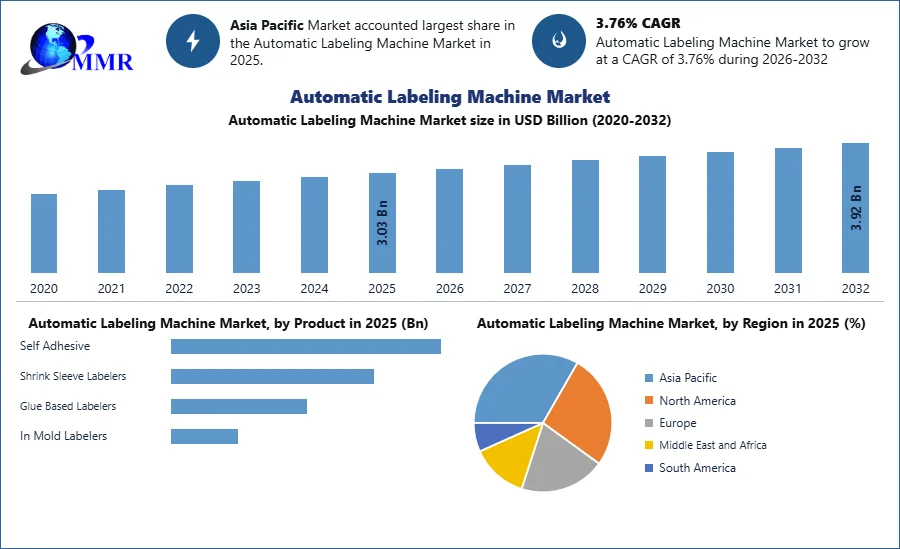
Asia-Pacific is emerging as a major growth engine. Manufacturing expansion across China, Japan, South Korea, and India is increasing demand for automated packaging and labeling technologies. Rapid industrialization and export-oriented production strategies continue supporting automation investments.
The regional growth story extends beyond packaging machinery. It reflects broader investments in industrial electronics, sensors, software platforms, communication technologies, and automation infrastructure.
Competitive Landscape
Competition increasingly centers on intelligent automation capabilities rather than mechanical performance alone. Equipment manufacturers are focusing on integrating sensors, machine vision systems, software analytics, and connectivity features into labeling platforms.
The most important strategic signal is the convergence of packaging equipment and digital manufacturing systems. Customers increasingly evaluate labeling solutions based on their ability to integrate with broader factory ecosystems.
Technology leadership is becoming increasingly software-driven. Machine performance remains important, but manufacturers now seek equipment capable of generating actionable operational data.
The competitive environment also highlights growing opportunities for semiconductor suppliers. Modern labeling machines require sophisticated electronic systems to support motion control, quality inspection, communications, and automation functions.
For industrial automation providers, the market demonstrates how packaging operations are becoming critical nodes within connected production environments. Companies capable of delivering integrated solutions gain stronger competitive positioning.
For investors, the market offers exposure to several long-term themes including industrial automation, smart manufacturing, digital traceability, and Industrial IoT adoption.
Recent Developments
Increasing adoption of Industry 4.0 manufacturing technologies.
Rising integration of machine vision inspection systems.
Expansion of digital traceability initiatives across industries.
Growing deployment of Industrial IoT-enabled production equipment.
Increased investment in automated packaging infrastructure.
Stronger focus on operational efficiency and quality assurance.
Growing integration between labeling systems and enterprise software platforms.
Strategic Implications
For semiconductor manufacturers, automatic labeling machines represent a growing source of demand for sensors, processors, communication modules, controllers, and power-management technologies.
For OEMs, the opportunity lies in developing equipment that combines mechanical reliability with advanced digital capabilities. Connected and intelligent systems increasingly command greater strategic value than standalone machinery.
For manufacturing organizations, automatic labeling systems improve productivity, traceability, compliance, and supply-chain visibility. These benefits extend beyond packaging operations and contribute directly to broader digital-transformation objectives.
For technology providers, integration opportunities continue expanding. Software analytics, Industrial IoT platforms, machine vision systems, and automation infrastructure increasingly operate as part of a unified manufacturing ecosystem.
The broader significance is clear. Labeling is no longer simply a packaging function. It is becoming an information-management process that connects physical products with digital supply chains.
Future Outlook
The next phase of market evolution will be driven by intelligent automation, machine vision, Industrial IoT connectivity, and real-time manufacturing analytics. Companies that transform labeling systems into data-generating, software-enabled production assets will establish durable competitive advantages, while those relying solely on conventional machinery risk losing relevance in an increasingly connected industrial economy.
Analyst Perspective
“Automatic labeling technology is evolving alongside broader manufacturing digitalization initiatives. The integration of automation, traceability, machine vision, and connected systems is creating new opportunities across industrial production environments.” — Rucha Deshpande
About Maximize Market Research
Maximize Market Research Pvt. Ltd. (MMR) is a global market research and consulting company that provides reliable, data-focused, and practical business insights. The firm serves a wide range of industries, including healthcare, pharmaceuticals, technology, automotive, electronics, chemicals, personal care, and consumer goods. Through market forecasts, competitive analysis, strategic consulting, and industry impact assessments, MMR helps organizations understand changing market conditions, identify growth opportunities, and make informed business decisions for long-term success.
2nd Floor, Navale IT Park Phase 3
Pune Banglore Highway, Narhe
Pune, Maharashtra 411041, India
+91 9607365656
sales@maximizemarketresearch.com
