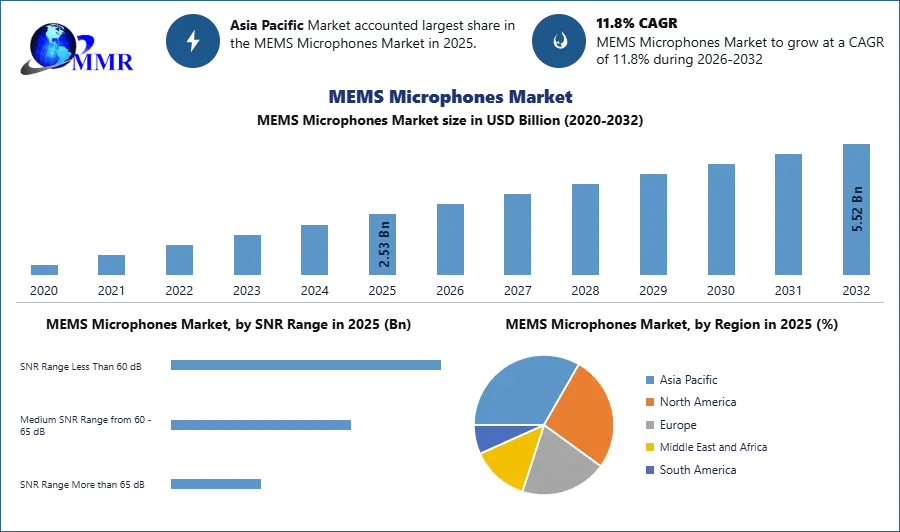
Market Overview
The Global MEMS Microphones Market is benefiting from rapid growth in smart consumer electronics, connected devices, and voice-enabled applications. MEMS microphones have increasingly replaced traditional microphone technologies due to their compact size, reliability, energy efficiency, and compatibility with modern semiconductor manufacturing processes.
What changed is the role of audio itself. Sound is no longer simply an input method. It has become a critical source of contextual information that supports artificial intelligence systems, digital assistants, communication platforms, and autonomous decision-making.
This evolution is expanding demand across multiple industries. Smartphones, tablets, laptops, smart speakers, wireless earbuds, wearables, automotive systems, and industrial IoT devices increasingly require sophisticated audio sensing capabilities.
For the semiconductor industry, MEMS microphones represent a high-volume component category that benefits directly from rising smart-device penetration and increasing adoption of AI-powered interfaces.
Key Trends Driving Growth
The most significant growth driver is the expansion of voice-enabled ecosystems. Consumers increasingly interact with devices through voice commands, creating demand for microphones capable of delivering accurate audio capture in diverse environments.
Artificial intelligence is accelerating this trend. AI-powered voice assistants rely on high-quality audio input to support speech recognition, contextual understanding, and natural-language interaction. As AI adoption expands, microphone performance becomes increasingly important.
Smartphone innovation continues to influence market dynamics. Modern smartphones incorporate multiple MEMS microphones to support voice communication, video recording, noise reduction, and virtual assistant functionality.
The rise of smart speakers has created another major demand channel. These devices depend on far-field voice detection and advanced audio processing, increasing requirements for sophisticated microphone arrays.
Automotive applications are also becoming increasingly important. Connected vehicles utilize MEMS microphones for voice control, hands-free communication, cabin monitoring, and driver-assistance systems.
IoT deployment is expanding addressable opportunities even further. Smart appliances, industrial equipment, healthcare devices, security systems, and connected infrastructure increasingly incorporate audio sensing capabilities as part of broader intelligent-system architectures.
The broader semiconductor implication is significant. Growing MEMS microphone deployment increases demand for sensor fabrication, wafer processing, advanced packaging technologies, signal-processing components, and edge-computing capabilities.
Request a Free Sample Copy or View Report Summary: https://www.maximizemarketresearch.com/request-sample/186923/
Segment Insights
Dominant Segment: Consumer Electronics
Consumer electronics remain the largest application segment due to extensive deployment across smartphones, tablets, laptops, wireless earbuds, and smart speakers.
Dominant Segment: Digital MEMS Microphones
Digital MEMS microphones continue to maintain strong market adoption because they offer superior integration with modern electronic systems and digital signal-processing architectures.
Fastest-Growing Opportunity Segment: Smart Speakers and Voice Assistants
Expansion of voice-enabled ecosystems is creating significant opportunities for advanced microphone technologies.
Emerging Opportunity: Automotive Electronics
Increasing deployment of connected and intelligent vehicle systems is generating new demand for high-performance audio sensors.
Technology Opportunity: AI-Optimized Audio Capture
The growth of artificial intelligence applications is increasing demand for microphones capable of supporting sophisticated voice-recognition workloads.
Regional Growth Story
Asia-Pacific continues to play a critical role in the MEMS microphones ecosystem due to its concentration of consumer electronics manufacturing, semiconductor production, and device assembly operations.
China remains an important manufacturing center for smartphones, wearables, smart-home devices, and other consumer electronics products that rely heavily on MEMS microphone technologies. Growing domestic demand further strengthens the regional market.
Japan and South Korea contribute through semiconductor innovation, advanced manufacturing capabilities, and leadership in consumer electronics development. These countries remain important participants in the broader MEMS supply chain.
North America continues to influence technology direction through leadership in AI platforms, smart-speaker ecosystems, software innovation, and connected-device development. Strong demand for voice-enabled technologies supports continued market expansion.
Europe benefits from increasing adoption of automotive electronics, industrial automation systems, and connected technologies that incorporate advanced audio sensing capabilities.
The regional landscape highlights how MEMS microphones have become an essential component within global semiconductor and electronics manufacturing ecosystems.
Competitive Landscape
Competition increasingly centers on performance, miniaturization, power efficiency, and integration capabilities. Manufacturers are investing in technologies that improve signal quality while supporting increasingly compact device designs.
The most important strategic signal is the convergence of audio sensing and artificial intelligence. Customers increasingly require microphone solutions capable of supporting advanced voice-recognition and contextual-awareness applications.
Technology leadership is becoming closely tied to semiconductor innovation. Improvements in MEMS fabrication, wafer-level packaging, signal processing, and power management directly influence product competitiveness.
The competitive environment also highlights the growing importance of advanced packaging. As device manufacturers seek smaller form factors and greater functionality, integration capabilities become a critical differentiator.
For semiconductor foundries, MEMS microphones represent a valuable category within the broader sensor market. Increasing deployment across multiple industries provides opportunities to leverage manufacturing expertise and economies of scale.
For investors, the market offers exposure to several powerful growth themes, including AI adoption, IoT expansion, smart-device proliferation, automotive digitalization, and advanced semiconductor manufacturing.
Recent Developments
Rising deployment of MEMS microphones in AI-enabled consumer devices.
Increasing adoption of voice-recognition technologies.
Expansion of smart-speaker and smart-home ecosystems.
Growing use of advanced audio processing architectures.
Higher integration of MEMS sensors in connected vehicles.
Continued miniaturization of semiconductor components.
Strong growth in IoT-enabled audio sensing applications.
Strategic Implications
For semiconductor manufacturers, MEMS microphones provide a direct pathway into expanding markets for AI-enabled devices, smart consumer electronics, and connected infrastructure.
For OEMs, audio quality increasingly influences user experience and product differentiation. Companies investing in advanced sensing technologies gain advantages in voice interaction, communication quality, and intelligent-device functionality.
For technology providers, opportunities extend beyond hardware. Software optimization, audio analytics, edge AI processing, and voice-recognition capabilities are becoming increasingly important sources of value creation.
For investors, the market demonstrates how sensor technologies continue gaining importance as intelligent devices become more pervasive across consumer, industrial, and automotive applications.
The broader significance is clear. Audio sensing is evolving from a supporting function into a strategic technology layer that enables more natural, intelligent, and context-aware digital experiences.
Future Outlook
The next phase of market evolution will be shaped by the convergence of MEMS sensing, artificial intelligence, edge computing, and advanced semiconductor packaging. Companies that combine superior audio capture, AI-ready architectures, and scalable manufacturing capabilities will define the future of intelligent voice ecosystems, while laggards risk losing relevance as voice becomes a primary interface for the connected world.
Analyst Perspective
“MEMS microphones are becoming increasingly important as voice-enabled technologies expand across consumer electronics, automotive systems, and IoT ecosystems. The combination of AI adoption, smart-device growth, and semiconductor innovation continues to create strong market opportunities.” — Rucha Deshpande
About Maximize Market Research
Maximize Market Research Pvt. Ltd. (MMR) is a global market research and consulting company that provides reliable, data-focused, and practical business insights. The firm serves a wide range of industries, including healthcare, pharmaceuticals, technology, automotive, electronics, chemicals, personal care, and consumer goods. Through market forecasts, competitive analysis, strategic consulting, and industry impact assessments, MMR helps organizations understand changing market conditions, identify growth opportunities, and make informed business decisions for long-term success.
2nd Floor, Navale IT Park Phase 3
Pune Banglore Highway, Narhe
Pune, Maharashtra 411041, India
+91 9607365656
sales@maximizemarketresearch.com
