Market Overview
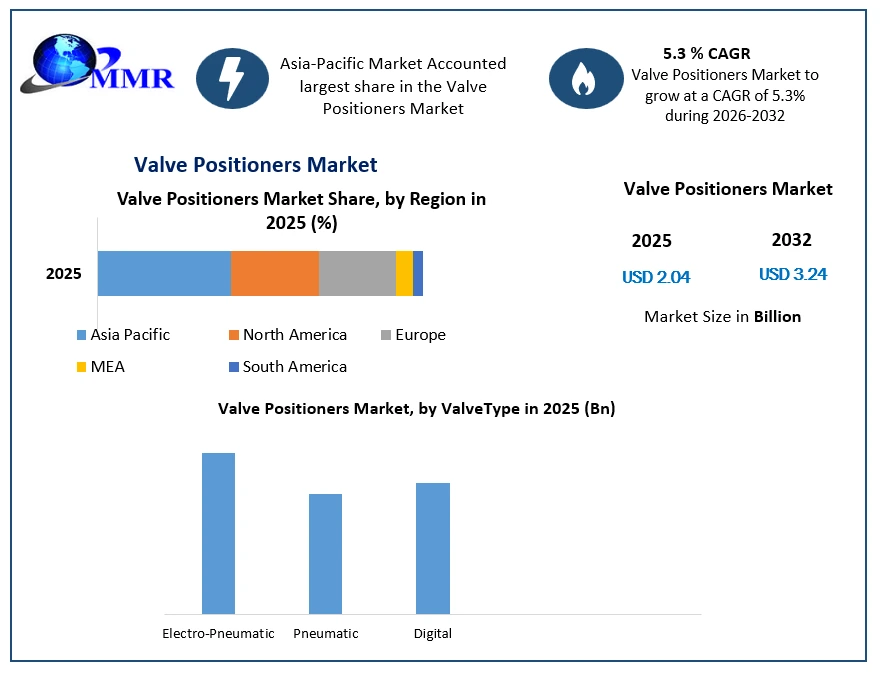
The Global Valve Positioners Market is expanding as industrial operators invest in automation technologies that improve precision, efficiency, and process reliability. Valve positioners are increasingly deployed across oil and gas facilities, power plants, chemical processing operations, water treatment systems, and manufacturing environments.
What changed is the importance of process intelligence. Industrial facilities now require continuous monitoring and adaptive control capabilities that support increasingly complex operations. Traditional mechanical systems are giving way to digitally enabled solutions capable of providing real-time performance data.
This evolution is creating new demand for advanced electronics. Modern valve positioners integrate sensors, microcontrollers, communication modules, embedded software, and diagnostic capabilities that transform them into intelligent assets within broader industrial ecosystems.
For semiconductor suppliers, valve positioners represent a growing application area for industrial-grade chips, sensors, power-management technologies, and communication components.
Key Trends Driving Growth
Industrial automation remains the primary growth catalyst. Organizations continue modernizing production facilities to improve efficiency, reduce downtime, and enhance operational consistency. Valve positioners play a critical role by ensuring precise control of fluid and gas flows throughout industrial processes.
Industry 4.0 adoption is accelerating technology upgrades. Smart factories increasingly require connected control devices capable of communicating with centralized management systems and operational analytics platforms.
Industrial IoT deployment is creating additional momentum. Connected positioners enable continuous monitoring, remote diagnostics, and predictive maintenance strategies that reduce unexpected equipment failures.
Predictive maintenance has emerged as a major investment area. Instead of relying on scheduled maintenance intervals, operators increasingly use equipment data to identify potential issues before failures occur. Intelligent valve positioners contribute valuable operational insights that support these initiatives.
Digital transformation across process industries is also driving adoption. Companies seek greater visibility into asset performance, energy consumption, and operational efficiency. Advanced positioners provide the data necessary to support these objectives.
The broader semiconductor implication is significant. As industrial devices become smarter, demand increases for sensors, processors, memory components, communication chips, and embedded computing platforms capable of supporting industrial-grade performance requirements.
Request a Free Sample Copy or View Report Summary: https://www.maximizemarketresearch.com/request-sample/34176/
Segment Insights
Dominant Segment: Digital Valve Positioners
Digital valve positioners maintain strong adoption because they provide enhanced accuracy, diagnostic capabilities, remote monitoring, and integration with modern automation systems.
Dominant Segment: Oil and Gas Applications
Oil and gas operations remain a major deployment area due to extensive use of flow-control systems across upstream, midstream, and downstream facilities.
Fastest-Growing Opportunity Segment: Industrial IoT Integration
Growing demand for connected industrial infrastructure is creating opportunities for intelligent valve positioning technologies.
Emerging Opportunity: Predictive Maintenance Solutions
Asset-monitoring initiatives are increasing demand for positioners capable of generating actionable operational data.
Technology Opportunity: Smart Process Automation
Digital manufacturing environments continue expanding requirements for intelligent control systems and connected field devices.
Regional Growth Story
North America remains an important market due to significant investments in industrial automation, energy infrastructure modernization, and advanced manufacturing technologies.
The United States continues to support adoption through investments in industrial digitalization, process optimization, and intelligent operational technologies. Energy production facilities, chemical plants, and manufacturing operations remain major users of valve automation solutions.
Europe maintains strong momentum through Industry 4.0 initiatives and industrial efficiency programs. Manufacturers increasingly deploy smart control systems to improve competitiveness, operational transparency, and sustainability performance.
Asia-Pacific is emerging as a major growth engine. Rapid industrialization, expanding manufacturing activity, and infrastructure investments across China, Japan, South Korea, and India are supporting adoption of advanced process-control technologies.
Regional growth also reflects broader demand for industrial electronics. Every intelligent valve positioner increases demand for semiconductors, sensors, communication systems, and automation infrastructure across manufacturing ecosystems.
Competitive Landscape
Competition increasingly centers on digital intelligence rather than mechanical functionality alone. Manufacturers are investing in technologies that combine precision control with diagnostics, connectivity, and analytics capabilities.
The most important strategic signal is the convergence of industrial automation and data intelligence. Customers increasingly evaluate valve positioners based on their ability to generate operational insights and integrate into digital management platforms.
Technology leadership is becoming software-driven. Hardware performance remains critical, but differentiation increasingly depends on analytics, remote monitoring, and predictive maintenance capabilities.
The competitive environment also highlights growing opportunities for semiconductor suppliers. Advanced positioners require increasingly sophisticated electronics that support sensing, communications, diagnostics, and embedded processing.
For industrial automation companies, the market demonstrates how field devices are evolving into intelligent endpoints within broader Industrial IoT ecosystems. Vendors capable of delivering integrated digital solutions gain stronger long-term positioning.
For investors, the market provides exposure to several enduring industrial trends, including automation, industrial digitalization, predictive maintenance, energy efficiency, and smart manufacturing.
Recent Developments
Increasing deployment of Industry 4.0 automation technologies.
Growing integration of Industrial IoT-enabled control systems.
Expansion of predictive maintenance initiatives across process industries.
Rising adoption of digital valve positioners.
Greater emphasis on operational efficiency and process optimization.
Increased investment in smart manufacturing infrastructure.
Growing demand for remote monitoring and diagnostics capabilities.
Strategic Implications
For semiconductor manufacturers, valve positioners represent a growing source of industrial electronics demand. Sensors, embedded processors, communication modules, and industrial-grade integrated circuits become increasingly important as digital adoption accelerates.
For OEMs, opportunities extend beyond hardware production. Customers increasingly seek intelligent systems capable of integrating into broader operational ecosystems and delivering measurable performance improvements.
For industrial operators, advanced valve positioners support improved reliability, lower maintenance costs, greater process visibility, and enhanced operational efficiency.
For technology providers, the opportunity lies in connecting process control, analytics, Industrial IoT, and automation capabilities into unified industrial intelligence platforms.
The broader significance extends beyond flow control. Valve positioners increasingly function as data-generating assets that contribute to enterprise-wide operational visibility and digital transformation initiatives.
Future Outlook
The next phase of market evolution will be driven by the convergence of Industrial IoT, embedded intelligence, predictive maintenance, and autonomous process optimization. Companies that transform valve positioners into intelligent industrial data platforms will establish lasting competitive advantages, while those relying on purely mechanical differentiation risk falling behind as industrial operations become increasingly software-defined and data-driven.
Analyst Perspective
“Valve positioners are evolving into intelligent control devices that support automation, diagnostics, and operational optimization. As industrial digitalization accelerates, opportunities continue expanding across sensors, embedded electronics, and smart process-control technologies.” — Rucha Deshpande
About Maximize Market Research
Maximize Market Research Pvt. Ltd. (MMR) is a global market research and consulting company that provides reliable, data-focused, and practical business insights. The firm serves a wide range of industries, including healthcare, pharmaceuticals, technology, automotive, electronics, chemicals, personal care, and consumer goods. Through market forecasts, competitive analysis, strategic consulting, and industry impact assessments, MMR helps organizations understand changing market conditions, identify growth opportunities, and make informed business decisions for long-term success.
2nd Floor, Navale IT Park Phase 3
Pune Banglore Highway, Narhe
Pune, Maharashtra 411041, India
+91 9607365656
sales@maximizemarketresearch.com
