Market Overview
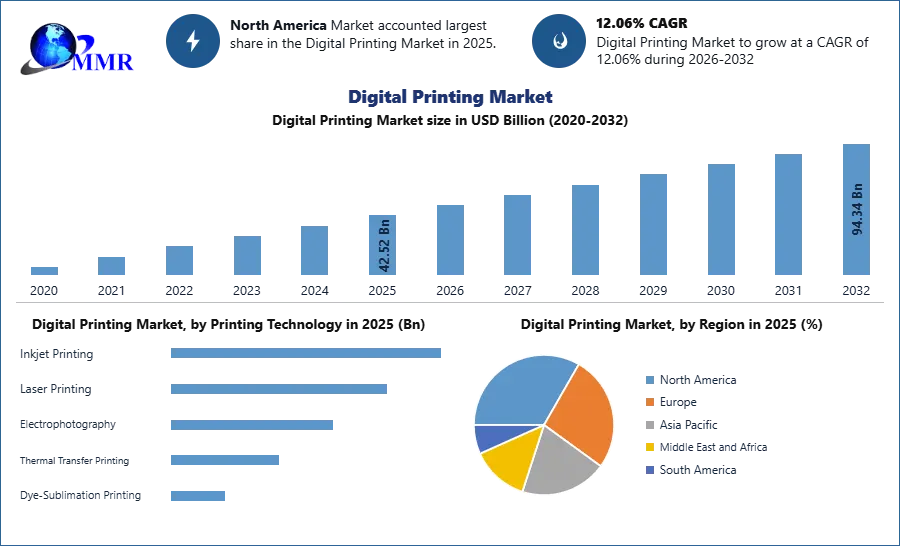
The Global Digital Printing Market was valued at USD 42.52 billion in 2025 and is expected to reach nearly USD 94.34 billion by 2032, expanding at a CAGR of 12.06% during the forecast period. This growth demonstrates accelerating adoption of digital production technologies across multiple industries. The business implication is straightforward: manufacturers are increasingly prioritizing flexibility, speed, and customization over traditional volume-based production models.
Digital printing eliminates many of the setup constraints associated with conventional printing methods. That capability is becoming increasingly valuable as companies respond to shorter product lifecycles, personalized consumer demand, and rapidly changing market conditions.
The technology’s role is also expanding beyond traditional print environments. Industrial manufacturers are deploying digital printing systems across packaging, labeling, textiles, product decoration, and emerging electronics applications.
For semiconductor executives, the significance extends further. Advanced print technologies increasingly intersect with printed electronics, sensor fabrication, smart packaging, and flexible device manufacturing.
Key Trends Driving Growth
Customization has become a primary market driver. Brands increasingly require shorter production runs, localized packaging, and personalized products. Digital printing allows manufacturers to deliver these capabilities without incurring the costs associated with traditional plate-based production.
Packaging continues to emerge as one of the strongest application areas. Consumer goods manufacturers are using digital printing to improve branding, support product differentiation, and accelerate time-to-market. Packaging applications have become a strategic growth engine because they combine high volumes with increasing demand for customization.
Industrial automation is reshaping production environments. Modern digital presses increasingly integrate with manufacturing execution systems, analytics platforms, and Industrial IoT infrastructure. This integration transforms printing from a standalone process into a connected production asset.
Sustainability is also becoming a competitive factor. Digital printing supports on-demand production, reducing inventory waste and minimizing excess materials. Companies seeking to improve environmental performance are increasingly adopting digital workflows as part of broader sustainability initiatives.
Another important trend is the rise of smart manufacturing. Connected print systems generate operational data that can be analyzed to improve efficiency, reduce downtime, and optimize resource utilization. These capabilities align closely with Industry 4.0 investment priorities.
The long-term semiconductor implication is significant. Advanced printheads, sensors, control electronics, imaging processors, memory components, and connectivity modules are becoming increasingly important within digital printing systems.
Request a Free Sample Copy or View Report Summary: https://www.maximizemarketresearch.com/request-sample/112840/
Segment Insights
Dominant Segment: Inkjet Printing Technology
Inkjet printing maintains a leading position due to its flexibility, scalability, cost efficiency, and suitability for industrial applications. Its dominance signals continued investment in precision printhead technologies and advanced control systems.
Dominant Segment: Packaging Applications
Packaging remains one of the largest application areas due to growing demand for customization, branding, and short-run production capabilities. The segment demonstrates how digital printing is becoming embedded within global supply chains.
Fastest-Growing Segment: Textile and Fabric Printing
Digital textile printing is experiencing rapid adoption as manufacturers seek greater design flexibility, reduced waste, and faster production cycles.
Emerging Opportunity: Printed Electronics
Printed sensors, smart labels, flexible electronics, and intelligent packaging create new opportunities for digital printing technologies within electronics manufacturing ecosystems.
Regional Growth Story
Asia-Pacific remains a major growth center for digital printing due to its manufacturing scale, electronics production capacity, and expanding industrial infrastructure. The region benefits from strong demand across packaging, textiles, consumer goods, and electronics manufacturing.
China continues to strengthen its position through manufacturing investments and large-scale production capabilities. The country’s role in electronics assembly, packaging production, and industrial automation creates significant opportunities for digital printing technologies.
India is becoming increasingly attractive due to expanding manufacturing activity, government-supported industrial development, and growing demand for modern production technologies.
North America remains an innovation center driven by automation investments, advanced manufacturing adoption, and strong demand for customized production. The United States continues to influence technology development across industrial printing systems.
Europe maintains leadership in sustainability initiatives, smart manufacturing deployment, and industrial technology innovation. Germany’s advanced manufacturing ecosystem continues to support adoption of digitally enabled production solutions.
Competitive Landscape
Competition increasingly centers on technology ecosystems rather than standalone hardware. Manufacturers are investing in software integration, automation capabilities, workflow optimization, and connected production platforms.
The strategic signal is clear. Market leadership is shifting toward companies capable of combining print hardware, industrial software, analytics, and automation into unified manufacturing solutions.
Advanced printhead technologies have become a key competitive differentiator. Precision control, higher throughput, and improved material compatibility are influencing purchasing decisions across industrial applications.
The competitive landscape also highlights a broader manufacturing trend. Digital printing vendors are evolving into industrial technology providers that support smart factories, connected production environments, and data-driven operations.
For semiconductor suppliers, this transition creates opportunities across sensing technologies, embedded processors, power management devices, memory systems, and industrial connectivity solutions.
Recent Developments
Expansion of industrial inkjet printing technologies.
Increased adoption of digital printing in packaging production.
Growing investment in smart manufacturing integration.
Rising deployment of connected printing systems.
Accelerating use of digital textile printing technologies.
Stronger focus on sustainable and waste-reduction manufacturing models.
Expansion of automation and Industrial IoT capabilities within production environments.
Strategic Implications
For semiconductor manufacturers, digital printing represents more than a printing market. It is a platform technology supporting industrial automation, smart manufacturing, and next-generation production systems.
For OEMs, opportunities extend into integrated solutions that combine hardware, software, analytics, and automation services. The value increasingly resides in ecosystem integration rather than equipment sales alone.
For investors, the market offers exposure to multiple long-term growth themes including digital transformation, industrial automation, advanced manufacturing, sustainability, and intelligent production systems.
The broader implication is that manufacturing flexibility is becoming a competitive advantage. Digital printing enables organizations to respond faster to market changes while reducing operational complexity.
Future Outlook
The next phase of market evolution will be defined by the convergence of AI-enabled production systems, Industrial IoT connectivity, printed electronics, smart packaging, and digitally integrated manufacturing networks; companies that transform digital printing into a core component of intelligent production infrastructure will establish durable competitive advantages, while laggards risk becoming trapped in manufacturing models built for scale rather than speed, intelligence, and adaptability.
Analyst Perspective
“Digital printing is evolving from a production technology into a strategic manufacturing capability. Organizations that leverage automation, customization, and digital workflows will be better positioned to capture value in increasingly dynamic industrial environments,” — Rucha Deshpande
About Maximize Market Research
Maximize Market Research Pvt. Ltd. (MMR) is a global market research and consulting company that provides reliable, data-focused, and practical business insights. The firm serves a wide range of industries, including healthcare, pharmaceuticals, technology, automotive, electronics, chemicals, personal care, and consumer goods. Through market forecasts, competitive analysis, strategic consulting, and industry impact assessments, MMR helps organizations understand changing market conditions, identify growth opportunities, and make informed business decisions for long-term success.
2nd Floor, Navale IT Park Phase 3
Pune Banglore Highway, Narhe
Pune, Maharashtra 411041, India
+91 9607365656
sales@maximizemarketresearch.com
