Market Overview
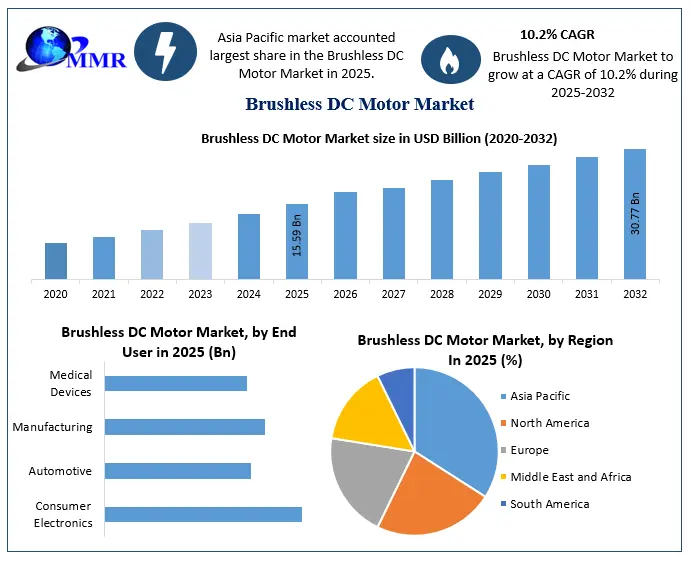
The Global Brushless DC Motors Market is expanding as industries seek higher efficiency, lower maintenance requirements, and improved operational performance compared with traditional brushed motor systems. According to the Maximize Market Research report, growing adoption across automotive, industrial, consumer electronics, and healthcare applications continues to support market expansion.
What changed is the increasing importance of energy efficiency. Manufacturers face rising pressure from sustainability targets, operating-cost reduction initiatives, and regulatory requirements. BLDC motors address these challenges by delivering improved efficiency, longer operational life, and superior control capabilities.
The business implication is significant. Every deployment of a brushless motor typically requires sophisticated electronic control systems, creating downstream opportunities for semiconductor manufacturers, embedded-system providers, and industrial automation companies.
The market is also benefiting from broader digitalization trends. Connected manufacturing environments increasingly require intelligent motion systems capable of integrating into Industrial IoT ecosystems and real-time operational networks.
Key Trends Driving Growth
Industrial automation remains one of the most important growth catalysts. Factories are increasingly deploying robotics, automated material-handling systems, and precision manufacturing equipment that depend on BLDC motors for reliable performance.
Electrification is creating another major demand engine. Electric vehicles require efficient motor technologies and advanced power-management systems. The growth of automotive electrification is strengthening demand not only for motors but also for power semiconductors, control electronics, and sensor technologies.
Smart consumer appliances represent an expanding application category. Washing machines, air conditioners, refrigerators, vacuum cleaners, and HVAC systems increasingly incorporate BLDC motors to improve efficiency and reduce operating noise.
The adoption of Industrial IoT is creating new opportunities. Connected motors equipped with monitoring capabilities allow predictive maintenance, performance optimization, and remote diagnostics. These functions depend heavily on semiconductor-enabled sensing and communications technologies.
Energy efficiency remains a defining trend. Governments and regulatory agencies worldwide continue encouraging deployment of technologies that reduce electricity consumption. BLDC motors align closely with these objectives because they offer higher efficiency than conventional alternatives.
Robotics growth is further strengthening market demand. Autonomous systems, collaborative robots, logistics automation platforms, and precision manufacturing equipment increasingly depend on advanced motion-control solutions.
For semiconductor suppliers, every one of these trends translates into growing demand for motor-driver ICs, microcontrollers, sensors, power-management devices, gate drivers, and connectivity modules.
Request a Free Sample Copy or View Report Summary: https://www.maximizemarketresearch.com/request-sample/29301/
Segment Insights
Dominant Segment: Industrial Machinery Applications
Industrial equipment remains a leading deployment area due to widespread adoption of automation technologies and precision manufacturing systems. The segment demonstrates how motor efficiency is becoming a core productivity metric.
Dominant Segment: Inner Rotor Brushless DC Motors
Inner rotor configurations continue to maintain broad adoption due to strong performance characteristics, compact design, and suitability across industrial applications.
Fastest-Growing Segment: Automotive Applications
Vehicle electrification is creating significant growth opportunities for BLDC motor deployment in propulsion systems, cooling systems, pumps, and auxiliary functions.
Fastest-Growing Opportunity: Robotics and Intelligent Automation
Advanced robotics applications increasingly require high-precision motion control and energy-efficient operation, supporting long-term adoption.
Emerging Technology Segment: Smart Motor Systems
Connected motor platforms integrated with predictive maintenance and IoT capabilities are becoming increasingly attractive to industrial users.
Regional Growth Story
Asia-Pacific remains the largest manufacturing hub for BLDC motor production and deployment. China, Japan, South Korea, and India continue expanding industrial capacity, consumer electronics production, and electric vehicle manufacturing.
China benefits from large-scale manufacturing ecosystems, extensive electronics supply chains, and substantial investments in automation technologies. Its position within global motor and electronics production supports continued market leadership.
Japan and South Korea maintain advantages in precision engineering, advanced electronics manufacturing, and industrial automation technologies. These capabilities strengthen regional competitiveness across high-performance motor applications.
India is emerging as an important growth market due to industrial modernization, infrastructure development, expanding appliance production, and increasing investment in manufacturing capacity.
North America continues benefiting from industrial automation investments and electrification initiatives. The United States remains an important center for robotics development, industrial software innovation, and advanced manufacturing technologies.
Europe is driven by sustainability regulations, industrial modernization, and electric mobility adoption. Germany’s leadership in industrial automation and precision engineering supports continued market demand.
Competitive Landscape
Competition increasingly revolves around integrated motion ecosystems rather than standalone motors. Manufacturers are investing in smarter control systems, advanced power electronics, and software-enabled performance optimization.
The most significant competitive signal is the growing convergence of motors and semiconductors. Performance advantages increasingly depend on electronic intelligence rather than mechanical design alone.
Companies that successfully combine efficient motor architectures with advanced semiconductor technologies are establishing stronger market positions. Intelligent control capabilities are becoming critical differentiators in industrial procurement decisions.
Supply-chain resilience is also becoming strategically important. Manufacturers are diversifying sourcing strategies to reduce dependence on concentrated component suppliers and improve operational stability.
The competitive environment increasingly favors organizations capable of delivering complete motion-control solutions that integrate hardware, software, sensors, and analytics.
Recent Developments
Increased deployment of BLDC motors in industrial automation systems.
Growing adoption across electric vehicle applications.
Expansion of smart appliance manufacturing.
Rising integration of predictive maintenance capabilities.
Stronger use of Industrial IoT connectivity in motion-control systems.
Continued investment in energy-efficient industrial equipment.
Advancements in motor-driver electronics and semiconductor control technologies.
Strategic Implications
For semiconductor manufacturers, BLDC motors represent a major growth opportunity because electronic content per motor continues increasing. Modern systems require sophisticated controllers, power semiconductors, sensors, and communication interfaces.
For OEMs, intelligent motion platforms provide opportunities to differentiate products through efficiency, reliability, and connectivity capabilities.
For investors, the market offers exposure to multiple structural growth drivers including industrial automation, electrification, robotics, smart manufacturing, and energy efficiency.
For supply-chain leaders, securing access to critical semiconductor components is becoming increasingly important as motor systems become more digitally sophisticated.
The broader implication is that motion control is evolving into a software-defined capability where intelligence, connectivity, and analytics increasingly determine value creation.
Future Outlook
The next phase of competition will be defined by the integration of AI-enabled motor control, intelligent power electronics, Industrial IoT connectivity, and semiconductor-driven motion optimization; companies that master this convergence will lead the future of electrified industry, while those that remain focused solely on mechanical performance risk falling behind in a market increasingly governed by digital intelligence and energy efficiency.
Analyst Perspective
“The Brushless DC Motors Market is benefiting from powerful structural trends including electrification, automation, and industrial digitalization. Organizations that align motor innovation with intelligent electronics and connected-control technologies will be best positioned to capture future growth opportunities,” — Rucha Deshpande
About Maximize Market Research
Maximize Market Research Pvt. Ltd. (MMR) is a global market research and consulting company that provides reliable, data-focused, and practical business insights. The firm serves a wide range of industries, including healthcare, pharmaceuticals, technology, automotive, electronics, chemicals, personal care, and consumer goods. Through market forecasts, competitive analysis, strategic consulting, and industry impact assessments, MMR helps organizations understand changing market conditions, identify growth opportunities, and make informed business decisions for long-term success.
2nd Floor, Navale IT Park Phase 3
Pune Banglore Highway, Narhe
Pune, Maharashtra 411041, India
+91 9607365656
sales@maximizemarketresearch.com
