Market Overview
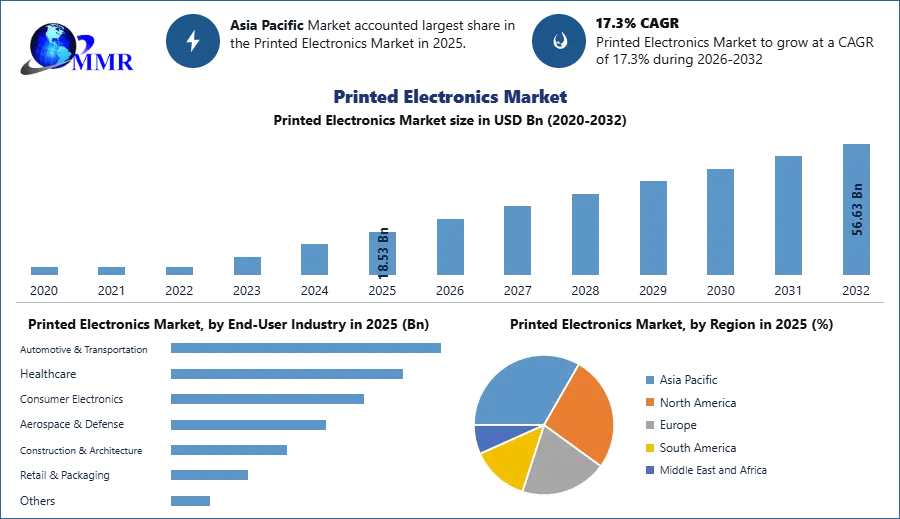
The global Printed Electronics Market was valued at USD 18.53 billion in 2025 and is expected to reach nearly USD 56.63 billion by 2032, growing at a CAGR of 17.3% during the forecast period. Rising demand across automotive, healthcare, and flexible electronics applications is driving market expansion.
Unlike conventional semiconductor fabrication, printed electronics uses printing technologies to create electronic devices on a broad range of substrates. The approach enables production of components such as thin-film transistors, capacitors, resistors, and coils through lower-cost manufacturing processes.
The business implication is significant. Manufacturers can potentially reduce material consumption, simplify production workflows, and introduce electronic functionality into products previously considered uneconomical for traditional electronics integration.
Key Trends Driving Growth
The strongest catalyst is the rise of flexible electronics. Consumer devices, automotive interiors, wearable technologies, and healthcare monitoring systems increasingly require lightweight and adaptable electronic components. Printed electronics directly addresses these design requirements.
IoT deployment is creating another major demand engine. Smart labels, RFID tags, sensors, and connected packaging solutions require scalable manufacturing methods that support high production volumes while maintaining cost efficiency. Printed electronics provides that capability.
Display innovation is also expanding adoption. Flexible displays, animated advertising surfaces, electronic signage, and interactive consumer interfaces are moving from niche applications toward broader commercial deployment. Printed electronics enables these form factors while supporting new product categories.
Healthcare is becoming an increasingly important growth arena. Printed sensors and flexible electronic components support wearable monitoring devices, diagnostics, and patient-tracking applications. The convergence of healthcare digitization and low-cost electronics manufacturing is creating new commercial opportunities.
Sustainability considerations are gaining influence as well. Manufacturers are seeking production methods that reduce material waste and support lightweight product designs. Printed manufacturing approaches align with broader industry efforts to improve resource efficiency across electronics supply chains.
Request a Free Sample Copy or View Report Summary: https://www.maximizemarketresearch.com/request-sample/26302/
Segment Insights
Dominant Segment: Material Segment – Inks
Conductive and functional inks remain fundamental to printed electronics manufacturing because they enable creation of electronic circuits, sensors, and display components on diverse substrates. Industry adoption continues to expand as performance improves across applications.
Dominant Technology Segment: Screen Printing
Screen printing maintains a leading position due to its versatility, scalability, and suitability for producing electronic circuits, sensors, batteries, touch panels, LED components, and solar cell structures. The technology remains attractive for large-volume manufacturing environments.
Fastest-Growing Technology Segment: Inkjet Printing
Inkjet printing is experiencing strong growth because it supports precision deposition, design flexibility, and efficient production for increasingly sophisticated printed electronic applications.
Leading Application Opportunity: Flexible Displays
Flexible displays continue to attract investment due to expanding demand across consumer electronics, retail displays, industrial interfaces, and emerging smart-device ecosystems.
High-Growth End-Use Opportunity
Automotive, healthcare, wearable electronics, smart packaging, and industrial IoT applications represent some of the most promising demand centers for future deployment.
Regional Growth Story
Asia-Pacific remains central to the printed electronics ecosystem because of its concentration of electronics manufacturing capabilities, component suppliers, display producers, and consumer electronics demand. The region benefits from established manufacturing infrastructure and large-scale production expertise.
China, Japan, South Korea, and India continue to play important roles in electronics manufacturing expansion, flexible display development, and supply-chain localization efforts. Their manufacturing ecosystems create favorable conditions for broader printed electronics adoption.
North America remains an innovation-driven market where demand is supported by advanced healthcare technologies, smart-device development, industrial automation initiatives, and next-generation electronics research.
Europe’s opportunity is increasingly tied to automotive electronics, industrial IoT, sustainable manufacturing strategies, and advanced materials innovation. These sectors align closely with printed electronics capabilities.
Competitive Landscape
Competition is increasingly shifting from component manufacturing toward platform development. Companies that control advanced materials, conductive inks, flexible substrates, display technologies, and scalable printing processes are positioning themselves to influence future electronics architectures.
Major industry participants include LG Display, DuPont, BASF, Molex, E Ink Holdings, NovaCentrix, and Agfa-Gevaert Group.
Their investments signal a broader industry transition toward flexible computing surfaces, smart packaging ecosystems, advanced sensing technologies, and connected product platforms. The winners are likely to be organizations capable of combining materials science, manufacturing scale, and application-specific innovation.
Recent Development
Increasing deployment of printed electronics in automotive applications.
Growing adoption of flexible electronic devices across consumer markets.
Expansion of printed RFID, sensors, and smart-label technologies supporting IoT ecosystems.
Continued innovation in conductive inks and functional materials.
Rising commercialization of flexible display technologies and interactive surfaces.
Strategic Implications
For electronics OEMs, printed electronics creates opportunities to redesign products around flexibility, lower weight, and embedded intelligence. For manufacturing companies, it offers potential reductions in production complexity and material costs.
For investors, the opportunity extends beyond device manufacturers. Materials suppliers, conductive ink developers, printing technology providers, flexible substrate producers, and smart-packaging specialists represent critical value-creation points across the ecosystem.
For supply-chain leaders, printed electronics supports diversification strategies by enabling alternative manufacturing approaches and reducing dependence on some traditional production constraints.
Future Outlook
The next phase of growth will be shaped by the convergence of IoT networks, intelligent packaging, wearable computing, flexible displays, healthcare monitoring systems, and connected industrial infrastructure. Printed electronics is moving from a specialty technology toward a foundational manufacturing approach for distributed intelligence.
As device makers seek to place sensing, identification, communication, and display capabilities into virtually every surface, product, and package, competitive advantage will increasingly belong to companies that can industrialize flexible electronics at scale while laggards remain tied to conventional manufacturing architectures.
Analyst Perspective
“Printed electronics is evolving from a niche manufacturing technique into a strategic enabler of next-generation connected products. The combination of flexible electronics, IoT expansion, smart packaging, and advanced display technologies is creating new growth pathways across multiple industries,” said Rucha Deshpande.
About Maximize Market Research
Maximize Market Research Pvt. Ltd. (MMR) is a global market research and consulting company that provides reliable, data-focused, and practical business insights. The firm serves a wide range of industries, including healthcare, pharmaceuticals, technology, automotive, electronics, chemicals, personal care, and consumer goods. Through market forecasts, competitive analysis, strategic consulting, and industry impact assessments, MMR helps organizations understand changing market conditions, identify growth opportunities, and make informed business decisions for long-term success.
2nd Floor, Navale IT Park Phase 3
Pune Banglore Highway, Narhe
Pune, Maharashtra 411041, India
+91 9607365656
sales@maximizemarketresearch.com
