Key Highlights
• Electronic Health Records Market growth is being driven by healthcare digitalization and interoperability initiatives.
• Cloud and web-based EHR platforms represent the dominant product segment.
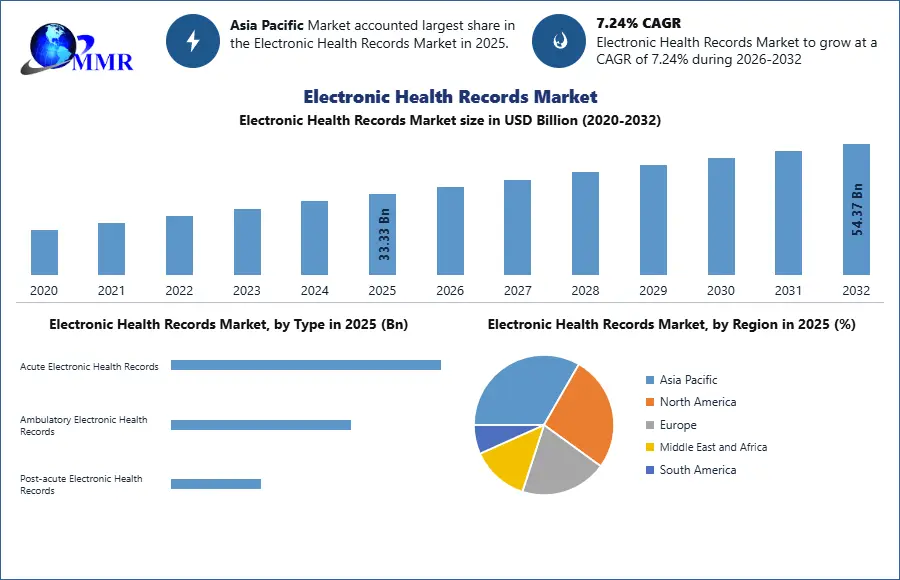
• Acute care systems maintain the largest market share across deployment environments.
• Ambulatory EHR solutions are emerging as the fastest-growing category.
• Hospitals remain the leading end-user segment due to large-scale digital transformation programs.
• AI-enabled analytics, telehealth integration, and connected healthcare ecosystems are reshaping competitive positioning.
• Government-backed healthcare modernization initiatives continue to accelerate adoption globally.
Why This Matters Now
Healthcare data has become a strategic asset. Hospitals, healthcare networks, technology providers, and digital infrastructure companies are racing to build platforms capable of turning fragmented clinical information into actionable intelligence.
The Electronic Health Records Market sits at the center of that transformation. As healthcare systems expand digital operations, EHR platforms are evolving from record-keeping systems into real-time intelligence engines that support clinical decisions, operational efficiency, patient engagement, and regulatory compliance. The shift creates opportunities not only for healthcare software providers but also for cloud infrastructure companies, AI developers, semiconductor manufacturers, and digital ecosystem participants.
Market Overview
The Electronic Health Records Market is entering a new phase of maturity driven by healthcare digitization, interoperability requirements, and growing demand for integrated patient information systems. Healthcare providers increasingly view EHR platforms as foundational infrastructure rather than administrative software.
What changed is the strategic role of healthcare data. Historically, EHR systems focused on documentation and record management. Today, healthcare organizations expect these platforms to support predictive analytics, telehealth integration, workflow automation, and population health management.
This evolution is creating demand for higher-performance computing infrastructure, cloud connectivity, secure data storage, and AI-enabled analytics capabilities. As healthcare data volumes expand, technology providers are investing heavily in scalable architectures that can process, analyze, and distribute clinical information across increasingly complex healthcare networks.
Key Trends Driving Growth
Interoperability has become the industry’s defining priority. Healthcare organizations increasingly require systems capable of exchanging patient information across hospitals, clinics, laboratories, pharmacies, and remote-care platforms. This shift is accelerating demand for standardized digital infrastructure and integrated software ecosystems.
Cloud deployment continues to reshape purchasing decisions. Web and cloud-based EHR platforms have emerged as the leading product category because they reduce infrastructure complexity while improving scalability and accessibility. For providers, this translates into lower implementation barriers and faster deployment timelines.
Artificial intelligence is becoming a competitive differentiator. Healthcare providers are exploring AI-assisted documentation, predictive analytics, clinical decision support, and workflow automation. The result is growing demand for computing infrastructure capable of supporting increasingly sophisticated healthcare applications.
Telehealth expansion is creating another growth catalyst. Remote care models require seamless integration between virtual consultations and patient records. Organizations capable of connecting telehealth workflows with EHR systems are gaining strategic advantages in patient engagement and care coordination.
Government initiatives are also accelerating adoption. Policymakers increasingly view digital healthcare infrastructure as essential for improving healthcare accessibility, operational efficiency, and long-term healthcare outcomes.
𝐃𝐨𝐰𝐧𝐥𝐨𝐚𝐝 𝐏𝐃𝐅 𝐁𝐫𝐨𝐜𝐡𝐮𝐫𝐞 @ https://www.maximizemarketresearch.com/request-sample/17991/
Segment Insights
• Dominant Segment: Web and cloud-based EHR solutions hold the largest market share, supported by scalability, lower infrastructure requirements, interoperability capabilities, and simplified deployment models.
• Fastest-Growing Segment: Ambulatory EHR solutions are projected to grow at the fastest pace as outpatient care facilities, physician practices, and specialized clinics continue digital transformation initiatives.
• Acute care EHR systems remain the leading type segment due to widespread deployment across hospitals and large healthcare institutions.
• Hospitals represent the dominant end-user segment as healthcare networks invest heavily in digital modernization and operational efficiency.
• Cardiology remains a leading application area due to rising clinical data requirements and increasing demand for integrated patient management systems.
Regional Growth Story
North America remains the largest market, supported by mature healthcare IT infrastructure, strong regulatory frameworks, and widespread adoption of digital healthcare technologies. The United States continues to lead global implementation efforts as healthcare organizations prioritize interoperability and data-driven care delivery.
Europe is advancing through regulatory modernization and healthcare digitization initiatives. Germany and other major healthcare markets are accelerating investments in interoperable healthcare systems to improve efficiency and reduce long-term costs.
Asia-Pacific represents the strongest growth opportunity. China is expanding digital healthcare infrastructure through government-led modernization programs, while healthcare providers increasingly adopt connected information systems.
India is emerging as a particularly attractive growth market. Government support for healthcare digitization, expanding healthcare infrastructure, and rising demand for efficient patient management systems are creating favorable conditions for EHR adoption.
Across all major regions, healthcare modernization is evolving into a national competitiveness issue. Countries capable of building integrated digital healthcare ecosystems are likely to achieve stronger healthcare outcomes and operational efficiencies.
Competitive Landscape
Competition is shifting beyond software functionality toward ecosystem control. Companies including Oracle Health, Epic Systems, eClinicalWorks, NextGen Healthcare, Veradigm, Meditech, and GE Healthcare are competing to become central platforms within increasingly interconnected healthcare networks.
This signals a broader industry transition. Market leadership will increasingly depend on interoperability, AI readiness, cloud scalability, cybersecurity capabilities, and ecosystem partnerships rather than standalone software performance.
Cloud-native architectures are strengthening vendor positioning because they enable continuous updates, analytics integration, and rapid scalability. Vendors that successfully combine clinical workflows, AI capabilities, and interoperable data platforms are building stronger competitive moats.
The market is also witnessing growing alignment between healthcare providers, cloud operators, analytics specialists, and digital health innovators. These partnerships are accelerating innovation while creating higher barriers to entry for smaller competitors.
Recent Developments
• Expansion of cloud-based EHR deployments across hospitals and healthcare networks.
• Increasing integration of telehealth capabilities with electronic health record platforms.
• Growing investment in interoperability frameworks and health information exchange networks.
• Adoption of AI-enabled analytics tools to improve clinical decision-making and workflow efficiency.
• Strengthening cybersecurity investments to protect sensitive healthcare information.
• Expansion of government-backed digital healthcare initiatives across developed and emerging economies.
Strategic Implications
For investors, the Electronic Health Records Market offers exposure to healthcare digitalization, cloud computing, artificial intelligence, cybersecurity, and connected care ecosystems simultaneously.
For healthcare providers, competitive advantage increasingly depends on transforming clinical data into operational intelligence. Organizations that successfully leverage integrated EHR systems can improve care quality, productivity, and patient engagement.
For technology companies, the opportunity extends beyond software. Demand is growing for cloud infrastructure, data management platforms, AI accelerators, analytics engines, and cybersecurity solutions capable of supporting next-generation healthcare environments.
For policymakers, interoperable healthcare systems are becoming critical infrastructure assets capable of improving public health management and healthcare accessibility.
Future Outlook
The next phase of Electronic Health Records Market development will be defined by intelligent automation, interoperability, predictive analytics, and cloud-native healthcare architectures. Healthcare organizations are moving toward platforms capable of connecting patients, providers, insurers, laboratories, and digital health applications within unified ecosystems.
The organizations that transform healthcare data into real-time intelligence will define the next generation of digital healthcare leadership, while those that remain dependent on fragmented information systems risk falling behind in an increasingly AI-driven healthcare economy.
Analyst Perspective
“The Electronic Health Records Market is evolving from a documentation platform into a strategic healthcare intelligence infrastructure. Organizations that prioritize interoperability, cloud scalability, and AI-enabled analytics will be best positioned to capture long-term value as healthcare digitalization accelerates globally,” said Alpana Patil, Research Analyst.
About Maximize Market Research
Maximize Market Research Pvt. Ltd. (MMR) is a global market research and consulting company that provides reliable, data-focused, and practical business insights. The firm serves a wide range of industries, including healthcare, pharmaceuticals, technology, automotive, electronics, chemicals, personal care, and consumer goods. Through market forecasts, competitive analysis, strategic consulting, and industry impact assessments, MMR helps organizations understand changing market conditions, identify growth opportunities, and make informed business decisions for long-term success.
2nd Floor, Navale IT Park Phase 3
Pune Banglore Highway, Narhe
Pune, Maharashtra 411041, India
+91 9607365656
sales@maximizemarketresearch.com
