Key Highlights
- Touch screen displays are becoming the primary interface for connected digital ecosystems.
- AI-enabled consumer electronics are driving demand for advanced display technologies.
- Display innovation is creating new opportunities across semiconductor and electronics supply chains.
- Smart devices, industrial automation systems, and connected vehicles are expanding application demand.
- Capacitive touchscreen technologies continue to dominate commercial deployments.
- Advanced display integration is increasing demand for display driver ICs and semiconductor components.
- Manufacturing investments across Asia-Pacific continue strengthening global supply capabilities.
Why This Matters Now
Every digital interaction increasingly begins with a display. Whether consumers engage with smartphones, industrial operators control automated systems, or drivers interact with connected vehicles, touch screen technologies have become the front-end interface of the digital economy.
The significance extends beyond displays. Growth in touch screen adoption directly influences semiconductor demand, display driver production, sensor integration, AI-enabled device development, and electronics manufacturing activity. As artificial intelligence becomes embedded into everyday products, displays are evolving from output devices into intelligent interaction platforms.
The result is a market positioned at the intersection of semiconductor innovation, consumer technology, and next-generation computing experiences.
Market Overview
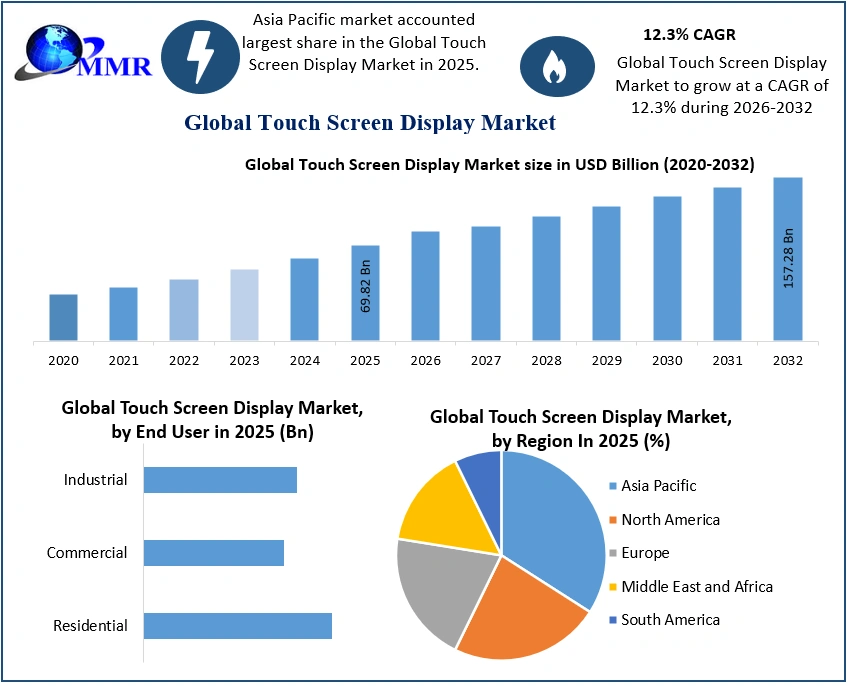
The Touch Screen Display Market is experiencing structural transformation as digital interfaces become central to modern electronics ecosystems. Demand is expanding across smartphones, tablets, industrial equipment, automotive systems, healthcare devices, retail environments, and smart home platforms.
What changed is the role of the display itself. Historically, displays served primarily as information presentation tools. Today, they function as intelligent control centers connecting users with increasingly sophisticated digital environments.
This transition is driving demand for higher-performance touch sensors, display driver integrated circuits, power management technologies, and advanced semiconductor components. Manufacturers are investing in technologies capable of delivering improved responsiveness, energy efficiency, durability, and user experience.
The market’s growth reflects a broader evolution toward seamless human-machine interaction across both consumer and enterprise environments.
Key Trends Driving Growth
Artificial intelligence is becoming a major catalyst for display innovation. AI-powered smartphones, tablets, smart appliances, and enterprise devices increasingly require more sophisticated user interfaces capable of supporting personalized experiences and intelligent interactions.
Smart consumer electronics remain a primary growth driver. Consumers expect intuitive interfaces, larger displays, enhanced responsiveness, and seamless connectivity across multiple devices. These expectations continue to push manufacturers toward advanced touchscreen technologies.
Capacitive touchscreen technology maintains strong market momentum because of its accuracy, durability, and multi-touch capabilities. The technology has become the preferred solution across smartphones, tablets, kiosks, and industrial applications.
Industrial automation is creating another important growth channel. Factories increasingly deploy touch-enabled human-machine interfaces to improve operational efficiency and support digital manufacturing initiatives. As Industry 4.0 adoption expands, demand for ruggedized display solutions continues growing.
Automotive digitalization is accelerating opportunities. Modern vehicles increasingly incorporate touch-enabled infotainment systems, navigation platforms, digital dashboards, and connected mobility solutions. These developments strengthen demand for high-performance display technologies.
IoT expansion is further increasing market potential. Connected devices across healthcare, retail, logistics, and smart city environments rely on touch-enabled interfaces for data visualization and user interaction.
Semiconductor innovation plays a critical role in supporting these trends. Display driver ICs, sensors, power management components, and processing technologies continue advancing to meet increasingly demanding performance requirements.
𝐃𝐨𝐰𝐧𝐥𝐨𝐚𝐝 𝐏𝐃𝐅 𝐁𝐫𝐨𝐜𝐡𝐮𝐫𝐞 @ https://www.maximizemarketresearch.com/request-sample/33463/
Segment Insights
- Dominant Segment: Capacitive touch screen technology continues to dominate due to superior accuracy, multi-touch functionality, durability, and widespread adoption across consumer electronics.
- Fastest-Growing Segment: Interactive and smart-display applications are emerging as the fastest-growing category as AI-enabled devices and connected ecosystems gain momentum.
- Smartphones remain a leading application segment because touch screens represent the primary interface for mobile computing.
- Industrial applications continue expanding as manufacturers invest in digital transformation and automation initiatives.
- Automotive touchscreen deployments are creating significant long-term opportunities due to vehicle digitalization trends.
Regional Growth Story
Asia-Pacific remains the center of global display manufacturing and electronics production. China, South Korea, Taiwan, and Japan collectively represent a critical ecosystem supporting display panel production, semiconductor manufacturing, and consumer electronics assembly.
China continues to strengthen its position through large-scale investments in display manufacturing capacity and electronics production infrastructure. These investments contribute to global supply-chain competitiveness and technology development.
South Korea maintains leadership in premium display technologies and advanced manufacturing capabilities. The country’s display ecosystem supports innovation across smartphones, televisions, and emerging display applications.
Taiwan benefits from strong semiconductor manufacturing capabilities and deep integration with global electronics supply chains. Display technologies increasingly rely on advanced semiconductor components, strengthening Taiwan’s strategic importance.
Japan remains influential through technological expertise, display innovation, and precision manufacturing capabilities. Continued investment in advanced display technologies supports competitiveness across global markets.
North America benefits from strong demand for premium consumer electronics, AI-enabled devices, and enterprise technology solutions. Technology companies continue driving innovation in user-interface design and device experiences.
Europe is expanding adoption across automotive, industrial automation, healthcare, and smart infrastructure applications. Germany remains particularly important because of its industrial technology leadership and automotive manufacturing strength.
India is emerging as a growing opportunity market as smartphone adoption, electronics manufacturing initiatives, and digital transformation programs continue expanding.
Competitive Landscape
Competition increasingly revolves around technological integration rather than display hardware alone. Companies such as Samsung Display, LG Display, BOE Technology, AUO Corporation, Sharp Corporation, Innolux Corporation, and Japan Display Inc. are investing in innovation strategies that combine display performance, energy efficiency, and intelligent functionality.
These investments signal a broader industry shift. Future market leadership will depend on the ability to integrate displays with AI capabilities, advanced sensors, semiconductor technologies, and connected ecosystems.
Display manufacturers are also strengthening relationships with semiconductor suppliers, OEMs, and technology developers. This collaboration reflects growing recognition that display innovation increasingly depends on advances in processing power, connectivity, and software intelligence.
The competitive advantage belongs to organizations capable of delivering complete user experiences rather than standalone display products.
Recent Developments
- Increased investment in advanced touchscreen manufacturing technologies.
- Expansion of AI-enabled smart device ecosystems.
- Growing deployment of touch-enabled industrial automation systems.
- Rising integration of interactive displays into connected vehicles.
- Continued innovation in display driver ICs and sensor technologies.
- Strengthening partnerships between display manufacturers and semiconductor companies.
Strategic Implications
For semiconductor manufacturers, the Touch Screen Display Market represents an important source of demand for display drivers, sensors, processors, and power management components.
For investors, the market offers exposure to several long-term growth themes, including AI adoption, smart devices, IoT ecosystems, connected mobility, and industrial digitalization.
For OEMs, display quality increasingly influences product differentiation and consumer purchasing decisions. Organizations that deliver superior user experiences gain stronger competitive positioning.
For policymakers, display manufacturing contributes to broader objectives related to semiconductor sovereignty, technology leadership, and supply-chain resilience.
Technology providers also benefit from growing demand for AI-powered interfaces, advanced connectivity solutions, and intelligent interaction platforms.
Future Outlook
The next generation of digital experiences will be defined by displays that not only present information but also understand context, anticipate user intent, and serve as intelligent gateways to AI-powered ecosystems. Touch screen technologies are becoming critical infrastructure within the broader evolution of connected computing.
The companies that successfully combine display innovation, semiconductor integration, AI-enabled functionality, and manufacturing scale will shape the future of human-machine interaction, while those that remain focused solely on hardware specifications risk losing relevance in an increasingly intelligent device economy.
Analyst Perspective
“Touch screen displays are evolving into intelligent interaction platforms that connect users with increasingly sophisticated digital ecosystems. Organizations that invest in display innovation, semiconductor integration, and AI-enabled experiences will be best positioned to capture future market opportunities,” said Alpana Patil, Research Analyst.
