Key Highlights
- Growing adoption of AI-powered voice assistants is transforming smart speakers from entertainment devices into intelligent control hubs.
- Smart home expansion is increasing demand for connectivity chips, AI processors, wireless modules, and edge-computing components.
- Hardware remains the dominant market segment, while software is emerging as the fastest-growing value creation layer.
- Smart home control applications are gaining momentum as consumers seek automation, convenience, and energy efficiency.
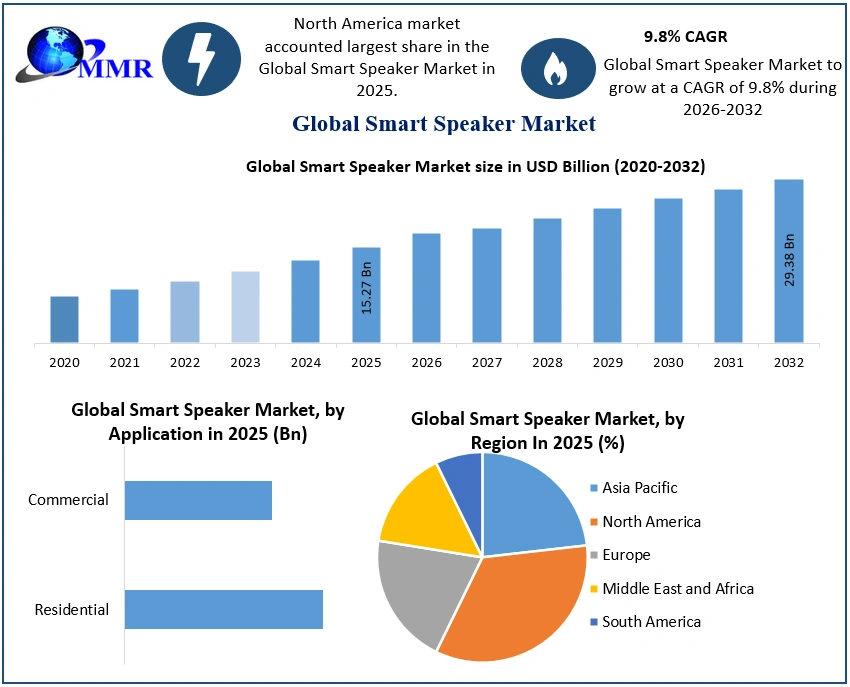
- North America leads adoption, while Asia-Pacific is becoming a major growth engine through digital transformation and connected-device penetration.
- Technology leaders are increasingly competing through ecosystem integration rather than standalone hardware performance.
Why This Matters Now
The smart speaker industry has moved beyond voice-controlled music playback. It now sits at the center of the connected-home economy, linking artificial intelligence, IoT networks, cloud platforms, and consumer electronics into a unified ecosystem.
For semiconductor manufacturers, electronics OEMs, and technology investors, this shift creates a new source of demand for AI processors, wireless communication chips, memory components, and edge-computing technologies. As consumers increasingly expect devices to understand context, automate routines, and control connected environments, smart speakers are becoming strategic gateways to larger digital ecosystems.
Market Overview
The Smart Speaker Market is benefiting from the convergence of artificial intelligence, cloud computing, wireless connectivity, and smart-home adoption. According to the Maximize Market Research report, rising consumer preference for voice-enabled convenience and increasing integration of connected devices continue to support market expansion.
What changed is the role of the device itself. Smart speakers are no longer standalone consumer electronics products. They increasingly function as central command centers for connected homes, integrating lighting systems, security devices, entertainment platforms, and household automation.
Why now? AI advancements have significantly improved speech recognition, contextual understanding, and personalization. These capabilities are turning voice interfaces into practical daily-use technologies rather than novelty features.
For technology providers, this transition creates recurring software, service, and ecosystem revenue opportunities that extend well beyond hardware sales.
Key Trends Driving Growth
Artificial intelligence remains the primary force reshaping the market. Improvements in natural language processing and machine learning have increased voice-command accuracy and expanded device functionality. As AI models become more capable, smart speakers are evolving into personalized digital assistants capable of handling increasingly complex tasks.
IoT adoption is creating another layer of momentum. Smart speakers act as orchestration platforms for connected devices, making them critical components within modern smart-home environments. The greater the number of connected devices within a household, the greater the value proposition of voice-controlled management.
The market also reflects broader semiconductor industry trends. AI-enabled consumer devices require increasingly sophisticated processors, connectivity modules, memory solutions, and power-management components. This creates downstream opportunities for chip designers, semiconductor manufacturers, and electronics manufacturing services providers.
Wireless connectivity continues to advance as Wi-Fi, Bluetooth, and hybrid connectivity architectures improve device performance and interoperability. These improvements reduce friction for consumers while expanding potential applications.
Commercial adoption is also emerging as a new opportunity. Hospitality, healthcare, retail, and enterprise environments are increasingly evaluating voice-enabled technologies to improve customer engagement and operational efficiency.
𝐃𝐨𝐰𝐧𝐥𝐨𝐚𝐝 𝐏𝐃𝐅 𝐁𝐫𝐨𝐜𝐡𝐮𝐫𝐞 @ https://www.maximizemarketresearch.com/request-sample/2355/
Segment Insights
- Dominant Segment: Hardware
- Hardware remains the largest segment of the Smart Speaker Market.
- Continued advances in audio performance, voice-recognition technology, and integrated chipsets support segment leadership.
- The dominance of hardware highlights sustained demand for semiconductor components, sensors, processors, microphones, and wireless communication modules.
- Fastest-Growing Segment: Software
- Software is projected to deliver the fastest growth.
- AI algorithms, voice-assistant platforms, analytics engines, and personalization technologies are becoming key competitive differentiators.
- This shift signals a broader transition toward software-defined consumer electronics ecosystems.
- Dominant Connectivity Segment: Wi-Fi
- Wi-Fi remains the primary connectivity standard because it enables cloud integration and smart-home interoperability.
- Strong Wi-Fi adoption increases demand for networking chipsets and wireless communication technologies.
- Fastest-Growing Connectivity Segment: Hybrid (Wi-Fi + Bluetooth)
- Hybrid connectivity combines flexibility with performance.
- The trend reflects growing consumer expectations for seamless device interaction across multiple environments.
- Dominant Application Segment: Music and Entertainment
- Entertainment remains the primary use case.
- Integration with streaming services continues to support consumer adoption.
- Fastest-Growing Application Segment: Smart Home Control
- Smart-home management is emerging as a major growth driver.
- Voice-controlled automation is increasing the strategic value of smart speakers within connected-device ecosystems.
Regional Growth Story
North America remains the market leader due to strong consumer adoption of connected-home technologies, advanced digital infrastructure, and the presence of major technology companies.
The United States continues to shape industry direction through AI innovation, smart-home ecosystem development, and platform integration. Technology providers operating in the region are using smart speakers as gateways into broader consumer ecosystems.
Asia-Pacific represents one of the most important strategic growth regions. Rapid digitalization, expanding internet access, rising disposable incomes, and increasing adoption of connected devices are supporting market expansion.
China’s position is particularly significant because domestic technology companies continue to strengthen AI ecosystems and smart-home integration. The country’s electronics manufacturing capabilities also provide advantages across production and supply-chain operations.
Japan presents unique opportunities through aging demographics and growing demand for voice-enabled assistance technologies. Meanwhile, India continues to benefit from accelerating digital adoption and expanding connected-device penetration.
Europe remains a key market as consumers increasingly adopt smart-home solutions and voice-enabled digital services. Strong broadband infrastructure and growing awareness of connected-home technologies continue to support adoption.
Competitive Landscape
Competition is increasingly centered on ecosystem control rather than device shipments alone.
Major participants including Amazon, Google, Apple, Alibaba, Baidu, Xiaomi, Samsung, Sony, Lenovo, Bose, Panasonic, Sonos, and Harman are competing to become the primary interface between consumers and connected digital services.
This signals a broader strategic shift. Companies that control voice platforms gain access to valuable user engagement data, recurring service revenues, and cross-selling opportunities across smart-home ecosystems.
AI capability is becoming the new competitive battleground. Vendors are investing heavily in natural language processing, contextual intelligence, and personalized user experiences. The result is a market where software sophistication increasingly determines long-term leadership.
For semiconductor suppliers, this competitive intensity creates demand for higher-performance processors, AI acceleration technologies, advanced memory architectures, and more efficient connectivity solutions.
Recent Developments
- Google introduced Gemini-powered smart home devices featuring advanced AI capabilities and enhanced contextual intelligence.
- Technology providers continue expanding smart-home ecosystem integration strategies.
- AI-powered voice assistants are receiving significant upgrades in contextual understanding and personalization.
- Commercial deployments are increasing across hospitality, healthcare, retail, and enterprise environments.
- Manufacturers are focusing on energy-efficient and networked audio solutions to support evolving user requirements.
Strategic Implications
The Smart Speaker Market offers a clear lesson for technology executives: hardware alone is no longer sufficient to sustain competitive advantage.
Value creation is increasingly moving toward software, AI services, ecosystem integration, and connected-device management. Companies that successfully combine hardware innovation with AI-driven user experiences are positioned to capture larger portions of the market value chain.
For semiconductor companies, the market represents a growing source of demand for AI processing, wireless communications, memory technologies, and edge-computing solutions.
For investors, the most attractive opportunities may lie not only in device manufacturers but also in enabling technologies that power intelligent voice ecosystems.
Future Outlook
The next phase of market development will be defined by deeper AI integration, broader smart-home adoption, and increasing convergence between voice interfaces and connected-device ecosystems.
As edge AI capabilities mature, smart speakers will perform more processing locally, improving responsiveness, privacy, and functionality. This evolution will increase demand for advanced semiconductor architectures while creating opportunities for new software and service models.
The companies that master AI-driven ecosystems, semiconductor-enabled intelligence, and seamless device interoperability will define the next generation of consumer technology leadership, while firms that remain focused on standalone hardware risk becoming irrelevant in an increasingly software-defined market.
Analyst Perspective
“The Smart Speaker Market is entering a new phase where artificial intelligence, connected-home ecosystems, and software innovation are becoming more important than hardware alone. Companies that successfully integrate AI-driven experiences with broader digital ecosystems will be best positioned to capture future value creation across the consumer technology landscape.” — Alpana Patil, Research Analyst
About Maximize Market Research
Maximize Market Research Pvt. Ltd. (MMR) is a global market research and consulting company that provides reliable, data-focused, and practical business insights. The firm serves a wide range of industries, including healthcare, pharmaceuticals, technology, automotive, electronics, chemicals, personal care, and consumer goods. Through market forecasts, competitive analysis, strategic consulting, and industry impact assessments, MMR helps organizations understand changing market conditions, identify growth opportunities, and make informed business decisions for long-term success.
2nd Floor, Navale IT Park Phase 3
Pune Banglore Highway, Narhe
Pune, Maharashtra 411041, India
+91 9607365656
sales@maximizemarketresearch.com
