Key Highlights
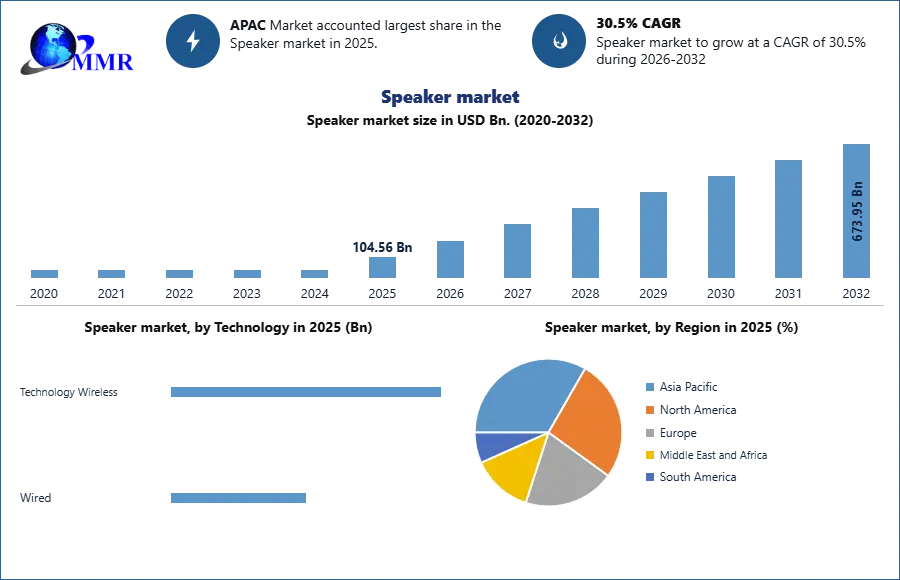
- Speaker Market valued at USD 104.56 billion in 2025
- Market projected to reach USD 673.95 billion by 2032
- Expected CAGR of 30.5% during 2026–2032
- Smart speaker adoption remains a primary growth catalyst
- Voice-assistant integration is reshaping product innovation
- Wireless connectivity technologies continue accelerating demand
- Smart-home ecosystem expansion is creating new revenue streams
- Premium audio experiences are driving consumer upgrades
Why This Matters Now
The battle for consumer attention is increasingly moving beyond screens and into voice-driven ecosystems. Smart speakers have evolved from audio accessories into strategic control hubs for connected homes, digital assistants, and AI-enabled services.
For electronics manufacturers, OEMs, semiconductor suppliers, and technology investors, the opportunity extends well beyond hardware sales. Every speaker sold strengthens participation in broader smart-device ecosystems where software, services, connectivity, and recurring user engagement generate long-term value.
Market Overview
The Speaker Market Size is entering a period of accelerated transformation as artificial intelligence, wireless technologies, and smart-home adoption converge across consumer electronics.
According to Maximize Market Research, the market was valued at USD 104.56 billion in 2025 and is expected to reach USD 673.95 billion by 2032, expanding at a 30.5% CAGR during the forecast period. Such growth indicates that speakers are no longer standalone audio devices. They are becoming intelligent endpoints within connected digital environments.
Demand is increasingly linked to multifunctionality. Consumers expect devices that can stream content, provide voice assistance, control smart-home equipment, deliver information, and integrate seamlessly with connected platforms. This shift is redefining competitive positioning across the electronics value chain.
The result is a market increasingly driven by software-enabled experiences rather than audio hardware alone.
Key Trends Driving Growth
Voice-enabled smart speakers have emerged as one of the industry’s most significant growth engines. Consumers increasingly prefer hands-free interactions for entertainment, communication, and home automation.
Wireless connectivity technologies continue removing friction from audio consumption. Bluetooth, Wi-Fi, and multi-device synchronization have transformed user expectations regarding portability and convenience.
Smart-home adoption is creating a powerful multiplier effect. Speakers now function as central interfaces connecting lighting systems, security devices, entertainment platforms, and household appliances. This expands their strategic importance within connected ecosystems.
AI integration is also becoming a critical differentiator. Advanced voice recognition, personalized recommendations, contextual responses, and intelligent automation are improving user engagement while increasing switching costs between ecosystems.
Consumer demand for premium audio experiences is simultaneously supporting higher-value product categories. Enhanced sound quality, immersive entertainment experiences, and sophisticated device integration are encouraging upgrades across residential and commercial segments.
Download a Sample Report Covering Market Dynamics and Key Trends
Segment Insights
- Dominant Segment: Smart speaker categories continue benefiting from growing demand for voice-controlled and connected home experiences.
- Fastest-Growing Segment: Wireless and AI-enabled speaker solutions are experiencing rapid adoption due to increasing consumer preference for mobility and convenience.
- Voice-assistant-enabled products are becoming a core purchasing consideration.
- Connected audio systems are gaining traction within broader IoT ecosystems.
- Premium audio solutions continue attracting consumers seeking immersive entertainment experiences.
- Portable and multifunctional speaker products remain key growth contributors.
The dominance of intelligent speaker categories highlights a broader industry transition from hardware-centric products to platform-based ecosystems. Companies that successfully integrate software, connectivity, and services are positioned to capture greater customer lifetime value.
Regional Growth Story
North America remains one of the most influential markets due to strong consumer adoption of smart-home technologies, high digital engagement, and rapid acceptance of connected devices.
The region’s leadership reflects mature consumer electronics infrastructure and a strong ecosystem of technology providers. For manufacturers, North America serves as an important market for premium product launches and next-generation feature deployment.
Asia-Pacific continues benefiting from rising consumer electronics demand, expanding middle-class populations, and large-scale manufacturing capabilities. The region’s importance extends beyond consumption because it remains central to global electronics production and supply-chain activity.
China, Japan, South Korea, and India continue influencing innovation, manufacturing competitiveness, and product development strategies across the global electronics industry.
Europe maintains demand for premium audio systems, sustainability-focused products, and advanced home entertainment solutions.
The broader regional landscape indicates that future growth will increasingly depend on balancing manufacturing efficiency, technology innovation, and ecosystem integration.
Competitive Landscape
Competition in the Speaker Market is rapidly shifting from audio performance alone toward ecosystem control.
Manufacturers are investing in voice-assistant compatibility, software capabilities, wireless technologies, and connected-device interoperability. The strategic objective is clear: own the consumer interface within the connected home.
Technology leadership is increasingly determined by how effectively companies integrate AI capabilities, cloud services, and smart-home functionality into audio products.
The competitive environment also signals growing convergence between consumer electronics companies, software providers, connectivity specialists, and platform operators. Success will depend on ecosystem strength rather than standalone hardware specifications.
Companies that can combine premium audio quality with seamless digital experiences are likely to strengthen pricing power and customer retention.
Recent Developments
- Increased integration of voice-assistant functionality into speaker platforms.
- Expansion of smart-home compatibility across product portfolios.
- Growing investment in wireless connectivity technologies.
- Enhanced focus on AI-driven user experiences and personalization.
- Development of multifunctional speaker solutions capable of controlling connected devices.
- Continued innovation in premium audio quality and immersive listening experiences.
Strategic Implications
For electronics OEMs, the market signals a transition toward platform-centric business models. Hardware differentiation alone is becoming insufficient to sustain competitive advantage.
Component suppliers benefit from increasing demand for microphones, connectivity modules, wireless chipsets, sensors, power-management solutions, and intelligent processing capabilities.
Technology providers gain opportunities through voice-assistant platforms, AI software, cloud integration services, and smart-home ecosystems.
Investors should view the market as part of a larger connected-device opportunity. Growth is increasingly linked to ecosystem participation rather than individual product categories.
Companies that establish strong interoperability and software-driven user experiences are likely to capture disproportionate value as smart-home adoption expands.
Future Outlook
The next phase of industry growth will be defined by intelligent audio platforms rather than traditional speaker hardware. AI-powered assistants, connected-device management, personalized user experiences, and smart-home integration will increasingly shape purchasing decisions.
As voice interfaces become more sophisticated and connected ecosystems expand, speakers will evolve into strategic digital gateways across homes, workplaces, and entertainment environments.
The companies that control intelligent audio ecosystems will define the next generation of consumer electronics, while those focused solely on hardware risk losing relevance in an AI-driven connected-device economy.
Analyst Perspective
“The Speaker Market is undergoing a fundamental transformation from audio playback devices to intelligent ecosystem hubs. The convergence of AI, wireless connectivity, and smart-home technologies is creating substantial opportunities for manufacturers that can deliver seamless, connected user experiences while continuously innovating in functionality and convenience.” — Rucha Deshpande, Analyst
About Maximize Market Research
Maximize Market Research Pvt. Ltd. (MMR) is a global market research and consulting company that provides reliable, data-focused, and practical business insights. The firm serves a wide range of industries, including healthcare, pharmaceuticals, technology, automotive, electronics, chemicals, personal care, and consumer goods. Through market forecasts, competitive analysis, strategic consulting, and industry impact assessments, MMR helps organizations understand changing market conditions, identify growth opportunities, and make informed business decisions for long-term success.
Contact Us
2nd Floor, Navale IT Park Phase 3
Pune Banglore Highway, Narhe
Pune, Maharashtra 411041, India
+91 9607365656
sales@maximizemarketresearch.com
