Key Highlights
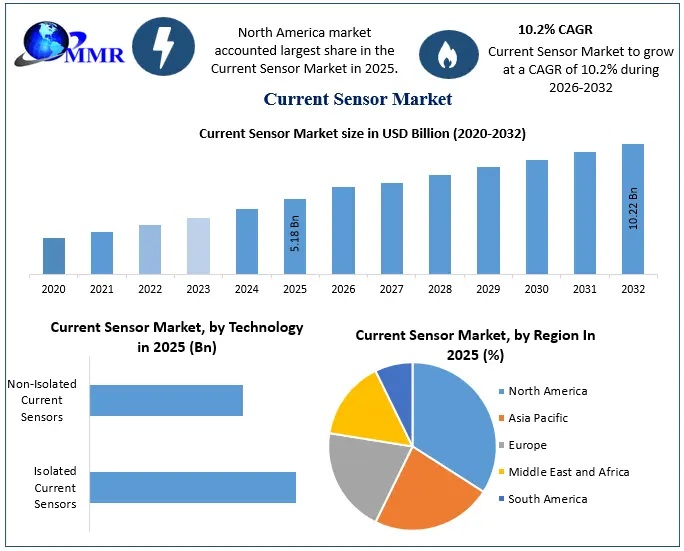
- Current Sensor Market size stood at USD 5.18 Billion in 2025.
- Market is forecast to reach USD 10.22 Billion by 2032.
- CAGR is projected at 10.2% during 2026–2032.
- Asia-Pacific remains the leading regional market.
- Direct current sensing is the dominant sensing method segment.
- Motor drive applications account for the largest revenue contribution.
- Electric vehicle adoption continues to strengthen demand for precision current monitoring.
- Industrial automation and smart electronics are creating new deployment opportunities.
Why This Matters Now
The semiconductor and electronics industry is entering a phase where power efficiency has become as important as computing performance. As AI-enabled devices, electric vehicles, industrial robots, and connected infrastructure scale globally, precise current measurement is becoming a critical requirement rather than a supporting feature.
Current sensors sit at the center of this transition. They help manufacturers optimize battery performance, reduce power losses, improve safety, and enable intelligent energy management. Companies that can integrate advanced sensing technologies into next-generation electronics will be positioned to benefit from rising demand across automotive, industrial, and consumer markets.
Market Overview
The Current Sensor Market Size generated USD 5.18 Billion in revenue in 2025 and is projected to reach USD 10.22 Billion by 2032, growing at a CAGR of 10.2%.
This growth reflects a broader transformation across electronics and semiconductor value chains. Increasing electrification, automation, and digitalization are expanding the need for accurate current measurement technologies. Current sensors are becoming essential components in battery management systems, power supplies, motor controls, renewable energy systems, and advanced electronic devices.
The market’s expansion signals a shift toward smarter power management architectures where efficiency, reliability, and operational visibility directly influence product competitiveness.
Key Trends Driving Growth
Electric vehicle production remains one of the strongest growth catalysts. Battery management systems require highly accurate current measurement to maximize battery life, improve charging efficiency, and ensure operational safety. As global EV deployment accelerates, sensor demand continues to rise.
Industrial automation is creating another major growth avenue. Modern factories increasingly rely on intelligent motor drives, robotics, and predictive maintenance systems. Current sensors provide real-time monitoring capabilities that improve machine efficiency and reduce downtime.
Smart consumer electronics are also expanding the addressable market. Smartphones, wearables, laptops, gaming systems, and connected home devices require efficient power management to support longer battery life and higher performance.
The rise of IoT ecosystems further strengthens demand. Connected devices need compact, low-power sensing solutions capable of delivering accurate energy monitoring and system diagnostics.
Renewable energy installations are contributing additional momentum. Solar inverters, energy storage systems, and power conversion equipment require current monitoring to improve system stability and energy efficiency.
Access an Exclusive Sample Report Covering Key Industry Insights
Segment Insights
- Dominant Segment: Direct Current Sensing
- Accounted for the largest share of market revenue.
- Widely adopted because of high accuracy, reliability, and cost efficiency.
- Critical for EV battery management systems and industrial control applications.
- Fastest-Growing Segment: Indirect Current Sensing
- Benefiting from demand for non-intrusive measurement technologies.
- Increasing adoption in renewable energy and high-current applications.
- Supports advanced monitoring requirements across electrification projects.
- Largest Application Segment: Motor Drive
- Represents the highest revenue contribution.
- Growth driven by industrial automation, robotics, and intelligent manufacturing systems.
- Technology Opportunity
- Flux gate technologies are witnessing increasing adoption where high precision and sensitivity are required.
- Advanced sensor architectures continue to improve performance in automotive and industrial environments.
Regional Growth Story
Asia-Pacific leads the Current Sensor Market and accounted for the largest share in 2023.
The region’s leadership reflects its position as the world’s electronics manufacturing center. Strong automotive production, expanding EV adoption, and large-scale consumer electronics manufacturing continue to support demand growth.
China remains a key contributor due to its extensive electronics and EV ecosystem. Semiconductor investments and industrial automation programs further strengthen demand for current sensing technologies.
Japan and South Korea continue to benefit from advanced manufacturing capabilities, strong automotive industries, and innovation in semiconductor and electronic components.
India is emerging as an important growth market as electronics manufacturing expansion, renewable energy investments, and electric mobility initiatives create new opportunities for sensor suppliers.
In North America, demand is supported by industrial automation, electrification programs, and investments in advanced manufacturing technologies.
Europe continues to benefit from automotive electrification, sustainability initiatives, and increasing adoption of energy-efficient industrial systems.
Competitive Landscape
Competition is increasingly focused on precision, integration, isolation capability, and power efficiency.
Leading semiconductor and sensor manufacturers are investing in technologies that improve measurement accuracy while reducing size and power consumption. This reflects broader industry demand for compact and intelligent electronic systems.
Companies that deliver integrated sensing solutions are gaining strategic advantages because OEMs increasingly prefer simplified system architectures. Higher integration lowers component count, reduces design complexity, and improves reliability.
The competitive landscape also signals a shift toward application-specific innovation. Automotive, industrial automation, renewable energy, and consumer electronics each require different performance characteristics, encouraging targeted product development.
As electrification expands, technology leadership will depend on the ability to deliver high-accuracy sensing under demanding operating conditions while maintaining cost competitiveness.
Recent Developments
- NOVOSENSE introduced the NSM2019 current sensor solution.
- The product delivers high isolation and low impedance characteristics.
- The sensor integrates measurement and isolation functionality into a compact architecture.
- The development supports industrial and automotive current measurement applications.
- Manufacturers continue to focus on integrated solutions that reduce external component requirements.
Strategic Implications
For semiconductor manufacturers, current sensors are becoming increasingly important components within power electronics ecosystems. Growth in EVs, automation, and smart devices is expanding long-term demand visibility.
For electronics OEMs, advanced sensing capabilities improve energy efficiency, operational safety, and system intelligence. These capabilities are becoming important differentiators in competitive markets.
For investors, the market highlights opportunities linked to electrification, industrial automation, and digital transformation. Demand growth is tied to structural technology trends rather than short-term product cycles.
For supply-chain participants, increasing adoption across multiple industries creates opportunities to strengthen partnerships with automotive, industrial, and consumer electronics manufacturers.
Future Outlook
The next phase of market growth will be shaped by intelligent power management, electrified transportation, connected industrial systems, and energy-efficient electronics. As AI-enabled devices, advanced automation systems, and smart energy infrastructure become more widespread, current sensing technologies will move from supporting components to mission-critical enablers of performance and reliability.
The companies that combine precision sensing, system integration, and scalable manufacturing will define the next generation of electronics leadership, while those that treat power intelligence as a secondary capability risk losing relevance in an increasingly electrified world.
Analyst Perspective
“Current sensors are evolving from measurement components into strategic enablers of intelligent power management. As electrification, industrial automation, and smart electronics continue to expand, demand for highly accurate and efficient current sensing solutions will accelerate across global markets,” says Rucha Deshpande, Analyst.
About Maximize Market Research
Maximize Market Research Pvt. Ltd. (MMR) is a global market research and consulting company that provides reliable, data-focused, and practical business insights. The firm serves a wide range of industries, including healthcare, pharmaceuticals, technology, automotive, electronics, chemicals, personal care, and consumer goods. Through market forecasts, competitive analysis, strategic consulting, and industry impact assessments, MMR helps organizations understand changing market conditions, identify growth opportunities, and make informed business decisions for long-term success.
Contact Us
2nd Floor, Navale IT Park Phase 3
Pune Banglore Highway, Narhe
Pune, Maharashtra 411041, India
+91 9607365656
sales@maximizemarketresearch.com
