Key Highlights
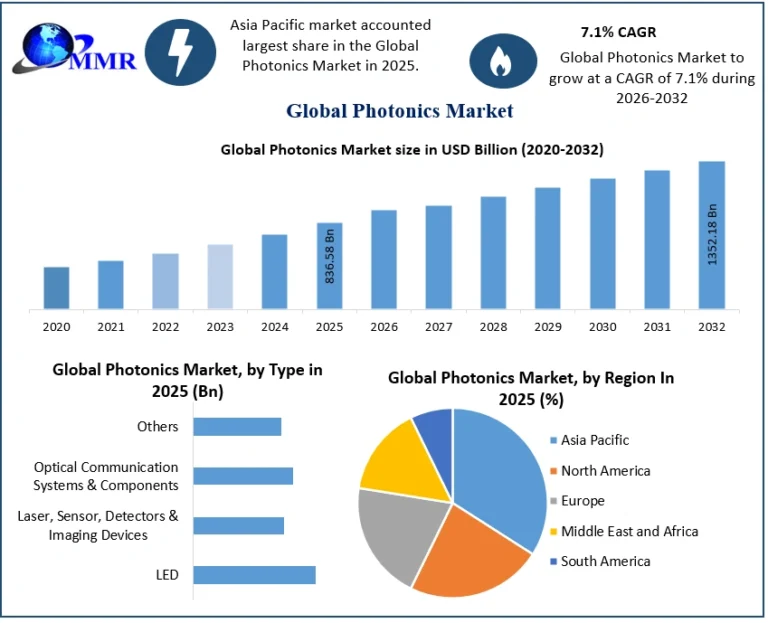
- Photonics Market size reached USD 836.58 Billion in 2025.
- Market expected to reach USD 1352.18 Billion by 2032.
- Forecast CAGR stands at 7.1% during 2026–2032.
- AI-driven computing infrastructure is increasing demand for high-speed optical technologies.
- Optical communication systems are becoming essential for data-intensive applications.
- Semiconductor manufacturers are investing heavily in silicon photonics capabilities.
- 5G deployment and edge computing expansion continue to support market growth.
- Photonic technologies are becoming increasingly important in healthcare, industrial automation, consumer electronics, and telecommunications.
Why This Matters Now
The race to build AI infrastructure is changing the economics of semiconductor and electronics manufacturing. Traditional electrical interconnects are reaching performance limits as data centers process increasingly larger AI workloads.
Photonics is emerging as a strategic technology that enables faster data transmission, lower latency, and improved energy efficiency. As AI training clusters, cloud infrastructure providers, and semiconductor manufacturers seek higher performance, photonic technologies are moving from niche applications to critical infrastructure components.
For electronics OEMs, foundries, component suppliers, and investors, the market’s growth trajectory signals a structural technology shift rather than a cyclical demand surge.
Market Overview
The Photonics Market Size was valued at USD 836.58 Billion in 2025 and is expected to reach USD 1352.18 Billion by 2032, expanding at a 7.1% CAGR during the forecast period.
Photonics focuses on the generation, transmission, manipulation, and detection of light. The technology supports applications ranging from optical communication and sensing to advanced manufacturing and consumer electronics.
What has changed is the scale of demand. Historically, photonics was largely associated with telecommunications and specialized industrial applications. Today, AI computing, hyperscale data centers, autonomous technologies, smart devices, and advanced healthcare systems are creating new demand centers.
The market is increasingly becoming a critical enabler of next-generation digital infrastructure.
Key Trends Driving Growth
AI computing is creating unprecedented demand for high-speed data movement. Optical communication technologies are becoming essential as AI workloads require faster connectivity between processors, memory, and storage systems.
The growth of cloud computing continues to support investment in optical networking infrastructure. Data center operators are increasingly exploring photonic solutions to reduce power consumption while improving bandwidth performance.
The semiconductor industry is also entering a new phase of photonics adoption. Silicon photonics is gaining attention because it allows optical functionality to be integrated with semiconductor manufacturing processes, creating opportunities for improved performance and scalability.
The global rollout of 5G networks is another major growth catalyst. Telecommunications providers require advanced optical infrastructure to support growing data traffic and low-latency applications.
Consumer electronics manufacturers are benefiting from advancements in imaging systems, sensors, display technologies, and optical components. As smart devices become more sophisticated, photonics is becoming a foundational technology across multiple product categories.
Industrial automation is also increasing demand. Manufacturers are adopting photonic solutions for precision measurement, quality control, machine vision, and automated production environments.
Download a Sample Report for Actionable Business Insights
Segment Insights
- Dominant Segment: Not specified in the report.
- Fastest-Growing Segment: Not specified in the report.
- Optical communication technologies continue to benefit from expanding network traffic and cloud infrastructure investment.
- Sensors and imaging applications are gaining importance across healthcare, industrial, automotive, and consumer electronics sectors.
- Laser technologies remain critical for advanced manufacturing, medical devices, and precision engineering applications.
- Photonic solutions are increasingly integrated into smart-device ecosystems and IoT-enabled environments.
Regional Growth Story
Asia-Pacific remains a major force in the photonics ecosystem due to its extensive electronics manufacturing capabilities, semiconductor production networks, and telecommunications infrastructure investments.
China continues expanding its advanced manufacturing base while pursuing greater technology self-sufficiency. Photonics technologies are increasingly important for communications infrastructure, industrial automation, and next-generation electronics.
Japan maintains strong capabilities in precision optics, sensors, and advanced materials. Long-standing expertise in photonic technologies supports continued innovation across industrial and consumer markets.
South Korea’s leadership in semiconductors, displays, and consumer electronics creates sustained demand for photonic components and systems.
The United States remains a global innovation center for AI computing, cloud infrastructure, semiconductor design, and optical networking. Growing investments in data-center infrastructure continue to create opportunities for advanced photonics suppliers.
Europe is strengthening its position through industrial automation, advanced manufacturing initiatives, and research-driven innovation. Germany’s manufacturing ecosystem remains particularly important for industrial photonics applications.
India is emerging as an increasingly attractive destination for electronics manufacturing and digital infrastructure investments, creating additional opportunities for photonics deployment.
Competitive Landscape
Competition in the photonics market is increasingly centered on technology leadership rather than component volume alone.
Companies investing in silicon photonics, photonic integrated circuits, optical networking platforms, and advanced sensing technologies are positioning themselves to benefit from the AI-driven transformation of digital infrastructure.
The strategic focus has shifted toward enabling higher computing efficiency. Organizations that can reduce data transmission bottlenecks while improving energy efficiency are likely to capture disproportionate value as AI workloads continue expanding.
Partnerships across semiconductor manufacturing, cloud infrastructure, telecommunications, and component ecosystems are becoming increasingly important. These collaborations help accelerate commercialization and reduce technology adoption barriers.
The competitive landscape also signals growing convergence between traditional semiconductor technologies and optical systems. Future leaders are expected to combine strengths in chip design, manufacturing scalability, and photonic integration.
Recent Developments
- AI infrastructure expansion is increasing demand for optical communication technologies.
- Semiconductor manufacturers are accelerating development of silicon photonics solutions.
- Data center operators are investing in higher-bandwidth optical networking architectures.
- 5G deployment continues to drive upgrades in optical communication infrastructure.
- Industrial automation initiatives are expanding the use of photonic sensing and measurement technologies.
- Advanced imaging and sensing applications are supporting growth across healthcare and smart-device markets.
Strategic Implications
The photonics industry is becoming a critical component of future semiconductor and electronics value chains.
For semiconductor manufacturers, photonics offers a pathway to overcome data-transfer limitations that increasingly constrain AI and high-performance computing systems.
For electronics OEMs, photonic technologies provide opportunities to enhance performance while improving energy efficiency. This combination is becoming increasingly important as sustainability and operational efficiency move higher on corporate agendas.
For investors, the market represents exposure to multiple structural growth themes simultaneously, including AI infrastructure, cloud computing, telecommunications modernization, advanced manufacturing, and smart-device adoption.
Supply-chain leaders should also recognize that photonics is evolving from a specialized technology segment into a foundational layer of digital infrastructure.
Future Outlook
The next decade will be defined by how effectively industries move, process, and manage data. Photonics is increasingly positioned at the center of that transition.
As AI systems become larger, data centers become denser, and digital infrastructure becomes more complex, optical technologies will play a growing role in enabling performance gains that traditional electronic architectures struggle to achieve.
The companies that successfully integrate photonics into semiconductor manufacturing, AI infrastructure, and next-generation computing platforms will shape the future of digital technology, while those that delay adoption risk falling behind in the race for computing efficiency and technology leadership.
Analyst Perspective
“Photonics is transitioning from a supporting technology to a strategic enabler of next-generation digital infrastructure. As AI computing, advanced communication networks, and smart electronics continue expanding, organizations that invest early in photonic innovation will be best positioned to capture long-term value across the technology ecosystem.” — Rucha Deshpande, Analyst
About Maximize Market Research
Maximize Market Research Pvt. Ltd. (MMR) is a global market research and consulting company that provides reliable, data-focused, and practical business insights. The firm serves a wide range of industries, including healthcare, pharmaceuticals, technology, automotive, electronics, chemicals, personal care, and consumer goods. Through market forecasts, competitive analysis, strategic consulting, and industry impact assessments, MMR helps organizations understand changing market conditions, identify growth opportunities, and make informed business decisions for long-term success.
Contact Us
2nd Floor, Navale IT Park Phase 3
Pune Banglore Highway, Narhe
Pune, Maharashtra 411041, India
+91 9607365656
sales@maximizemarketresearch.com
