Key Highlights
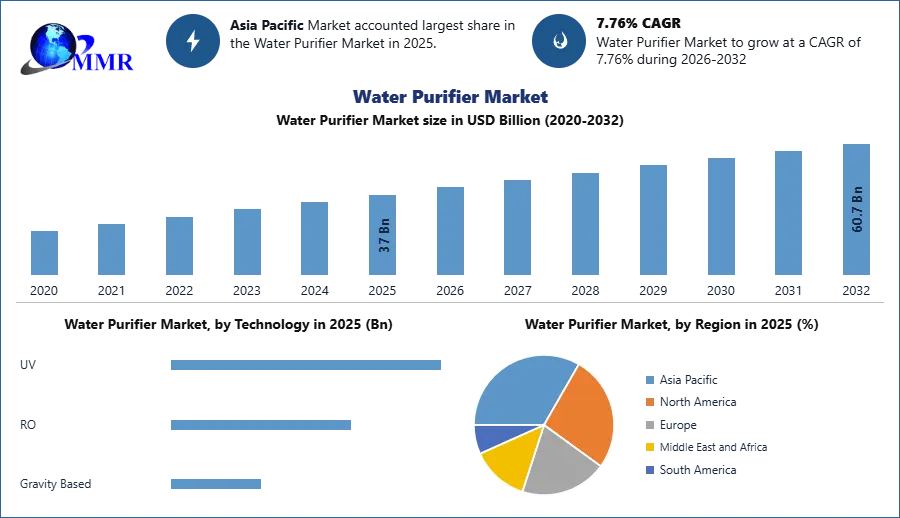
- Water Purifier Market size stood at USD 37 Billion in 2025. This scale confirms water purification as a mainstream consumer technology category rather than a niche appliance segment.
- The market is projected to reach nearly USD 60.7 Billion by 2032. The expansion signals accelerating demand for connected and intelligent water management solutions.
- CAGR is expected at 7.5% from 2026 to 2032, creating sustained opportunities for appliance manufacturers, electronics suppliers, sensor developers, and IoT platform providers.
- AI integration, cloud connectivity, and real-time monitoring are becoming central product differentiators.
- Government initiatives and tightening drinking-water quality standards continue to accelerate adoption worldwide.
Why This Matters Now
The next phase of consumer electronics growth is increasingly tied to health-focused connected devices. Water purifiers are evolving from filtration appliances into intelligent platforms capable of monitoring water quality, predicting maintenance cycles, and integrating with broader smart-home ecosystems.
For technology companies, the opportunity extends beyond filtration hardware. Sensors, embedded electronics, connectivity modules, cloud analytics, AI software, and digital service subscriptions are becoming part of the value chain. Companies that establish leadership in connected purification systems could secure recurring revenue streams while strengthening their position in the expanding smart-home market.
Market Overview
The Water Purifier Market is entering a technology-led growth cycle. Valued at USD 37 Billion in 2025, the industry is forecast to reach nearly USD 60.7 Billion by 2032. That trajectory indicates rising consumer willingness to invest in advanced purification technologies and digitally enabled health solutions.
What changed is the role of technology. Traditional purification systems focused primarily on contaminant removal. Today’s products increasingly incorporate AI-driven monitoring, IoT connectivity, predictive maintenance capabilities, and cloud-based performance management. These features transform water purification into a data-driven service category.
Why now? Consumers are demanding greater transparency around water quality while governments continue strengthening water-safety regulations. At the same time, smart-home adoption is creating an environment where connected appliances can deliver measurable value through automation and real-time insights.
Key Trends Driving Growth
Smart water purification has emerged as one of the market’s most significant developments. Connected devices now provide real-time water quality monitoring, automated filter-life tracking, and predictive maintenance alerts. These capabilities improve user experience while reducing operational inefficiencies.
AI integration is creating another competitive frontier. Intelligent purification systems can optimize filtration performance based on changing water conditions and usage patterns. This shift mirrors broader trends across consumer electronics, where AI increasingly serves as a product differentiation tool.
Advanced filtration technologies are also gaining momentum. Manufacturers are investing in systems capable of addressing emerging contaminants, including microplastics, pharmaceutical residues, and heavy metals. This technological evolution expands the addressable market while raising performance expectations across the industry.
Sustainability has become a strategic growth driver. Consumers are increasingly replacing single-use plastic bottles with purification systems, creating demand for environmentally responsible solutions that combine health benefits with waste reduction.
Government-led safe drinking water programs are further supporting adoption. Regulatory pressure creates long-term demand visibility for manufacturers and encourages continuous innovation across purification technologies.
Explore detailed analysis, insights, and growth opportunities
Segment Insights
Note: The supplied source does not provide detailed segment-share data. Unsupported segment rankings have been omitted in accordance with source restrictions.
- Dominant Segment: Not specified in the supplied source.
- Fastest-Growing Segment: Not specified in the supplied source.
- Smart water purifiers with AI and IoT capabilities are emerging as a major innovation category.
- Cloud-connected purification systems are gaining adoption for centralized monitoring and operational optimization.
- Advanced filtration technologies targeting emerging contaminants represent a significant product-development focus.
Regional Growth Story
The industry’s growth story is increasingly linked to national water-security priorities and digital infrastructure development. Programs aimed at improving access to safe drinking water are creating favorable conditions for technology adoption across major economies.
India’s Jal Jeevan Mission is cited as one of the policy initiatives influencing market expansion. The initiative demonstrates how public-sector investment can accelerate adoption of advanced purification technologies while creating opportunities for appliance manufacturers and technology providers.
The United States and European markets continue to benefit from stringent drinking-water standards. Regulatory oversight raises product-performance requirements and encourages innovation in monitoring, filtration, and connectivity solutions.
For electronics manufacturers, these regional dynamics create demand not only for purification hardware but also for sensors, software platforms, connectivity technologies, and digital service ecosystems.
Competitive Landscape
Competition is shifting from hardware performance toward technology ecosystems. Manufacturers that combine filtration expertise with AI capabilities, cloud connectivity, and smart-home integration are establishing stronger competitive positions.
The emergence of intelligent purification systems signals a broader convergence between consumer appliances and digital technology. Product leadership increasingly depends on software functionality, data analytics, and user experience rather than filtration performance alone.
This transition has implications for pricing power. Companies capable of delivering predictive maintenance, remote monitoring, and personalized water-quality insights may command premium pricing while generating recurring digital-service revenue streams.
The competitive landscape also indicates growing collaboration opportunities between appliance manufacturers, IoT platform providers, semiconductor suppliers, and cloud-service operators. These partnerships will likely shape the next generation of connected water-management solutions.
Recent Developments
- Growing deployment of AI-enabled smart water purifiers with automated purification adjustments.
- Expansion of cloud-connected purification platforms supporting remote monitoring capabilities.
- Increased adoption of advanced filtration technologies targeting microplastics and emerging contaminants.
- Rising focus on eco-friendly purification systems as alternatives to bottled water consumption.
- Continued support from government drinking-water quality initiatives and regulatory programs.
Strategic Implications
For semiconductor and electronics companies, the Water Purifier Market illustrates how traditionally mechanical products are becoming connected digital devices. Every smart purifier requires sensors, processing capability, connectivity modules, software intelligence, and data-management infrastructure.
OEMs that integrate purification systems into broader smart-home ecosystems gain access to valuable consumer data and recurring service opportunities. Technology providers supplying AI algorithms, embedded systems, and cloud platforms stand to benefit from increasing digitalization across the appliance sector.
Investors should monitor the intersection of health technology, sustainability, and connected devices. These themes are converging to create a more sophisticated and higher-value water purification industry.
Future Outlook
The next competitive battleground will not be filtration alone. It will be the ability to combine AI, IoT connectivity, predictive analytics, sustainability, and real-time water intelligence into a unified consumer platform. Companies that build data-driven purification ecosystems will define the future of the industry, while those that remain focused solely on hardware risk losing relevance as intelligent water infrastructure becomes the new standard.
Analyst Perspective
“The Water Purifier Market is transitioning from a filtration-centric industry to a connected technology ecosystem. AI-enabled monitoring, cloud integration, and advanced purification capabilities are creating new growth avenues while redefining consumer expectations around health, convenience, and sustainability.” — Rucha Deshpande, Analyst
About Maximize Market Research
Maximize Market Research Pvt. Ltd. (MMR) is a global market research and consulting company that provides reliable, data-focused, and practical business insights. The firm serves a wide range of industries, including healthcare, pharmaceuticals, technology, automotive, electronics, chemicals, personal care, and consumer goods. Through market forecasts, competitive analysis, strategic consulting, and industry impact assessments, MMR helps organizations understand changing market conditions, identify growth opportunities, and make informed business decisions for long-term success.
Contact Us :
2nd Floor, Navale IT Park Phase 3
Pune Banglore Highway, Narhe
Pune, Maharashtra 411041, India
+91 9607365656
sales@maximizemarketresearch.com
