Key Highlights
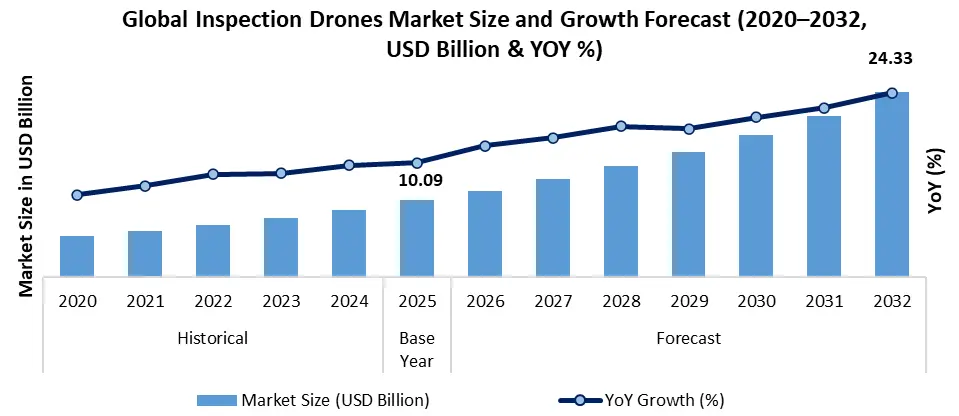
- The Inspection Drones Market was valued at USD 10.09 Billion in 2025.
- The market is expected to reach USD 24.33 Billion by 2032.
- The market is projected to grow at a 13.40% CAGR during 2026–2032.
- North America remains the leading regional market.
- Asia Pacific is the fastest-growing region.
- AI-powered drone inspection solutions are emerging as the primary technology driver.
- Industrial asset monitoring, predictive maintenance, and autonomous inspections are accelerating adoption.
- Cloud-based inspection platforms and Drone-as-a-Service (DaaS) models are expanding enterprise deployment.
Why This Matters Now
Industrial operators are facing mounting pressure to inspect larger infrastructure networks while reducing operational risks and costs. Traditional inspection methods are increasingly unable to meet the demands of modern energy systems, transportation corridors, utilities, and industrial facilities.
Inspection drones have moved from pilot projects to mission-critical infrastructure tools. The combination of artificial intelligence, autonomous navigation, thermal imaging, LiDAR, edge computing, and cloud analytics is transforming drones into real-time industrial intelligence platforms. Organizations that deploy these technologies gain faster asset visibility, lower downtime, and improved safety outcomes.
Market Overview
The Inspection Drones Market Size is entering a new phase of industrial adoption. According to Maximize Market Research, the market was valued at USD 10.09 Billion in 2025 and is projected to reach USD 24.33 Billion by 2032, growing at a 13.40% CAGR.
The growth story is closely linked to digital transformation across infrastructure-intensive industries. Utilities, oil and gas companies, renewable energy operators, transportation agencies, and industrial manufacturers increasingly rely on drone-generated data to support predictive maintenance strategies.
What changed is the maturity of inspection technology. Modern drones no longer simply capture images. They collect thermal data, create digital twins, generate 3D models, and support AI-driven anomaly detection. This transition converts inspections from periodic activities into continuous intelligence operations.
The result is a measurable shift in how organizations manage assets, reduce operational risks, and allocate maintenance budgets.
Key Trends Driving Growth
Artificial intelligence is becoming central to inspection workflows. AI-powered drone inspection solutions help identify defects, corrosion, structural weaknesses, and equipment anomalies with greater speed and accuracy than manual inspections.
Autonomous drone inspection systems represent another major shift. Advanced navigation technologies, obstacle avoidance systems, and automated flight planning allow drones to inspect hazardous and hard-to-access locations with minimal human intervention.
Cloud-based inspection platforms are also changing enterprise adoption patterns. Organizations can now centralize inspection data, perform analytics remotely, and integrate findings into broader asset management systems.
Digital twin integration is gaining momentum as enterprises seek real-time representations of physical infrastructure. Drone-generated data feeds these digital environments, enabling predictive maintenance and operational optimization.
The expansion of Drone-as-a-Service models further lowers adoption barriers by reducing capital expenditure requirements and allowing organizations to scale inspection programs more efficiently.
Get a Sample Report Featuring Industry Growth and Revenue Forecasts
Segment Insights
- Dominant Segment: Mainframe component segment led the market in 2025, highlighting the importance of industrial-grade drone platforms capable of supporting advanced sensors and extended operational performance.
- Fastest-Growing Segment: Asia Pacific emerged as the fastest-growing regional segment, supported by expanding infrastructure projects, industrial modernization, and increased UAV deployment.
- Fixed-wing drones continue to support long-distance inspection requirements across pipelines, utilities, and large infrastructure networks.
- Rotary-wing (multirotor) drones remain widely used for detailed inspections requiring hovering capability and maneuverability.
- Oil and gas pipeline inspection remains a major application area due to the need for continuous monitoring of extensive assets.
- Solar panel, power line, and windmill inspections are benefiting from growing investments in renewable energy infrastructure.
- Critical infrastructure inspections are expanding as governments and operators prioritize asset resilience and public safety.
Regional Growth Story
North America maintains its leadership position in the Inspection Drones Market. The region benefits from strong industrial automation adoption, advanced drone technology ecosystems, and extensive infrastructure inspection requirements.
The region’s leadership reflects a broader shift toward predictive maintenance and digital asset management. Utilities, energy companies, and infrastructure operators increasingly view drone inspections as operational necessities rather than optional technologies.
Asia Pacific is recording the fastest growth. Rapid industrialization, infrastructure expansion, renewable energy deployment, and smart city initiatives are creating substantial demand for inspection drones.
The region’s growth trajectory indicates that future market expansion will be strongly linked to infrastructure development and industrial modernization programs.
Europe continues to invest in infrastructure maintenance, renewable energy assets, and industrial digitization, supporting steady demand for drone-based inspection technologies.
Competitive Landscape
Competition is shifting from hardware capabilities alone toward integrated inspection ecosystems.
Technology providers are increasingly combining drones, AI analytics, cloud platforms, thermal imaging, LiDAR capabilities, and autonomous operations into unified solutions. This signals a market transition from equipment sales to intelligence-driven service models.
Companies investing in autonomous inspection capabilities are positioning themselves for long-term leadership. Autonomous operations reduce labor requirements, increase inspection frequency, and improve scalability.
The growing emphasis on cloud-based platforms indicates that data ownership and analytics capabilities may become more valuable than hardware differentiation alone.
Similarly, digital twin integration points toward a future where inspection drones function as data acquisition layers within broader industrial intelligence networks.
The companies that successfully combine autonomous flight, AI analytics, predictive maintenance, and enterprise software integration are likely to define the next phase of market leadership.
Recent Developments
- Growing deployment of AI-powered drone inspection solutions across industrial sectors.
- Increased adoption of thermal imaging and LiDAR-enabled inspection systems.
- Expansion of autonomous drone inspection technologies.
- Rising implementation of cloud-based inspection platforms.
- Stronger integration of digital twin technologies with drone-generated data.
- Expansion of Drone-as-a-Service business models.
- Increased use of UAV inspection services across utilities, infrastructure, and energy sectors.
Strategic Implications
For industrial operators, inspection drones are becoming strategic infrastructure assets rather than standalone technologies.
The business case extends beyond inspection efficiency. Organizations gain improved asset visibility, faster maintenance decisions, lower safety risks, and enhanced operational resilience.
For technology providers, value creation is increasingly tied to software, analytics, and data services. Hardware remains essential, but competitive differentiation is moving toward AI-driven insights and integrated asset management capabilities.
For investors, the market represents a convergence of automation, AI, industrial IoT, cloud computing, and infrastructure modernization. These overlapping trends create long-term demand drivers that extend beyond the drone industry itself.
Future Outlook
The Inspection Drones Market is evolving into a core component of industrial digital transformation. As AI-powered analytics, autonomous operations, digital twins, and cloud-based inspection ecosystems become standard, drone inspections will increasingly serve as the foundation of predictive maintenance strategies across critical infrastructure sectors.
The next generation of market leaders will be those that transform drone data into real-time industrial intelligence, while laggards remain trapped in manual inspection models that cannot compete with autonomous, AI-driven infrastructure management.
Analyst Perspective
“Inspection drones are rapidly becoming the operational intelligence layer for modern infrastructure. Organizations are moving beyond visual inspections toward autonomous, AI-powered monitoring systems that deliver actionable insights in real time. The market’s next phase will be defined by analytics, automation, and scalable digital inspection ecosystems.” — Rucha Deshpande, Analyst
About Maximize Market Research
Maximize Market Research Pvt. Ltd. (MMR) is a global market research and consulting company that provides reliable, data-focused, and practical business insights. The firm serves a wide range of industries, including healthcare, pharmaceuticals, technology, automotive, electronics, chemicals, personal care, and consumer goods. Through market forecasts, competitive analysis, strategic consulting, and industry impact assessments, MMR helps organizations understand changing market conditions, identify growth opportunities, and make informed business decisions for long-term success.
Contact Us
2nd Floor, Navale IT Park Phase 3
Pune Banglore Highway, Narhe
Pune, Maharashtra 411041, India
+91 9607365656
sales@maximizemarketresearch.com
