Why This Matters Now
The race to control the next generation of wearable computing is moving beyond smartwatches. As artificial intelligence becomes embedded in personal health monitoring and edge computing devices, smart rings are emerging as one of the most efficient form factors for continuous biometric intelligence.
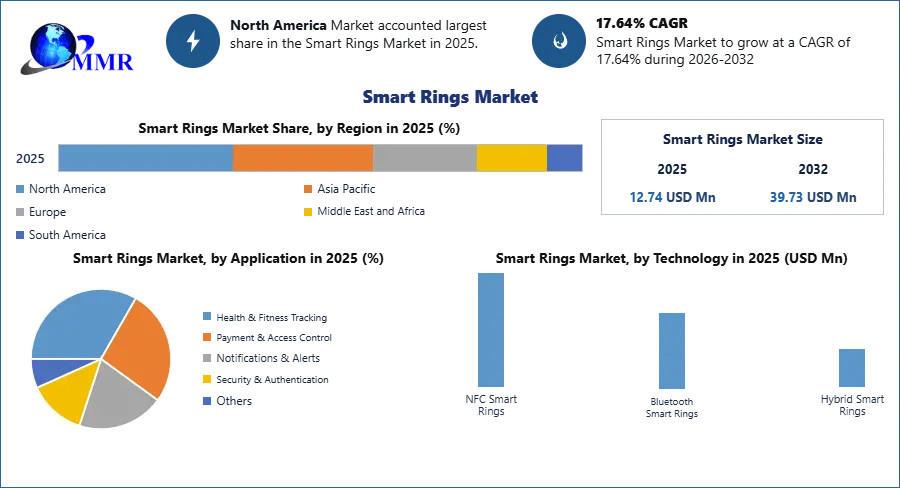
The Smart Rings Market was valued at USD 12.74 Million in 2025 and is expected to reach nearly USD 39.73 Million by 2032, growing at a CAGR of 17.64%. For semiconductor suppliers, sensor manufacturers, electronics OEMs, and wearable technology investors, that growth signals increasing demand for miniaturized chips, ultra-low-power processors, advanced sensors, and compact wireless connectivity solutions.
Market Overview
Smart rings Market have evolved from niche accessories into sophisticated wearable computing platforms. They combine health monitoring, payment functionality, authentication capabilities, notifications, and connectivity within a compact device worn continuously throughout the day.
What changed is the convergence of consumer health awareness, AI-driven analytics, and advances in sensor miniaturization. Consumers increasingly want continuous health insights without the bulk of smartwatches. Smart rings address that demand while creating new opportunities for biometric authentication, digital identity, and contactless commerce.
For electronics manufacturers, smart rings represent a high-value segment where design efficiency, battery optimization, sensor accuracy, and software ecosystems determine competitive advantage.
Key Trends Driving Growth
AI-powered health monitoring has become the primary growth catalyst. Modern smart rings continuously collect biometric signals including heart rate, body temperature, sleep patterns, and activity data, creating a foundation for predictive health analytics. This trend increases demand for advanced sensor integration and low-power processing architectures.
Contactless ecosystems are expanding the market beyond wellness applications. Smart rings increasingly support payments, authentication, access control, and digital identity functions. This transition creates opportunities for NFC component suppliers, secure element manufacturers, and cybersecurity technology providers.
Miniaturization remains a critical innovation area. Advances in battery efficiency, wireless connectivity, and sensor integration are enabling more functionality within smaller devices. These developments increase demand for advanced semiconductor packaging and highly integrated system architectures.
The broader IoT ecosystem is also supporting adoption. Smart rings increasingly interact with smartphones, connected homes, digital wallets, and enterprise access systems, expanding their relevance across consumer and commercial markets.
Explore detailed analysis, insights, and growth opportunities
Segment Insights
- Dominant Segment: Health & Fitness Tracking
Health and fitness tracking remains the leading application segment. Rising consumer demand for sleep monitoring, wellness analytics, heart-rate measurement, and continuous health tracking is driving adoption. This positions biometric sensors and AI-enabled analytics platforms as core value creators within the wearable technology supply chain.
- Fastest-Growing Segment: Payment & Access Control
Contactless payments and secure access capabilities are emerging as major growth opportunities. As consumers increasingly embrace cashless transactions and digital identity systems, smart rings are evolving into multifunctional authentication devices. This trend expands opportunities for NFC technologies, secure chipsets, and digital credential ecosystems.
- Technology Segment
The market includes NFC smart rings, Bluetooth smart rings, and hybrid smart rings. Hybrid designs are becoming strategically important because they combine connectivity, sensing, and authentication capabilities within a single device architecture.
- Distribution Channel
Online distribution continues to accelerate market accessibility and global reach, allowing emerging brands to scale rapidly without traditional retail infrastructure.
Regional Growth Story
North America remains a major center of demand, supported by strong consumer spending on wearable technologies, advanced digital health adoption, and mature technology ecosystems. The region’s leadership attracts investment into sensor technologies, software platforms, and wearable innovation.
Asia-Pacific is becoming increasingly important from both manufacturing and market perspectives. China, South Korea, Japan, Taiwan, and India possess extensive electronics manufacturing capabilities, semiconductor ecosystems, and growing consumer demand for connected devices. These advantages strengthen the region’s role in wearable production and component sourcing.
Europe contributes through digital health innovation and premium wearable adoption. Companies such as Oura have demonstrated how software-driven health ecosystems can create recurring revenue streams and strong brand differentiation.
The broader regional story reflects a strategic shift toward supply-chain resilience, localized manufacturing, and technology sovereignty across consumer electronics sectors.
Competitive Landscape
Competition is increasingly centered on ecosystem control rather than hardware alone.
Key companies include Oura Health, Samsung Electronics, Ultrahuman Healthcare, RingConn, Zepp Health Corporation, Boat, and Noise.
Oura’s expansion demonstrates how smart ring vendors are evolving into health-data platforms rather than device manufacturers. Its growing subscriber base highlights the industry’s shift toward recurring software and analytics revenue.
Samsung’s participation signals increasing interest from global consumer electronics leaders. As major OEMs enter the segment, competition will intensify around sensor accuracy, AI capabilities, ecosystem integration, and manufacturing scale.
The next competitive phase is likely to be defined by biometric intelligence, digital identity functionality, and seamless integration across connected-device ecosystems. Companies that control both hardware and health-data platforms will possess stronger pricing power and customer retention.
Recent Developments
- Oura introduced its fifth-generation smart ring with enhanced health-monitoring capabilities and a smaller form factor, highlighting ongoing advances in device miniaturization.
- Smart ring vendors are increasingly pursuing digital identity, payment, and authentication applications beyond health monitoring.
- Research activity continues to expand around multimodal sensing, gesture recognition, and advanced wearable interaction technologies.
- Industry investment is increasingly focused on AI-enabled analytics and subscription-based health intelligence platforms.
Strategic Implications
For semiconductor companies, smart rings represent a high-value opportunity in sensor integration, wireless connectivity, low-power computing, and secure authentication technologies.
For electronics manufacturing services providers, rising demand creates opportunities in precision assembly, miniaturized component integration, and advanced manufacturing processes.
For investors, the market demonstrates how hardware increasingly serves as the gateway to recurring software, analytics, and subscription revenue models. Companies capable of building scalable health-data ecosystems may capture significantly greater value than hardware-only competitors.
For OEMs, success will depend on balancing device aesthetics, battery life, AI-driven insights, privacy protection, and interoperability across broader consumer technology ecosystems.
Future Outlook
The next phase of growth will be defined by the convergence of wearable computing, AI-driven health intelligence, digital identity, and contactless commerce. As smart rings evolve from accessories into always-on computing platforms, competitive advantage will increasingly depend on sensor innovation, software ecosystems, and semiconductor integration capabilities. The companies that transform biometric data into actionable intelligence will define the next generation of wearable technology leadership, while hardware-centric competitors risk becoming interchangeable suppliers.
Analyst Perspective
“Smart rings are transitioning from wearable accessories to intelligent personal computing platforms. The combination of health monitoring, biometric authentication, and AI-powered analytics is creating a new category of connected devices with significant implications for consumer electronics, digital health, and semiconductor innovation.” — Rucha Deshpande
About Maximize Market Research
Maximize Market Research Pvt. Ltd. (MMR) is a global market research and consulting company that provides reliable, data-focused, and practical business insights. The firm serves a wide range of industries, including healthcare, pharmaceuticals, technology, automotive, electronics, chemicals, personal care, and consumer goods. Through market forecasts, competitive analysis, strategic consulting, and industry impact assessments, MMR helps organizations understand changing market conditions, identify growth opportunities, and make informed business decisions for long-term success.
Contact Us :
2nd Floor, Navale IT Park Phase 3
Pune Banglore Highway, Narhe
Pune, Maharashtra 411041, India
+91 9607365656
sales@maximizemarketresearch.com
