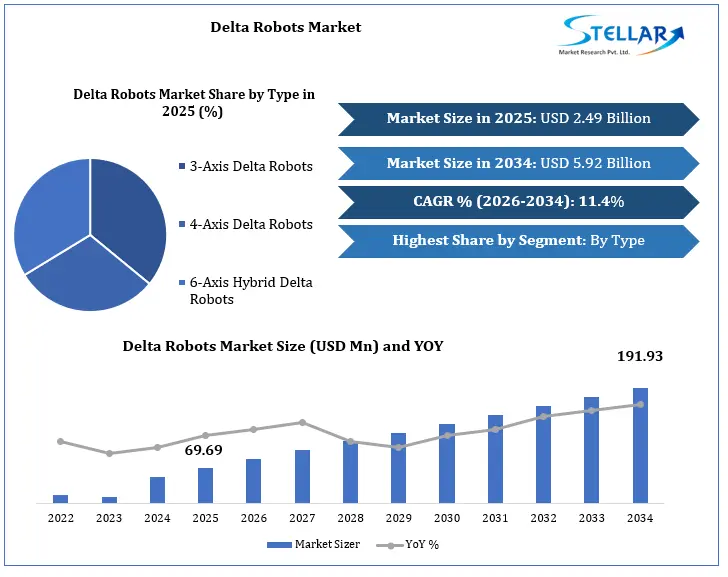
PUNE, India, June 25, 2026 – The Delta Robots Market is entering a new growth phase as manufacturers across food processing, electronics, pharmaceuticals, and e-commerce logistics increasingly adopt high-speed robotic automation to improve productivity, accuracy, and operational flexibility. According to the latest Delta Robots Market Report published by Stellar Market Research, the market was valued at USD 2.49 billion in 2025 and is expected to reach USD 5.92 billion by 2034, registering a CAGR of 12.4% during the forecast period.
The report highlights that the convergence of artificial intelligence, machine vision, predictive maintenance, and smart manufacturing initiatives is transforming delta robots from specialized pick-and-place systems into strategic assets for modern industrial operations.
Market Opportunity Overview
Global manufacturers are under increasing pressure to reduce labor dependency, improve throughput, and maintain consistent product quality. Delta robots, known for their lightweight parallel-arm architecture and ultra-fast motion capabilities, are emerging as a preferred automation solution for high-volume production environments.
The market’s growth is being fueled by rising investments in automated packaging lines, semiconductor manufacturing, pharmaceutical production, and warehouse fulfillment centers. As supply chains become more complex and labor shortages continue across key industrial economies, companies are prioritizing robotic systems capable of delivering precision, speed, and scalability.
The shift toward localized manufacturing and smart factories is further strengthening demand. Modern delta robots integrated with AI-driven vision systems can identify, sort, inspect, and package products in real time, creating significant productivity gains while minimizing operational costs.
Download Free PDF Brochure: https://www.stellarmr.com/report/req_sample/delta-robots-market/2953
Key Findings from the Report
- The global Delta Robots Market is projected to grow from USD 2.49 billion in 2025 to USD 5.92 billion by 2034.
- The market is expected to register a 12.4% CAGR during the forecast period.
- Pick-and-place applications continue to represent the largest revenue-generating segment due to widespread adoption in packaging and assembly operations.
- The food & beverage industry remains a dominant end-user segment, supported by increasing automation of packaging and sorting processes.
- Pharmaceutical and medical device manufacturing is emerging as one of the fastest-growing application areas due to stringent hygiene and precision requirements.
- Asia-Pacific maintains leadership in deployment, driven by manufacturing expansion in China, Japan, South Korea, and India.
- AI-powered machine vision, predictive maintenance, and smart factory integration are increasing investment attractiveness across industrial sectors.
Market Drivers and Restraints
Key Drivers
Industrial Automation Expansion
Manufacturers continue to automate production lines to improve productivity, reduce operational costs, and address workforce shortages.
Growth of Smart Manufacturing
Industry 4.0 initiatives are accelerating demand for robotic systems that integrate seamlessly with digital production ecosystems and industrial IoT networks.
Increasing Demand for High-Speed Packaging
E-commerce growth and rising consumer goods production are creating strong demand for rapid sorting, packaging, and fulfillment solutions.
Key Restraints
High Initial Investment Costs
Small and medium-sized enterprises often face challenges related to capital expenditure and integration costs associated with advanced robotic systems.
Technical Complexity and Skill Gaps
Deployment, programming, and maintenance of sophisticated robotic platforms require specialized expertise, limiting adoption in some emerging markets.
Technology, Regulation, and Sustainability Trends
The delta robot industry is increasingly influenced by advances in artificial intelligence, machine learning, machine vision, and cloud-connected automation platforms. Manufacturers are embedding predictive maintenance capabilities that reduce downtime and improve equipment utilization.
Government-backed smart manufacturing programs in major industrial economies are encouraging automation investments through incentives and digital transformation initiatives. Regulatory requirements in pharmaceuticals, food processing, and electronics manufacturing are also promoting adoption of robotic systems capable of delivering traceability, precision, and compliance.
From a sustainability perspective, modern delta robots help reduce material waste, improve energy efficiency, optimize production cycles, and support resource-efficient manufacturing practices. These advantages align with corporate ESG goals and global decarbonization strategies.
Regional Insights
Asia-Pacific Leads Global Growth
Asia-Pacific remains the largest market for delta robots due to extensive manufacturing activity and aggressive automation investments. China continues to dominate industrial robotics deployment, while Japan and South Korea maintain leadership in advanced automation technologies. India is emerging as a significant growth market supported by manufacturing modernization and government-led industrial development programs.
North America Strengthens Automation Investments
The United States and Canada are witnessing increased adoption of robotic systems in food processing, logistics, pharmaceuticals, and electronics manufacturing. Labor shortages and reshoring strategies are accelerating capital investment in automation.
Europe Expands Smart Factory Initiatives
Germany, France, Italy, and the Nordic countries continue investing in intelligent manufacturing systems, creating strong demand for high-speed robotic solutions integrated with AI and industrial IoT platforms.
Recent Industry Developments
ABB (2025): Introduced three new robot families for China’s growing mid-market automation segment, targeting electronics, food processing, and packaging applications, expanding accessibility of robotic automation.
ABB Robotics (2025): Expanded production capabilities at its Shanghai robotics facility to support rising demand from Asian manufacturing customers.
SoftBank Group (2025): Announced acquisition of ABB’s robotics business for approximately USD 5.4 billion, highlighting growing investor confidence in AI-enabled industrial robotics.
Industrial Robotics Manufacturers (2025): Increased integration of AI-based programming and machine vision systems, enabling faster deployment and improved operational flexibility.
Automation Solution Providers (2025–2026): Expanded deployment of predictive maintenance and cloud-connected robotics platforms to improve manufacturing efficiency and reduce downtime.
Competitive Landscape
The Delta Robots Market remains highly competitive, with leading manufacturers focusing on product innovation, AI integration, software-driven automation, and strategic partnerships. Key participants include ABB Ltd., FANUC Corporation, Yaskawa Electric Corporation, KUKA AG, Omron Corporation, DENSO Corporation, and Mitsubishi Electric Corporation.
Companies are increasingly investing in AI-enabled robotics, advanced vision systems, modular architectures, and industry-specific automation solutions to strengthen market positioning and address evolving customer requirements.
Download Free PDF Brochure: https://www.stellarmr.com/report/req_sample/delta-robots-market/2953
Analyst Commentary
“The next stage of growth in the delta robots market will be driven by intelligent automation rather than mechanical speed alone. Companies that combine robotics with AI, machine vision, and predictive analytics will create significant competitive advantages in manufacturing efficiency, quality control, and operational resilience,” said a Senior Research Analyst at Stellar Market Research.
Future Outlook
Through 2034, demand for delta robots is expected to accelerate as industries pursue digital transformation, smart manufacturing, and resilient supply chain strategies. Advances in AI, edge computing, machine vision, and collaborative robotics will broaden application areas beyond traditional packaging and assembly operations.
Investment activity is expected to remain strong as manufacturers seek productivity gains, workforce optimization, and sustainability improvements. Companies capable of delivering flexible, software-driven, and energy-efficient robotic platforms are likely to capture a larger share of future market growth.
About Stellar Market Research
Stellar Market Research is a global market research and business consulting firm delivering strategic intelligence across industries including manufacturing, technology, healthcare, chemicals, consumer goods, energy, and industrial automation. The company provides comprehensive market sizing, competitive benchmarking, trend analysis, forecasting, and advisory services that support business decision-making and investment planning. Through a combination of primary research, data analytics, and industry expertise, Stellar Market Research helps organizations identify growth opportunities, assess market risks, and develop sustainable competitive strategies. Its research solutions are trusted by corporations, investors, policymakers, and industry stakeholders worldwide for actionable market insights and long-term strategic planning.
Media Contact
Stellar Market Research
Website: Stellar Market Research – Global Research Reports & Consulting
Email: sales@stellarmr.com
