Key Highlights
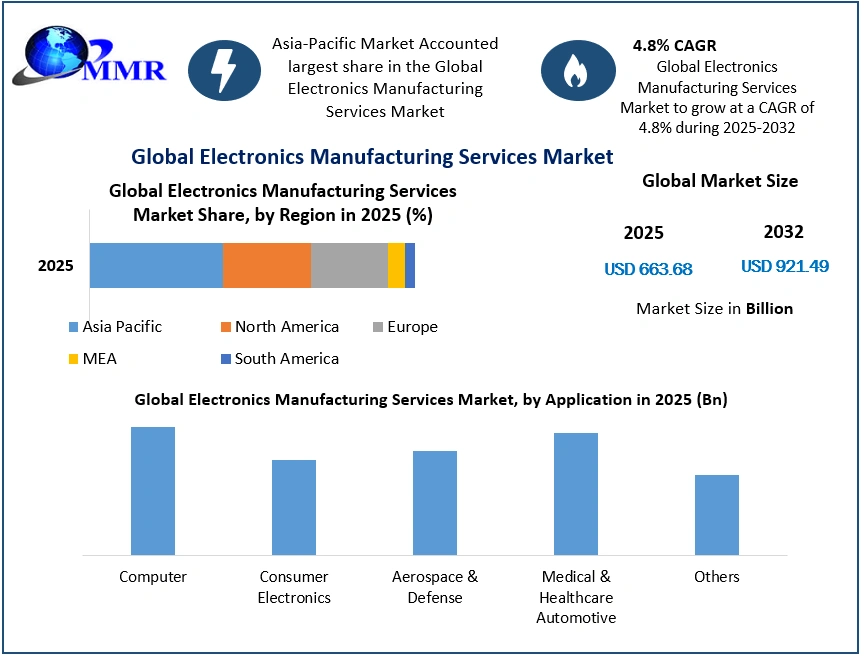
- Electronics Manufacturing Services Market valued at USD 663.68 Billion in 2025.
- Market expected to reach USD 921.49 Billion by 2032.
- CAGR projected at 4.8% from 2026 to 2032.
- AI-enabled devices are increasing electronics production complexity and outsourcing demand.
- OEMs are accelerating contract manufacturing strategies to improve flexibility and capital efficiency.
- Supply-chain diversification remains a top priority across electronics ecosystems.
- Automation, digital manufacturing, and Industry 4.0 technologies are reshaping EMS operations.
- Semiconductor availability continues to influence production planning and manufacturing investments.
Why This Matters Now
Artificial intelligence is moving from cloud infrastructure into consumer devices, industrial equipment, automotive platforms, healthcare systems, and edge computing hardware. That shift is forcing electronics manufacturers to rethink production capacity, component sourcing, and product assembly strategies.
The Electronics Manufacturing Services Market is becoming a strategic enabler of this transformation. Valued at USD 663.68 Billion in 2025 and expected to reach USD 921.49 Billion by 2032 at a CAGR of 4.8%, the sector is no longer simply a cost-reduction mechanism for OEMs. It has become a critical pillar supporting AI adoption, connected-device expansion, supply-chain resilience, and global technology competitiveness.
As semiconductor demand grows and product lifecycles shorten, EMS providers are increasingly positioned at the center of technology commercialization.
Market Overview
The electronics industry is undergoing one of its largest structural shifts in decades. Manufacturers are balancing rising demand for advanced electronics with growing pressure to reduce costs, improve supply-chain resilience, and accelerate product launches.
Global OEMs increasingly rely on Electronics Manufacturing Services providers to manage complex production environments. Outsourcing allows companies to focus on product design, software development, ecosystem expansion, and customer experience while leveraging specialized manufacturing expertise.
The market’s projected growth to USD 921.49 Billion by 2032 signals continued confidence in outsourced manufacturing models. The implication is clear: companies are prioritizing scalability and operational flexibility over asset-heavy manufacturing ownership.
The transition is especially visible in sectors such as consumer electronics, telecommunications equipment, industrial automation, automotive electronics, healthcare devices, and smart infrastructure systems.
Key Trends Driving Growth
Artificial intelligence is rapidly increasing electronics content across industries. AI-enabled devices require more sophisticated processing capabilities, advanced components, and highly integrated manufacturing processes. EMS providers capable of handling these requirements are gaining strategic importance within global technology ecosystems.
Industrial IoT deployment continues to expand across manufacturing, logistics, healthcare, and smart-city environments. Every connected device adds demand for sensors, communication modules, printed circuit boards, and electronic assemblies. This creates sustained production opportunities for contract manufacturers.
Smart manufacturing initiatives are transforming factory operations. Automation, robotics, machine vision, digital twins, predictive maintenance, and real-time analytics are helping EMS companies improve productivity while addressing labor shortages and quality requirements.
Supply-chain diversification remains another major growth catalyst. Recent disruptions exposed vulnerabilities in concentrated manufacturing networks. Electronics companies are now pursuing geographically diversified production strategies, creating opportunities for manufacturing hubs across Asia-Pacific, North America, and Europe.
Sustainability is also becoming a competitive differentiator. OEM customers increasingly evaluate manufacturing partners based on energy efficiency, waste reduction programs, responsible sourcing practices, and environmental compliance capabilities.
The result is a market where manufacturing excellence is measured not only by cost and volume but also by resilience, sustainability, and technological sophistication.
𝐃𝐨𝐰𝐧𝐥𝐨𝐚𝐝 𝐏𝐃𝐅 𝐁𝐫𝐨𝐜𝐡𝐮𝐫𝐞 @https://www.maximizemarketresearch.com/request-sample/112137/
Segment Insights
- Dominant Segment: The report identifies the leading segment based on its market share contribution, highlighting the continued importance of large-scale electronics production and established manufacturing demand.
- Fastest-Growing Segment: The report identifies the fastest-growing segment driven by evolving technology adoption, increasing electronics integration, and expanding digital ecosystems.
- Consumer electronics continue to generate substantial manufacturing demand as smart devices become more powerful and interconnected.
- Industrial electronics are benefiting from automation investments and Industry 4.0 deployment across manufacturing sectors.
- Telecommunications equipment production is expanding alongside network modernization and advanced connectivity requirements.
- Automotive electronics are becoming increasingly important as vehicles incorporate advanced computing, connectivity, sensing, and control systems.
- Healthcare electronics are creating new opportunities through connected medical devices, monitoring systems, and digital healthcare infrastructure.
Regional Growth Story
Asia-Pacific remains the center of global electronics manufacturing activity. The region’s extensive supplier ecosystems, established production infrastructure, and manufacturing expertise continue to attract investments from leading technology companies.
China remains a critical manufacturing hub due to its scale, component availability, and integrated supply chains. At the same time, diversification efforts are encouraging additional production investments across other Asian economies.
India is emerging as a strategically important electronics manufacturing destination. Government initiatives supporting domestic production, supply-chain localization, and technology investment are attracting global manufacturers seeking alternative production bases.
Taiwan and South Korea continue to play vital roles within the broader electronics ecosystem due to their advanced semiconductor capabilities and technology leadership.
The United States is strengthening domestic manufacturing through industrial policy initiatives focused on supply-chain security, semiconductor competitiveness, and advanced technology development.
Germany and Japan remain important centers for industrial electronics, automation technologies, precision manufacturing, and engineering-intensive production.
The regional story is increasingly defined by resilience rather than cost alone. Governments and corporations alike are investing in manufacturing capacity that reduces dependency risks while strengthening technology sovereignty.
Competitive Landscape
Competition within the Electronics Manufacturing Services Market is shifting beyond traditional scale advantages.
Leading EMS providers are investing in automation, digital manufacturing platforms, engineering services, and supply-chain intelligence capabilities. These investments signal a transition from contract assembly providers to strategic technology partners.
Manufacturers that can support advanced electronics production, rapid product introductions, and highly customized manufacturing requirements are strengthening their competitive positioning. This trend is particularly relevant as AI-enabled devices introduce new design complexities and production challenges.
Strategic partnerships between EMS providers, semiconductor companies, component suppliers, and OEMs are becoming increasingly important. Such collaborations help accelerate product development cycles, improve component availability, and reduce supply-chain risks.
The competitive landscape also reflects growing emphasis on sustainability. Companies that demonstrate efficient resource utilization and environmental compliance are gaining advantages in customer acquisition and long-term contract opportunities.
Technology leadership increasingly depends on manufacturing agility. Providers capable of adapting quickly to changing demand patterns, component constraints, and emerging product categories are likely to capture disproportionate market share.
Recent Developments
- Increased adoption of smart factory technologies across electronics manufacturing operations.
- Expansion of automation and robotics deployment to improve production efficiency.
- Growing OEM focus on outsourcing complex electronics manufacturing activities.
- Rising investment in digital supply-chain visibility and risk-management capabilities.
- Enhanced sustainability initiatives focused on energy efficiency and waste reduction.
- Broader integration of Industry 4.0 technologies within manufacturing environments.
- Continued efforts to diversify manufacturing footprints and strengthen resilience.
Strategic Implications
For OEMs, the market’s expansion reinforces the importance of selecting manufacturing partners capable of supporting rapid innovation cycles. Production flexibility is becoming as valuable as production scale.
For investors, EMS providers represent a direct way to participate in long-term technology growth trends. AI devices, IoT ecosystems, industrial automation, connected healthcare, and smart infrastructure all depend on sophisticated manufacturing capabilities.
For governments, electronics manufacturing has become a strategic industry tied to economic competitiveness, technological independence, and supply-chain security.
For technology companies, the ability to efficiently scale hardware production may increasingly determine commercial success. Product innovation alone is no longer enough; manufacturing execution has become a competitive weapon.
Future Outlook
The Electronics Manufacturing Services Market is evolving into a foundational layer of the digital economy. As AI-enabled hardware, connected devices, advanced communications infrastructure, and intelligent industrial systems proliferate, demand for sophisticated manufacturing services will continue to expand.
The next phase of competition will be defined by automation, supply-chain resilience, sustainability performance, and manufacturing intelligence. Companies that combine engineering expertise with digital manufacturing capabilities will be best positioned to capture emerging opportunities.
The decisive advantage will belong to organizations that can translate AI-era hardware innovation into scalable production faster than competitors, while laggards risk becoming bottlenecks in the world’s accelerating technology supply chain.
Analyst Perspective
“The Electronics Manufacturing Services Market is entering a period where manufacturing agility, digitalization, and supply-chain resilience are becoming just as important as production scale. Organizations that align advanced manufacturing capabilities with emerging technology demand will be best positioned to create long-term value in the global electronics ecosystem.” — Rucha Deshpande, Analyst
About Maximize Market Research
Maximize Market Research Pvt. Ltd. (MMR) is a global market research and consulting company that provides reliable, data-focused, and practical business insights. The firm serves a wide range of industries, including healthcare, pharmaceuticals, technology, automotive, electronics, chemicals, personal care, and consumer goods. Through market forecasts, competitive analysis, strategic consulting, and industry impact assessments, MMR helps organizations understand changing market conditions, identify growth opportunities, and make informed business decisions for long-term success.
2nd Floor, Navale IT Park Phase 3
Pune Banglore Highway, Narhe
Pune, Maharashtra 411041, India
+91 9607365656
sales@maximizemarketresearch.com
