Key Highlights
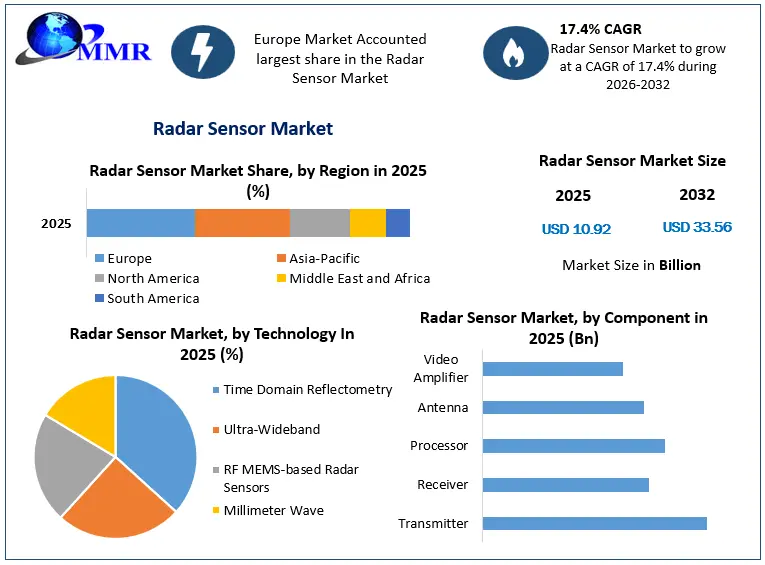
- Radar Sensor Market valued at USD 10.92 Billion in 2025.
- Market projected to reach nearly USD 33.56 Billion by 2032.
- CAGR of 17.4% expected from 2026 to 2032.
- Automotive safety systems remain a major catalyst for radar sensor adoption.
- Defense modernization programs continue driving advanced sensing investments.
- Industrial automation is increasing demand for intelligent sensing platforms.
- AI integration is enhancing radar performance and real-time decision-making capabilities.
- Semiconductor manufacturers are benefiting from growing sensor content across industries.
Why This Matters Now
Artificial intelligence is rapidly shifting from data centers into vehicles, factories, defense systems, and edge-computing platforms. That transition requires machines to perceive their surroundings with greater accuracy, creating unprecedented demand for radar sensors capable of operating in complex environments.
The Radar Sensor Market was valued at USD 10.92 Billion in 2025 and is expected to reach nearly USD 33.56 Billion by 2032, growing at a CAGR of 17.4%. This growth trajectory signals a major expansion in semiconductor content across automotive, industrial, aerospace, and defense applications. For chipmakers, sensor manufacturers, OEMs, and technology investors, radar is becoming one of the most strategically important sensing technologies in the intelligent systems economy.
The result is a market moving from specialized deployment toward mainstream adoption across multiple high-growth industries.
Market Overview
Radar technology has evolved significantly from its traditional military origins. Today, radar sensors are embedded across connected vehicles, industrial equipment, logistics systems, smart infrastructure, and advanced security applications.
The market’s growth reflects increasing demand for reliable sensing solutions capable of operating in challenging conditions where cameras and optical systems face limitations. Radar provides object detection, distance measurement, motion tracking, and environmental awareness regardless of lighting or weather conditions.
As autonomous systems become more sophisticated, sensor fusion strategies are gaining importance. Radar increasingly works alongside cameras, LiDAR, AI processors, and edge-computing platforms to deliver comprehensive situational awareness.
For semiconductor companies, this trend translates into rising demand for radio-frequency chips, signal-processing devices, microcontrollers, AI accelerators, and integrated sensing solutions.
The radar sensor ecosystem is no longer limited to defense contractors. It has become a foundational technology layer supporting next-generation mobility, industrial intelligence, and smart infrastructure.
Key Trends Driving Growth
Automotive safety remains one of the strongest demand drivers. Advanced Driver Assistance Systems (ADAS) increasingly rely on radar sensors for collision avoidance, adaptive cruise control, blind-spot monitoring, emergency braking, and parking assistance.
The transition toward autonomous and semi-autonomous mobility is expanding radar deployment across vehicle platforms. Every additional sensing capability increases semiconductor content and creates new opportunities for component suppliers.
Defense modernization programs continue generating significant investment activity. Governments are prioritizing surveillance, threat detection, border security, and battlefield awareness systems that depend heavily on radar technologies.
Industrial automation is emerging as another major growth engine. Factories adopting robotics, machine automation, predictive maintenance, and intelligent monitoring systems require reliable sensing platforms capable of operating in dynamic industrial environments.
Artificial intelligence is amplifying radar capabilities. AI algorithms improve object classification, reduce false detections, and enhance real-time decision-making. This convergence of sensing and intelligence is creating higher-value solutions across multiple end markets.
IoT adoption is contributing additional momentum. Smart cities, connected infrastructure, traffic management systems, and intelligent transportation networks increasingly utilize radar-enabled sensing technologies.
Semiconductor innovation continues to accelerate radar adoption. Advances in integrated circuits, signal processing, packaging technologies, and power efficiency are improving sensor performance while reducing size and cost.
𝐃𝐨𝐰𝐧𝐥𝐨𝐚𝐝 𝐏𝐃𝐅 𝐁𝐫𝐨𝐜𝐡𝐮𝐫𝐞 @https://www.maximizemarketresearch.com/request-sample/32532/
Segment Insights
- Dominant Segment: The report identifies the leading segment based on overall market share contribution and widespread deployment across key applications.
- Fastest-Growing Segment: The report identifies the fastest-growing segment driven by emerging technology adoption, intelligent mobility initiatives, and expanding industrial automation requirements.
- Automotive applications remain a major source of demand due to increasing safety regulations and vehicle intelligence requirements.
- Defense and aerospace deployments continue benefiting from surveillance modernization and security investments.
- Industrial automation systems are creating opportunities for radar-based sensing and monitoring solutions.
- Smart infrastructure projects are expanding deployment opportunities across transportation and urban environments.
Regional Growth Story
North America remains a significant market due to strong defense spending, advanced automotive technology development, and leadership in semiconductor innovation. Investments in autonomous mobility and intelligent infrastructure continue supporting radar adoption.
The United States plays a central role in radar technology development through its aerospace, defense, semiconductor, and automotive industries. Demand for advanced sensing capabilities continues to drive innovation across multiple sectors.
Europe benefits from stringent vehicle safety regulations and strong automotive manufacturing capabilities. Radar sensors are becoming increasingly important as automakers accelerate deployment of advanced safety and driver-assistance features.
Germany remains a key contributor through its automotive engineering expertise and industrial automation leadership.
Asia-Pacific is emerging as a major growth region due to expanding electronics manufacturing activity, automotive production, semiconductor investments, and smart infrastructure development.
China continues strengthening its position through investments in autonomous vehicles, industrial modernization, electronics manufacturing, and semiconductor ecosystems.
Japan and South Korea contribute advanced semiconductor expertise, sensor innovation capabilities, and automotive technology leadership.
India is gradually increasing its relevance through automotive industry expansion, industrial automation adoption, and digital infrastructure investments.
Regional competition increasingly centers on semiconductor capacity, sensor innovation, manufacturing efficiency, and technology sovereignty.
Competitive Landscape
Competition within the Radar Sensor Market is becoming increasingly technology-driven. Manufacturers are investing in higher-resolution sensing capabilities, AI-enabled processing platforms, and integrated semiconductor architectures.
The market’s evolution signals a broader shift toward intelligent sensing ecosystems. Companies that combine hardware expertise with AI software capabilities are building stronger competitive advantages.
Semiconductor integration is becoming a critical differentiator. Advanced radar solutions increasingly depend on sophisticated chip designs capable of processing large volumes of sensor data in real time.
Partnerships among automotive OEMs, semiconductor manufacturers, software developers, and sensor suppliers are accelerating innovation cycles. These collaborations reduce development timelines while improving performance and scalability.
Defense-related investments continue pushing technological boundaries. Innovations developed for military applications often influence commercial markets, accelerating adoption of advanced radar capabilities.
Supply-chain resilience is also emerging as a strategic priority. Organizations with diversified manufacturing footprints and secure semiconductor sourcing strategies are better positioned to navigate market volatility.
The competitive landscape increasingly rewards companies capable of integrating sensing, processing, connectivity, and intelligence into unified platforms.
Recent Developments
- Increased deployment of radar sensors within ADAS and autonomous vehicle systems.
- Growing integration of AI capabilities into radar processing platforms.
- Expansion of industrial automation projects utilizing advanced sensing technologies.
- Rising investments in defense surveillance and security modernization programs.
- Continued semiconductor innovation supporting radar performance improvements.
- Greater adoption of sensor fusion architectures across intelligent systems.
- Strengthened focus on manufacturing resilience and component supply security.
Strategic Implications
For automotive OEMs, radar sensors are becoming essential components of future mobility platforms. Safety, autonomy, and user experience increasingly depend on advanced sensing capabilities.
For semiconductor manufacturers, radar represents a high-growth opportunity linked to automotive electronics, industrial automation, defense modernization, and AI-driven edge computing.
For investors, the market offers exposure to multiple structural growth themes, including autonomous transportation, intelligent infrastructure, AI adoption, and industrial digitization.
For policymakers, radar technologies contribute to transportation safety, national security, industrial competitiveness, and technology leadership objectives.
The strategic importance of radar extends beyond sensing. It increasingly serves as a critical data-generation layer supporting AI-powered decision-making systems.
Future Outlook
Radar sensors are becoming indispensable components of intelligent machines, connected infrastructure, and autonomous systems. The technology’s ability to deliver reliable environmental awareness across diverse operating conditions positions it as a foundational element of next-generation electronics ecosystems.
Growth will increasingly depend on advances in semiconductor integration, AI-enabled signal processing, sensor fusion architectures, and manufacturing scale. Companies capable of combining these capabilities will define the next era of sensing innovation.
As autonomous mobility, AI-powered industrial systems, and intelligent defense platforms converge, future market leaders will be those that control the semiconductor and sensing technologies enabling machines to perceive, interpret, and act on the physical world, while laggards risk becoming suppliers to more intelligent competitors.
Analyst Perspective
“Radar sensors are transitioning from specialized components into core enablers of intelligent systems. Organizations that combine advanced sensing technologies, semiconductor innovation, AI capabilities, and resilient supply chains will be best positioned to capture long-term value across mobility, industrial, and defense markets.” — Rucha Deshpande, Analyst
About Maximize Market Research
Maximize Market Research Pvt. Ltd. (MMR) is a global market research and consulting company that provides reliable, data-focused, and practical business insights. The firm serves a wide range of industries, including healthcare, pharmaceuticals, technology, automotive, electronics, chemicals, personal care, and consumer goods. Through market forecasts, competitive analysis, strategic consulting, and industry impact assessments, MMR helps organizations understand changing market conditions, identify growth opportunities, and make informed business decisions for long-term success.
2nd Floor, Navale IT Park Phase 3
Pune Banglore Highway, Narhe
Pune, Maharashtra 411041, India
+91 9607365656
sales@maximizemarketresearch.com
