Key Highlights
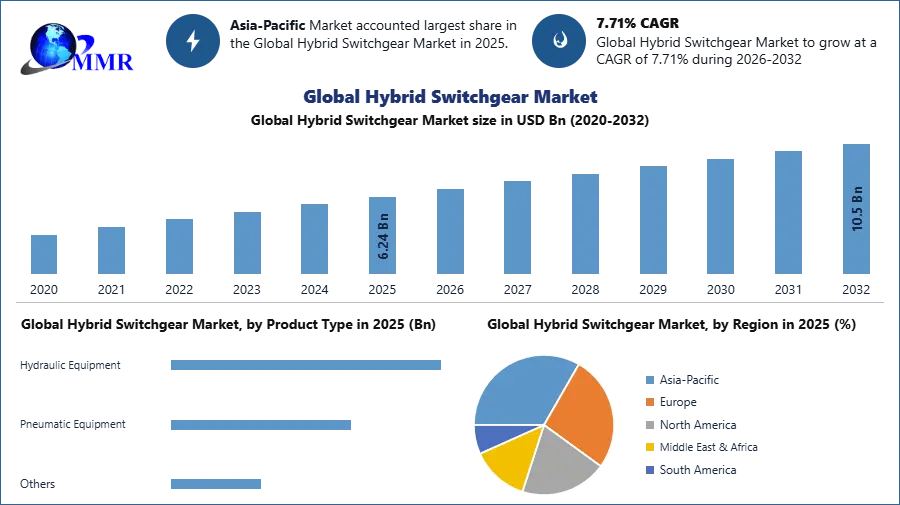
- Global Hybrid Switchgear Market valued at US$ 6.24 Bn in 2025.
- Market expected to reach US$ 10.5 Bn by 2032.
- CAGR projected at 7.71% during the forecast period.
- Smart grid modernization is increasing demand for advanced switchgear systems.
- Renewable energy integration is driving upgrades across transmission and distribution networks.
- AI data center expansion is creating new power infrastructure requirements.
- Utilities are prioritizing compact, reliable, and digitally enabled power systems.
- Industrial electrification initiatives continue to strengthen long-term market demand.
Why This Matters Now
The global race to build AI infrastructure is placing unprecedented pressure on power networks. Every semiconductor fabrication plant, hyperscale data center, electric vehicle factory, and advanced manufacturing facility requires reliable electrical distribution systems capable of supporting growing energy demand.
The Hybrid Switchgear Market was valued at US$ 6.24 Bn in 2025 and is expected to reach US$ 10.5 Bn by 2032 at a CAGR of 7.71%. That expansion reflects more than equipment demand. It signals accelerating investment in the electrical infrastructure required to support digital economies, renewable energy integration, and next-generation industrial growth.
As governments pursue energy transition strategies and technology companies expand computing capacity, switchgear is becoming a strategic component of national infrastructure planning.
Market Overview
Hybrid switchgear occupies a critical position within modern power systems. It combines the advantages of conventional air-insulated and gas-insulated technologies, offering utilities and industrial operators greater efficiency, reduced footprint requirements, and enhanced operational reliability.
Power infrastructure is experiencing a significant transformation. Traditional centralized electricity systems are evolving into interconnected networks capable of managing renewable energy, distributed generation assets, electric mobility ecosystems, and intelligent grid technologies.
This evolution is increasing demand for advanced switching and protection equipment. Utilities require solutions that improve reliability while minimizing maintenance requirements and operational risks.
The market’s expected growth from US$ 6.24 Bn in 2025 to US$ 10.5 Bn by 2032 demonstrates the scale of global infrastructure investment underway. For equipment suppliers and technology providers, this represents an opportunity to participate in one of the most important upgrades occurring across energy systems worldwide.
Key Trends Driving Growth
Grid modernization remains the dominant growth catalyst. Aging transmission and distribution infrastructure is being upgraded to support increasing electricity demand, digital monitoring systems, and renewable energy integration.
Renewable energy deployment is creating new technical challenges for utilities. Wind and solar resources introduce variability into power networks, requiring advanced switching technologies capable of maintaining system stability and operational flexibility.
Artificial intelligence is emerging as an indirect but powerful demand driver. AI data centers consume significant amounts of electricity and require highly reliable power infrastructure. Every expansion in computing capacity increases demand for advanced electrical distribution systems.
Industrial electrification is gaining momentum across manufacturing sectors. Factories adopting automation, robotics, digital manufacturing systems, and smart production technologies require modern electrical infrastructure capable of supporting continuous operations.
Digital substations are transforming utility operations. Integration of sensors, communication technologies, IoT-enabled monitoring platforms, and predictive maintenance capabilities is increasing demand for intelligent switchgear solutions.
Sustainability objectives are also influencing purchasing decisions. Utilities and industrial operators increasingly prioritize equipment that improves efficiency, reduces environmental impact, and supports long-term decarbonization goals.
Supply-chain resilience has become another critical consideration. Governments and infrastructure operators are focusing on secure sourcing strategies to reduce vulnerabilities associated with global disruptions.
𝐃𝐨𝐰𝐧𝐥𝐨𝐚𝐝 𝐏𝐃𝐅 𝐁𝐫𝐨𝐜𝐡𝐮𝐫𝐞 @https://www.maximizemarketresearch.com/request-sample/66384/
Segment Insights
- Dominant Segment: The report identifies the leading segment based on its contribution to overall market demand and widespread deployment across utility and industrial applications.
- Fastest-Growing Segment: The report identifies the fastest-growing segment driven by modernization investments, renewable energy integration, and evolving power infrastructure requirements.
- Utility applications continue generating substantial demand due to transmission and distribution network upgrades.
- Renewable energy projects are creating opportunities for advanced switching technologies across generation and grid-connection infrastructure.
- Industrial facilities increasingly require compact and efficient switchgear systems to support automation and electrification initiatives.
- Smart grid deployments are accelerating adoption of digitally enabled power distribution equipment.
Regional Growth Story
Asia-Pacific remains a major center of infrastructure investment and power system expansion. Rapid industrialization, urbanization, and rising electricity demand continue to drive demand for advanced electrical equipment.
China plays a central role through extensive grid investments, renewable energy deployment, and industrial expansion. The country’s infrastructure development efforts continue influencing global equipment demand patterns.
India is emerging as a significant growth market due to rising electricity consumption, renewable energy investments, and ongoing transmission and distribution upgrades. Government-led infrastructure initiatives are strengthening long-term demand prospects.
Japan and South Korea contribute advanced engineering expertise, power system innovation, and manufacturing capabilities. Their focus on energy efficiency and grid reliability supports technology adoption.
The United States is increasing investments in grid resilience, domestic manufacturing, AI infrastructure, and energy transition initiatives. Utilities are upgrading equipment to improve reliability and accommodate evolving demand profiles.
Germany remains an important market due to renewable energy integration efforts, industrial automation leadership, and advanced power infrastructure requirements. European modernization initiatives continue creating opportunities for equipment manufacturers.
Regional competition increasingly centers on technology leadership, manufacturing capabilities, infrastructure spending, and energy security priorities.
Competitive Landscape
Competition within the Hybrid Switchgear Market is shifting beyond traditional equipment performance. Manufacturers increasingly compete on digital capabilities, lifecycle efficiency, and integration with intelligent grid platforms.
Technology providers are investing in advanced monitoring systems, predictive maintenance technologies, and IoT-enabled equipment architectures. These investments signal a transition from conventional hardware suppliers toward intelligent infrastructure partners.
The rise of AI-powered grid management platforms is influencing competitive strategies. Switchgear suppliers capable of supporting digital utility operations are strengthening their market positions.
Manufacturing competitiveness remains another key differentiator. Companies with efficient production networks, strong supply-chain management capabilities, and engineering expertise can respond more effectively to rising infrastructure demand.
Partnerships across utilities, technology firms, industrial operators, and energy infrastructure developers are becoming increasingly important. Collaboration accelerates deployment timelines and improves system performance.
The market’s future direction points toward greater convergence between electrical equipment, digital technologies, and intelligent energy management systems.
Recent Developments
- Increased investments in smart grid modernization programs.
- Expansion of renewable energy projects requiring advanced grid infrastructure.
- Growing adoption of digital substations and intelligent monitoring technologies.
- Rising utility focus on grid reliability and operational efficiency.
- Enhanced deployment of IoT-enabled power distribution systems.
- Continued investment in industrial electrification and automation initiatives.
- Strengthened efforts to improve supply-chain resilience and equipment availability.
Strategic Implications
For utilities, hybrid switchgear offers a pathway toward improved reliability, operational flexibility, and efficient integration of renewable energy resources. Infrastructure modernization increasingly depends on advanced switching technologies.
For technology providers, opportunities extend beyond equipment sales. Software, predictive analytics, digital monitoring platforms, and intelligent grid management systems are becoming critical value drivers.
For investors, the market provides exposure to several structural growth trends, including energy transition, grid modernization, industrial electrification, and AI infrastructure expansion.
For policymakers, hybrid switchgear supports energy security, renewable integration, infrastructure resilience, and economic development objectives.
The sector’s strategic importance is increasing as power infrastructure becomes the foundation supporting digital transformation and industrial competitiveness.
Future Outlook
Hybrid switchgear is becoming a critical enabler of next-generation energy systems. Growth is increasingly tied to electrification, renewable integration, AI-driven infrastructure expansion, and intelligent grid development.
Future market leadership will depend on the ability to combine electrical engineering excellence with digital intelligence, operational efficiency, and sustainable infrastructure design. Utilities and industrial operators are seeking partners capable of delivering integrated solutions rather than standalone equipment.
As AI computing clusters, renewable energy networks, and electrified industrial ecosystems reshape global power demand, the companies that control intelligent grid infrastructure will define the next era of energy competitiveness, while laggards risk becoming constrained by outdated power architectures.
Analyst Perspective
“Hybrid switchgear is evolving into a strategic component of modern power infrastructure. Organizations that combine advanced engineering, digital capabilities, and resilient supply chains will be best positioned to support the growing demands of electrification, renewable integration, and intelligent energy networks.” — Rucha Deshpande, Analyst
About Maximize Market Research
Maximize Market Research Pvt. Ltd. (MMR) is a global market research and consulting company that provides reliable, data-focused, and practical business insights. The firm serves a wide range of industries, including healthcare, pharmaceuticals, technology, automotive, electronics, chemicals, personal care, and consumer goods. Through market forecasts, competitive analysis, strategic consulting, and industry impact assessments, MMR helps organizations understand changing market conditions, identify growth opportunities, and make informed business decisions for long-term success.
2nd Floor, Navale IT Park Phase 3
Pune Banglore Highway, Narhe
Pune, Maharashtra 411041, India
+91 9607365656
sales@maximizemarketresearch.com
