Fishing Nets Market to Grow from USD 1.88 Billion (2025) to USD 2.41 Billion by 2032, Driven by Rising Seafood Demand, Technological Net Innovations, and Sustainable Fishing Practices
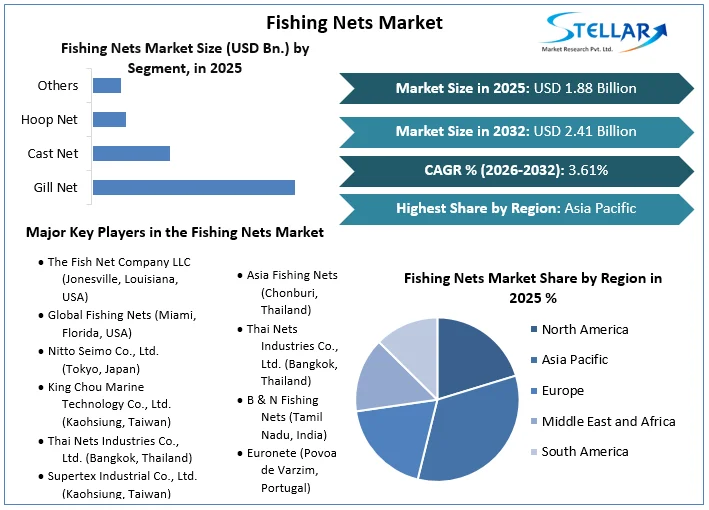
PUNE, India, June 25, 2026 — The Fishing Nets Market, as analyzed by Stellar Market Research, is entering a structural transformation phase driven by aquaculture expansion, stricter marine sustainability regulations, and rapid adoption of advanced netting materials. The market, valued at USD 1.88 billion in 2025, is projected to reach USD 2.41 billion by 2032, reflecting a steady CAGR of 3.61% during the forecast period.
Fishing nets are evolving from traditional fishing tools into engineered marine solutions, supporting commercial fishing fleets, aquaculture farms, and recreational applications globally.
Market Opportunity Overview
The global Fishing Nets Market is undergoing a shift from conventional nylon-based nets toward high-performance, durable, and eco-friendly alternatives. Rising global seafood consumption, expansion of aquaculture farming, and government-led sustainability initiatives are reshaping procurement strategies across marine industries.
A key transformation is the integration of low-impact fishing technologies designed to reduce bycatch and “ghost fishing” losses. Additionally, smart net systems embedded with monitoring sensors are gaining traction in industrial-scale aquaculture operations, improving yield efficiency and operational visibility.
With aquaculture now accounting for nearly half of global seafood supply in several regions, demand for specialized nets is increasing significantly across Asia and Europe.
Download Free PDF Brochure: https://www.stellarmr.com/report/req_sample/Fishing-Nets-Market/2161
Key Findings from the Report
- Global market size: USD 1.88 billion (2025)
- Forecast value: USD 2.41 billion by 2032
- CAGR: 3.61% (2025–2032)
- Aquaculture nets represent the fastest-growing application segment
- Commercial fishing remains the dominant end-use segment
- Asia Pacific leads global demand with strong aquaculture penetration
- Europe is emerging as a sustainability-driven innovation hub
Market Drivers and Restraints
Key Drivers
- Rising Global Seafood Consumption
Increasing protein demand is accelerating commercial fishing and aquaculture expansion, directly boosting net procurement cycles. - Expansion of Aquaculture Industry
Large-scale fish farming operations require durable, anti-fouling nets, significantly driving product demand. - Technological Advancements in Net Materials
High-density polyethylene (HDPE) and biodegradable polymers are improving durability, reducing environmental impact, and enhancing operational efficiency.
Key Restraints
- Environmental Concerns Over Ghost Fishing
Abandoned fishing nets contribute to marine pollution, leading to stricter regulations. - Volatility in Raw Material Prices
Fluctuations in synthetic fiber pricing impact manufacturing margins and supply stability.
Technology, Regulation, and Sustainability Trends
The Fishing Nets Market is experiencing rapid technological evolution, particularly in smart fishing systems equipped with IoT-based monitoring for catch optimization and net tracking.
Regulatory bodies such as the EU Commission and FAO are promoting selective fishing gear to reduce marine biodiversity loss. Meanwhile, sustainability initiatives are accelerating adoption of recyclable and biodegradable net materials.
Manufacturers are increasingly investing in eco-design frameworks, ensuring compliance with global marine conservation standards while maintaining commercial performance.
Regional Insights
Asia Pacific – Leading Region
Asia Pacific dominates the global Fishing Nets Market, driven by large-scale aquaculture production in China, India, Vietnam, and Indonesia. The region benefits from strong government support and cost-efficient manufacturing ecosystems.
Europe – Sustainability-Led Growth
Europe is emerging as a key innovation hub, with countries such as Norway and Spain investing in sustainable fishing technologies and marine ecosystem protection.
North America – Technological Adoption
The United States and Canada are witnessing increased adoption of smart fishing solutions and advanced aquaculture systems supported by regulatory monitoring.
Emerging Regions
Latin America and the Middle East & Africa are gaining traction due to expanding coastal fishing activities and aquaculture investments.
Recent Industry Developments
EU Commission (2025): Introduced stricter regulations on fishing gear disposal and marine plastic waste, accelerating demand for biodegradable nets.
FAO (2025): Expanded global sustainable fisheries program promoting eco-friendly netting materials in developing coastal economies.
Government of India (2024): Strengthened aquaculture subsidies under Blue Economy initiatives, boosting domestic net demand.
NOAA (2024): Implemented enhanced bycatch reduction guidelines in commercial fisheries, influencing gear redesign in North America.
Norway Ministry of Fisheries (2025): Invested in smart aquaculture infrastructure, supporting sensor-enabled net deployment in salmon farming operations.
Competitive Landscape
The Fishing Nets Market is moderately fragmented, with competition centered on material innovation, durability performance, and sustainability compliance. Key participants include :
- The Fish Net Company LLC (Jonesville, Louisiana, USA)
- Global Fishing Nets (Miami, Florida, USA)
- Nitto Seimo Co., Ltd. (Tokyo, Japan)
- King Chou Marine Technology Co., Ltd. (Kaohsiung, Taiwan)
- Thai Nets Industries Co., Ltd. (Bangkok, Thailand)
- Supertex Industrial Co., Ltd. (Kaohsiung, Taiwan)
- Ching Fa Fishing Implements Factory Co., Ltd. (Kaohsiung, Taiwan)
- Shandong Haoyuntong International Trade Co., Ltd. (Shandong, China)
Download Free PDF Brochure: https://www.stellarmr.com/report/req_sample/Fishing-Nets-Market/2161
Analyst Commentary
“Fishing nets are no longer viewed as simple capture tools; they are becoming engineered marine systems aligned with sustainability mandates and aquaculture productivity goals,” said a Senior Research Analyst at Stellar Market Research. “The next phase of growth will be defined by material innovation and regulatory alignment rather than volume expansion alone.”
Future Outlook
Between 2026 and 2032, the Fishing Nets Market is expected to transition toward a technology-enabled, sustainability-driven ecosystem. Demand will increasingly be shaped by aquaculture scaling, stricter environmental compliance, and adoption of recyclable materials.
Investment inflows are expected to concentrate in smart net technologies, while competition will intensify around biodegradable polymer innovation. Regulatory frameworks will continue to play a decisive role in shaping procurement decisions across developed markets.
About Stellar Market Research
Stellar Market Research is a global market intelligence and consulting firm delivering actionable insights across industries including materials, manufacturing, energy, healthcare, and advanced technologies. The company specializes in data-driven forecasting, competitive benchmarking, and strategic advisory services for enterprises, investors, and policymakers. With a strong analytical framework and domain expertise, Stellar Market Research helps organizations identify growth opportunities, mitigate risks, and optimize strategic decisions in rapidly evolving global markets. Its research reports are widely used by Fortune 500 companies and emerging enterprises for informed decision-making and market expansion strategies.
Media Contact
Stellar Market Research
Website: Stellar Market Research – Global Research Reports & Consulting
Email: sales@stellarmr.com
