Key Highlights
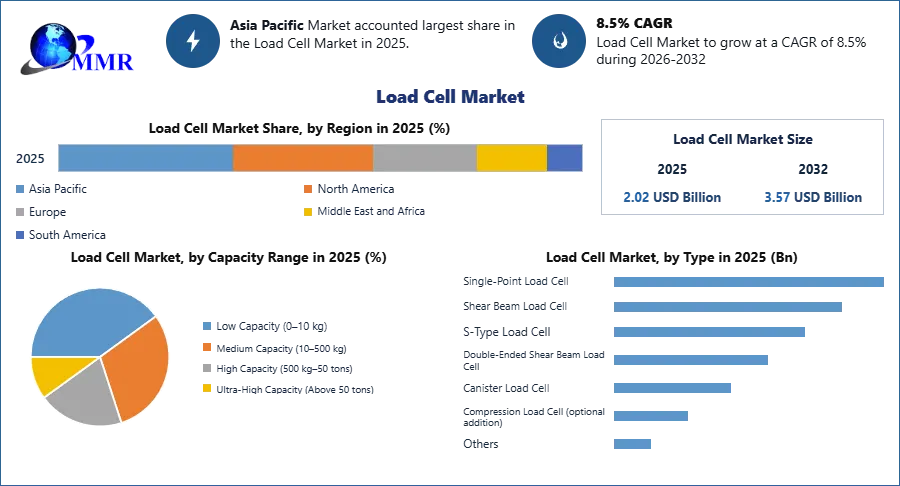
- Global Load Cell Market valued at USD 2.02 Billion in 2025.
- Market expected to reach nearly USD 3.57 Billion by 2032.
- Revenue projected to grow at a CAGR of 3.4% from 2026 to 2032.
- Industrial automation is increasing demand for precision sensing technologies.
- Smart factory deployments are accelerating adoption of connected load measurement systems.
- AI-driven manufacturing environments require higher levels of operational accuracy.
- IoT integration is transforming traditional load monitoring applications.
- Semiconductor and electronics manufacturing expansion is supporting sensor demand.
Why This Matters Now
Artificial intelligence is reshaping factories, but accurate data remains the foundation of every automated decision. As manufacturers invest in AI-driven production, robotics, and smart industrial systems, demand is growing for sensors capable of delivering precise, real-time measurement data.
The Global Load Cell Market was valued at USD 2.02 Billion in 2025 and is expected to reach nearly USD 3.57 Billion by 2032. This expansion signals increasing investment in industrial intelligence infrastructure. Every automated production line, robotic system, semiconductor fabrication facility, and connected manufacturing operation depends on accurate force and weight measurement technologies to maintain efficiency, safety, and product quality.
The result is a growing strategic role for load cells within the broader digital transformation of manufacturing.
Market Overview
Load cells have traditionally served as essential components in weighing systems and industrial measurement equipment. Today, their role is expanding as industries embrace automation, digitization, and intelligent manufacturing strategies.
Modern factories increasingly rely on data-driven operations. Accurate measurement of force, load, pressure, and weight enables better process control, predictive maintenance, and operational optimization. As a result, load cells are evolving from standalone measurement devices into critical data-generation assets within industrial ecosystems.
The market’s projected growth from USD 2.02 Billion in 2025 to nearly USD 3.57 Billion by 2032 reflects increasing adoption across manufacturing, logistics, healthcare, transportation, aerospace, energy, and industrial automation applications.
For technology providers and electronics manufacturers, load cells represent a crucial intersection between physical operations and digital intelligence.
Key Trends Driving Growth
Industrial automation remains the most significant growth catalyst. Manufacturers are increasingly deploying robotics, automated material handling systems, and intelligent production equipment that require continuous measurement and monitoring capabilities.
Smart factory initiatives are accelerating sensor deployment. Connected manufacturing environments depend on real-time operational data to improve productivity, reduce downtime, and enhance quality control processes.
IoT integration is transforming traditional load measurement systems. Connected load cells can transmit performance data directly to enterprise platforms, enabling predictive maintenance and remote monitoring capabilities.
AI-enabled manufacturing systems are creating new opportunities. Machine learning algorithms require accurate operational data to optimize workflows and improve production efficiency. Load cells provide essential measurement inputs that support these analytical capabilities.
Semiconductor manufacturing growth is also contributing to demand. Advanced fabrication facilities require highly precise measurement systems across production, testing, packaging, and materials handling operations.
Electronics manufacturing services providers are increasingly integrating intelligent sensing technologies into production environments. This trend supports quality assurance while improving operational visibility.
Supply-chain digitization represents another important driver. Logistics operators, warehouses, and distribution centers are investing in advanced measurement systems to improve inventory management and operational efficiency.
The broader transition toward Industry 4.0 continues expanding the role of sensors within connected industrial ecosystems.
𝐃𝐨𝐰𝐧𝐥𝐨𝐚𝐝 𝐏𝐃𝐅 𝐁𝐫𝐨𝐜𝐡𝐮𝐫𝐞 @https://www.maximizemarketresearch.com/request-sample/17396/
Segment Insights
- Dominant Segment: The report identifies the leading segment based on its contribution to overall market revenue and broad industrial adoption.
- Fastest-Growing Segment: The report identifies the fastest-growing segment supported by automation investments, digital transformation initiatives, and advanced manufacturing requirements.
- Industrial manufacturing remains a major application area due to increasing automation deployment.
- Smart weighing systems continue gaining adoption across logistics and supply-chain operations.
- Semiconductor and electronics production environments increasingly require precision measurement technologies.
- Connected sensing solutions are benefiting from growing Industry 4.0 implementation strategies.
Regional Growth Story
Asia-Pacific remains a central hub for industrial production, electronics manufacturing, and automation investments. Strong manufacturing ecosystems continue driving demand for advanced sensing technologies.
China plays a critical role through large-scale manufacturing operations, industrial modernization initiatives, and expanding electronics production capacity. The country’s industrial transformation efforts continue supporting sensor deployment.
Japan contributes through advanced manufacturing expertise, robotics leadership, and precision engineering capabilities. High-performance industrial environments require increasingly sophisticated measurement technologies.
South Korea benefits from strong semiconductor manufacturing, electronics production, and industrial automation adoption. These sectors generate sustained demand for precision sensors.
The United States remains a major market due to investments in smart manufacturing, semiconductor fabrication, aerospace production, and AI-enabled industrial systems.
Germany continues demonstrating leadership in Industry 4.0 implementation. Advanced industrial automation and engineering excellence create opportunities for high-performance sensing solutions.
India is emerging as an important growth market as manufacturing expansion, industrial digitization, and infrastructure development increase demand for automation technologies.
Regional competition increasingly revolves around manufacturing sophistication, industrial productivity, and technology adoption rates.
Competitive Landscape
Competition in the Load Cell Market is increasingly shaped by digital capabilities rather than measurement performance alone. Customers increasingly seek integrated solutions that combine sensing, connectivity, analytics, and operational intelligence.
The rise of smart manufacturing is changing competitive priorities. Companies capable of delivering connected load monitoring solutions are strengthening their positions within industrial automation ecosystems.
IoT-enabled load cells represent a major area of innovation. Real-time monitoring, cloud connectivity, and predictive maintenance capabilities are creating new value propositions for industrial customers.
AI readiness is becoming another important differentiator. Manufacturers increasingly require sensing platforms capable of generating high-quality operational data that supports advanced analytics and machine learning applications.
Supply-chain resilience is influencing competitive strategies. Customers seek reliable suppliers capable of supporting long-term industrial modernization programs and maintaining consistent product availability.
Research and development investments increasingly focus on improving measurement accuracy, environmental durability, digital connectivity, and system integration capabilities.
The future competitive landscape will be defined by companies that successfully bridge industrial measurement and intelligent automation technologies.
Recent Developments
- Increased adoption of IoT-enabled load monitoring systems.
- Growing integration of load cells within smart factory environments.
- Expansion of industrial automation projects across manufacturing sectors.
- Rising deployment of predictive maintenance platforms using sensor data.
- Continued investment in semiconductor and electronics manufacturing facilities.
- Increased focus on operational efficiency and quality control technologies.
- Greater adoption of connected measurement systems across logistics networks.
Strategic Implications
For industrial equipment manufacturers, load cells are becoming essential components of intelligent production systems. Measurement accuracy increasingly influences operational performance and automation effectiveness.
For semiconductor and electronics manufacturers, precision sensing technologies support production quality, equipment reliability, and process optimization. As fabrication environments become more sophisticated, demand for advanced measurement solutions continues growing.
For investors, the market offers exposure to structural themes including Industry 4.0 adoption, industrial automation expansion, AI-enabled manufacturing, and smart infrastructure development.
For supply-chain leaders, connected sensing technologies provide greater visibility into operations, inventory movement, and equipment performance.
The strategic importance of load cells now extends beyond measurement. They increasingly function as critical data-generation assets within digitally connected industrial ecosystems.
Future Outlook
Load cells are evolving into intelligent sensing platforms that support the next generation of industrial automation. Future growth will increasingly depend on connectivity, analytics integration, and compatibility with broader Industry 4.0 architectures.
Manufacturers that combine sensor innovation with digital intelligence capabilities will strengthen their competitive positions. Precision measurement alone will no longer be sufficient; customers increasingly demand actionable operational insights.
As AI-powered factories, semiconductor fabs, autonomous logistics networks, and connected industrial ecosystems become standard, future market leaders will be those that transform measurement data into strategic intelligence, while laggards remain limited to supplying commodity sensing hardware.
Analyst Perspective
“Load cells are becoming increasingly important within the digital manufacturing landscape. As automation, industrial AI, and connected operations expand globally, organizations that integrate precision sensing with intelligent data capabilities will be best positioned to capture long-term value across industrial ecosystems.” — Rucha Deshpande, Analyst
About Maximize Market Research
Maximize Market Research Pvt. Ltd. (MMR) is a global market research and consulting company that provides reliable, data-focused, and practical business insights. The firm serves a wide range of industries, including healthcare, pharmaceuticals, technology, automotive, electronics, chemicals, personal care, and consumer goods. Through market forecasts, competitive analysis, strategic consulting, and industry impact assessments, MMR helps organizations understand changing market conditions, identify growth opportunities, and make informed business decisions for long-term success.
2nd Floor, Navale IT Park Phase 3
Pune Banglore Highway, Narhe
Pune, Maharashtra 411041, India
+91 9607365656
sales@maximizemarketresearch.com
