Key Highlights
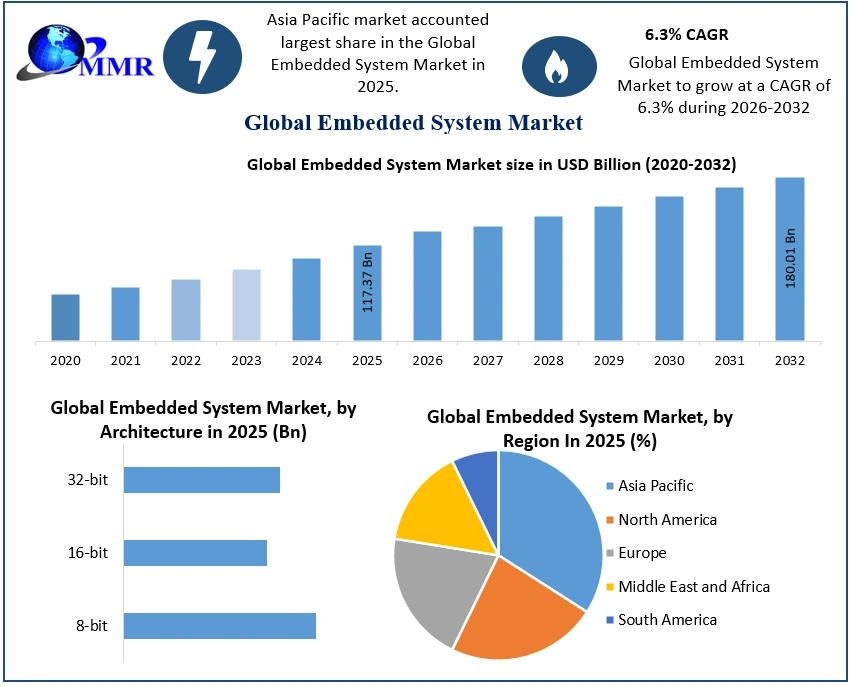
- Embedded System Market valued at USD 117.37 Billion in 2025.
- Market expected to reach nearly USD 180.01 Billion by 2032.
- CAGR of 6.3% anticipated during the forecast period.
- AI-enabled edge devices are increasing semiconductor content across industries.
- IoT deployment continues driving demand for embedded processors and controllers.
- Automotive, industrial, healthcare, and consumer electronics sectors remain major adopters.
- Edge computing architectures are reducing reliance on centralized cloud infrastructure.
- Semiconductor innovation is expanding embedded intelligence across connected ecosystems.
Why This Matters Now
Artificial intelligence is no longer confined to hyperscale data centers. Intelligence is moving directly into devices, machines, vehicles, factories, medical equipment, and consumer electronics through embedded systems.
The Embedded System Market was valued at USD 117.37 Billion in 2025 and is projected to reach nearly USD 180.01 Billion by 2032. That expansion signals rising demand for processors, microcontrollers, memory technologies, connectivity chips, and embedded software platforms that increasingly serve as the digital foundation of modern economies.
For semiconductor manufacturers, electronics OEMs, foundries, investors, and technology strategists, embedded systems have become one of the most important growth engines in the broader electronics ecosystem.
Market Overview
Embedded systems have evolved from simple control units into sophisticated computing platforms capable of processing data, executing AI workloads, managing connectivity, and supporting autonomous decision-making.
The market’s growth from USD 117.37 Billion in 2025 to nearly USD 180.01 Billion by 2032 reflects the increasing digitalization of physical infrastructure. Every connected vehicle, industrial robot, medical device, smart appliance, and IoT sensor depends on embedded computing capabilities.
Unlike traditional computing platforms, embedded systems are purpose-built. They combine hardware and software to perform dedicated tasks with high efficiency, low power consumption, and real-time responsiveness.
As organizations seek greater automation, intelligence, and operational efficiency, embedded technologies are becoming indispensable across virtually every industry.
Key Trends Driving Growth
Artificial intelligence is becoming a central feature of embedded architecture. AI-enabled devices increasingly perform local inference, predictive analytics, image recognition, voice processing, and autonomous decision-making without constant cloud connectivity.
Edge computing has emerged as a major market catalyst. Processing data closer to its source reduces latency, improves reliability, and enhances cybersecurity while lowering bandwidth requirements.
IoT adoption continues accelerating demand. Billions of connected devices require embedded processors, sensors, communications modules, and software platforms capable of operating continuously in diverse environments.
The automotive industry remains a major innovation driver. Modern vehicles increasingly incorporate advanced driver assistance systems, autonomous functions, infotainment platforms, battery management systems, and vehicle-to-everything communications, all supported by embedded technologies.
Industrial automation is expanding rapidly. Smart factories increasingly deploy embedded systems for robotics, predictive maintenance, machine vision, and operational analytics.
Healthcare digitization is creating additional opportunities. Medical monitoring devices, wearable technologies, diagnostic equipment, and connected healthcare infrastructure depend heavily on embedded computing platforms.
The transition toward intelligent consumer electronics is also expanding market demand. Smart televisions, home automation systems, connected appliances, gaming devices, and wearable products increasingly require sophisticated embedded capabilities.
𝐃𝐨𝐰𝐧𝐥𝐨𝐚𝐝 𝐏𝐃𝐅 𝐁𝐫𝐨𝐜𝐡𝐮𝐫𝐞 @https://www.maximizemarketresearch.com/request-sample/33374/
Segment Insights
- Dominant Segment: The report identifies the leading segment based on widespread deployment across industrial, automotive, consumer electronics, and communication applications.
- Fastest-Growing Segment: The report identifies the fastest-growing segment supported by AI integration, IoT expansion, and increasing adoption of intelligent edge devices.
- Embedded processors continue serving as the computational core of connected systems.
- Industrial automation applications remain significant contributors to market demand.
- Automotive electronics continue driving innovation in safety, connectivity, and autonomous functionality.
- AI-enabled embedded platforms are increasing semiconductor content across multiple end-use sectors.
Regional Growth Story
North America continues to play a pivotal role in embedded system innovation. Strong semiconductor ecosystems, AI research leadership, advanced electronics manufacturing, and significant technology investments support market expansion.
The United States remains a global center for embedded processor design, software development, AI innovation, and semiconductor research. Growing investments in semiconductor manufacturing capacity strengthen long-term competitiveness.
Asia-Pacific remains the largest manufacturing hub for electronics and embedded technologies. Extensive supply chains, large-scale semiconductor production, and robust consumer electronics industries continue supporting regional growth.
China benefits from manufacturing scale, electronics production capabilities, and increasing investment in domestic semiconductor development. Embedded systems remain central to industrial modernization initiatives.
Taiwan plays a critical role through advanced semiconductor manufacturing capabilities that support global demand for embedded processors and specialized chips.
South Korea contributes through strengths in memory technologies, semiconductor fabrication, consumer electronics, and communications infrastructure.
Japan remains influential due to expertise in automotive electronics, industrial automation systems, robotics, and precision engineering.
India is emerging as a significant growth market supported by electronics manufacturing expansion, digital transformation initiatives, smart infrastructure investments, and government efforts to strengthen domestic technology ecosystems.
Europe continues advancing embedded innovation through automotive leadership, industrial automation expertise, and Industry 4.0 adoption. Germany remains a major center for industrial embedded technologies and advanced manufacturing systems.
Competitive Landscape
Competition is increasingly centered on intelligence, efficiency, and integration. Companies are competing not simply to provide hardware but to deliver complete embedded platforms capable of supporting AI workloads, connectivity, security, and real-time analytics.
Semiconductor innovation has become a primary differentiator. Advanced processors, specialized AI accelerators, low-power architectures, and integrated connectivity solutions are enabling new generations of embedded products.
AI readiness is reshaping competitive strategies. Organizations capable of integrating machine learning capabilities directly into embedded devices are gaining significant advantages.
The convergence of software and hardware is becoming increasingly important. Embedded platforms now require optimized operating systems, development environments, cybersecurity frameworks, and AI toolchains.
Partnerships among semiconductor firms, electronics manufacturers, cloud providers, and software developers are accelerating innovation. These collaborations enable faster deployment of intelligent connected systems.
Supply-chain resilience has also become a strategic priority. Companies are diversifying sourcing strategies and strengthening manufacturing networks to reduce operational risk and improve responsiveness.
Recent Developments
- Growing deployment of AI-enabled embedded processors.
- Increased adoption of edge computing architectures.
- Expansion of industrial IoT and smart factory initiatives.
- Rising investment in automotive embedded technologies.
- Greater integration of cybersecurity capabilities into embedded platforms.
- Increasing demand for low-power, high-performance semiconductor solutions.
- Continued development of connected healthcare and wearable technologies.
Strategic Implications
For semiconductor manufacturers, embedded systems represent a long-term demand engine extending far beyond traditional computing markets.
For OEMs, embedded intelligence provides opportunities to create differentiated products with enhanced functionality, automation, and user experiences.
For investors, the sector offers exposure to multiple structural growth trends including AI, IoT, industrial automation, connected mobility, healthcare digitization, and edge computing.
For governments, embedded technologies increasingly intersect with national priorities related to semiconductor sovereignty, industrial competitiveness, digital infrastructure, and technological leadership.
Organizations that successfully align embedded innovation with AI capabilities will be positioned to capture significant value as intelligent devices proliferate globally.
Future Outlook
The next phase of computing will occur at the edge. Devices will increasingly process information locally, make autonomous decisions, and interact intelligently with broader digital ecosystems.
Embedded systems will become the operational layer connecting physical assets with artificial intelligence. Semiconductor advances will further expand capabilities while reducing power consumption and increasing performance.
The companies that master AI-enabled embedded computing, secure semiconductor supply chains, and scalable edge intelligence platforms will define the next generation of technology leadership, while laggards risk becoming suppliers to ecosystems they no longer control.
Analyst Perspective
“Embedded systems are becoming the intelligence layer of the digital economy. As AI moves closer to the edge and connected devices proliferate across industries, demand for advanced embedded computing platforms and semiconductor technologies will continue accelerating worldwide,” says Rucha Deshpande, Analyst.
About Maximize Market Research
Maximize Market Research Pvt. Ltd. (MMR) is a global market research and consulting company that provides reliable, data-focused, and practical business insights. The firm serves a wide range of industries, including healthcare, pharmaceuticals, technology, automotive, electronics, chemicals, personal care, and consumer goods. Through market forecasts, competitive analysis, strategic consulting, and industry impact assessments, MMR helps organizations understand changing market conditions, identify growth opportunities, and make informed business decisions for long-term success.
2nd Floor, Navale IT Park Phase 3
Pune Banglore Highway, Narhe
Pune, Maharashtra 411041, India
+91 9607365656
sales@maximizemarketresearch.com
