Key Highlights
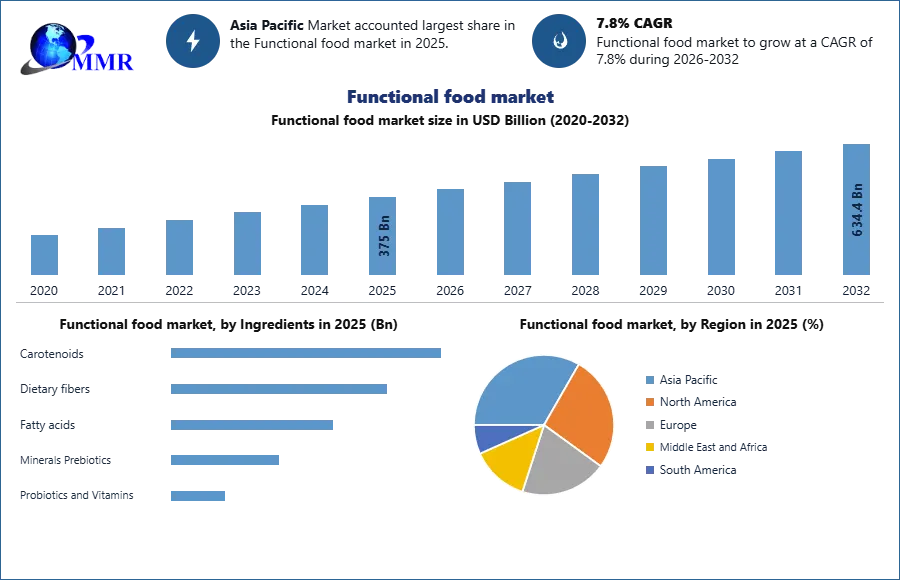
- Functional Food Market size was valued at USD 375 Billion in 2025.
- Market revenue is projected to reach nearly USD 634.4 Billion by 2032.
- The industry is expected to grow at a CAGR of 7.8% between 2026 and 2032.
- Preventive healthcare is becoming a core driver of food purchasing decisions.
- Functional ingredients are moving from niche wellness products into mainstream consumption.
- Product innovation focused on immunity, digestive health, and nutrition enhancement is expanding category penetration.
- Competition is intensifying as food manufacturers seek differentiation through science-backed formulations and health claims.
Why This Matters Now
Food companies face a strategic shift that extends beyond taste, convenience, and price. Consumers increasingly expect food products to contribute to measurable health outcomes.
The Functional Food Market reached USD 375 Billion in 2025. That scale signals that wellness-focused consumption is no longer a specialty segment. It has become a core revenue pool for food manufacturers, retailers, ingredient suppliers, and investors.
The market is forecast to reach USD 634.4 Billion by 2032, growing at a CAGR of 7.8%. For businesses, that growth indicates sustained consumer willingness to pay for products associated with immunity support, digestive health, nutrition enhancement, and overall well-being.
Market Overview
The global food industry is entering a period where nutrition is becoming a competitive differentiator. Functional foods sit at the center of this transition. Consumers increasingly evaluate products based on health benefits alongside traditional purchasing factors.
The market’s projected expansion from USD 375 Billion in 2025 to USD 634.4 Billion by 2032 represents more than category growth. It reflects a broader reallocation of consumer spending toward products perceived as supporting long-term health outcomes.
Manufacturers are responding by expanding portfolios that combine nutritional value with everyday consumption habits. The result is a market where health-focused innovation increasingly determines shelf space, brand loyalty, and pricing power.
Key Trends Driving Growth
Preventive healthcare is emerging as a major force in food purchasing behavior. Consumers are seeking ways to support health through daily dietary choices rather than relying solely on medical interventions. This creates recurring demand rather than occasional purchases.
Health and wellness have moved from lifestyle preferences to mainstream priorities. As consumers become more informed about nutrition, demand is rising for products that deliver specific functional benefits.
Clean-label expectations are also influencing product development. Consumers increasingly scrutinize ingredient lists and favor products perceived as natural, transparent, and minimally processed. This trend is pushing manufacturers to reformulate products while maintaining efficacy and taste.
Innovation remains another growth engine. Companies are introducing products that address immunity support, digestive health, energy management, and nutritional enhancement. Faster product cycles are creating opportunities for brands that can quickly align with changing consumer needs.
Digital commerce is expanding market reach. E-commerce platforms provide consumers with access to a broader range of health-oriented products while allowing brands to communicate product benefits directly. This improves consumer education and accelerates category adoption.
𝐃𝐨𝐰𝐧𝐥𝐨𝐚𝐝 𝐏𝐃𝐅 𝐁𝐫𝐨𝐜𝐡𝐮𝐫𝐞 @https://www.maximizemarketresearch.com/request-sample/101443/
Segment Insights
- Dominant Segment: Information not specified in the supplied source.
- Fastest-Growing Segment: Information not specified in the supplied source.
- Functional foods continue to gain traction as consumers seek products offering benefits beyond basic nutrition.
- Health-focused product categories are benefiting from increased awareness around wellness and disease prevention.
- Innovation in ingredient formulation remains a critical differentiator for manufacturers.
- Consumer demand is increasingly centered on products that integrate nutrition into everyday eating habits.
Regional Growth Story
Functional food adoption is expanding across developed and emerging markets. Rising health awareness, increasing disposable income, and growing access to nutritional information are contributing to market growth.
In mature markets, consumers are seeking advanced nutritional solutions and premium wellness products. In developing economies, rising urbanization and greater exposure to health-focused lifestyles are expanding the consumer base for functional foods.
The result is a broad-based growth pattern that reduces reliance on any single geography. For multinational food companies, this creates opportunities to scale successful product concepts across multiple markets while adapting formulations to local consumer preferences.
Competitive Landscape
Competition in the Functional Food Market is shifting from product availability to credibility and scientific validation. Companies are increasingly competing on evidence-based health claims, ingredient quality, and consumer trust.
This shift signals a higher barrier to entry. Brands that can demonstrate efficacy and transparency are likely to command stronger pricing power and deeper consumer loyalty. Those relying solely on marketing narratives may face growing scrutiny from consumers and regulators.
The competitive environment also suggests continued investment in research, formulation development, and strategic partnerships. Over the next 12 to 24 months, companies with strong innovation pipelines are positioned to capture disproportionate market share as health-conscious consumption expands.
Manufacturers are also expected to pursue portfolio diversification to address multiple wellness categories simultaneously. This strategy reduces dependence on individual product segments and increases resilience against changing consumer trends.
Recent Developments
- Increased industry focus on preventive nutrition and wellness-oriented product development.
- Growing investment in functional ingredients that support targeted health benefits.
- Expansion of health-focused food portfolios by manufacturers seeking premium growth opportunities.
- Greater emphasis on clean-label formulations and ingredient transparency.
- Continued strengthening of digital and direct-to-consumer distribution strategies.
Strategic Implications
The market’s projected growth trajectory creates opportunities across the value chain. Ingredient suppliers can benefit from rising demand for specialized nutritional components. Food manufacturers can capture higher-value consumer segments through differentiated formulations.
Retailers face an opportunity to optimize product assortments around health and wellness categories. Shelf placement, consumer education, and personalized recommendations are becoming increasingly important competitive tools.
Investors should view functional foods as part of a broader shift toward preventive health ecosystems. The convergence of nutrition, wellness, and consumer health creates multiple avenues for long-term value creation.
For brands, success will depend on balancing scientific credibility, product accessibility, and consumer trust. Companies that excel across all three dimensions are likely to outperform category averages.
Future Outlook
The Functional Food Market is expected to reach nearly USD 634.4 Billion by 2032, supported by sustained demand for products that combine convenience with measurable health benefits.
As health consciousness becomes embedded in purchasing decisions, functional foods are likely to move further into mainstream consumption. Innovation, transparency, and nutritional efficacy will increasingly define competitive success.
The next phase of growth will not be determined by who sells food, but by who can convincingly demonstrate health value—creating clear winners and leaving slower-moving competitors behind.
Analyst Perspective
“The Functional Food Market is entering a period where health benefits are becoming a primary purchasing criterion rather than a secondary consideration. Companies that align innovation with consumer wellness priorities and scientific credibility will be best positioned to capture the market’s long-term growth potential.” — Siddhi Dole, Analyst
About Maximize Market Research
Maximize Market Research Pvt. Ltd. (MMR) is a global market research and consulting company that provides reliable, data-focused, and practical business insights. The firm serves a wide range of industries, including healthcare, pharmaceuticals, technology, automotive, electronics, chemicals, personal care, and consumer goods. Through market forecasts, competitive analysis, strategic consulting, and industry impact assessments, MMR helps organizations understand changing market conditions, identify growth opportunities, and make informed business decisions for long-term success.
2nd Floor, Navale IT Park Phase 3
Pune Banglore Highway, Narhe
Pune, Maharashtra 411041, India
+91 9607365656
sales@maximizemarketresearch.com
