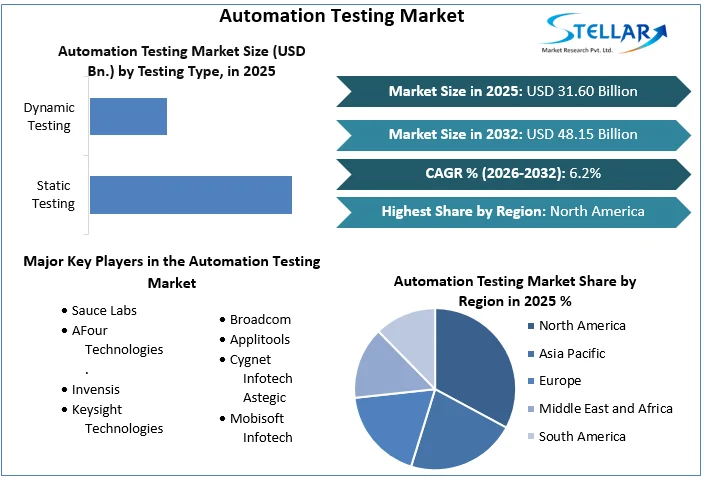
Automation Testing Market valued at USD 31.60 billion in 2025 is projected to reach USD 48.15 billion by 2032, growing at a CAGR of 6.2%. Rising adoption of AI, DevOps, cloud-native applications, and continuous testing frameworks is transforming software quality assurance worldwide.
PUNE, India, June 25, 2026 – The Automation Testing Market is entering a new growth phase as enterprises increasingly integrate AI-driven testing, cloud-based development environments, and continuous delivery pipelines into their software engineering strategies. According to the latest Automation Testing Market Report published by Stellar Market Research, the global market was valued at USD 31.60 billion in 2025 and is expected to reach USD 48.15 billion by 2032, expanding at a CAGR of 6.2% during the forecast period (2026–2032).
Market Opportunity Overview
The software industry is undergoing a structural transformation from traditional quality assurance practices toward intelligent, autonomous testing ecosystems. Organizations are under increasing pressure to accelerate release cycles while maintaining application reliability, security, and compliance.
As enterprises embrace Agile, DevOps, and DevSecOps methodologies, manual testing is proving inadequate for handling complex application architectures, cloud deployments, and frequent software updates. Automation testing is emerging as a strategic enabler, helping businesses reduce testing time, improve release quality, and lower operational costs.
The rapid adoption of artificial intelligence and machine learning technologies is further enhancing automation capabilities, enabling predictive defect detection, self-healing test scripts, and intelligent test orchestration. These developments are creating significant opportunities for technology providers, software vendors, investors, and enterprise buyers.
Download Free PDF Brochure: https://www.stellarmr.com/report/req_sample/Automation-Testing-Market/1385
Key Findings from the Report
- The global Automation Testing Market was valued at USD 31.60 billion in 2025 and is forecast to reach USD 48.15 billion by 2032.
- The market is expected to expand at a 6.2% CAGR between 2026 and 2032.
- By testing type, dynamic testing continues to dominate enterprise adoption due to its effectiveness in validating application behavior during execution.
- Small and medium-sized enterprises (SMEs) are emerging as the fastest-growing user segment as cloud-based testing platforms reduce deployment costs.
- North America remains the leading regional market, supported by high digital maturity and extensive enterprise software investments.
- Asia-Pacific is projected to record the fastest growth, driven by digital transformation initiatives across India, China, Japan, Singapore, and Australia.
- Increasing adoption of AI, cloud computing, IoT applications, and mobile-first software development continues to strengthen demand for automated testing solutions.
Market Drivers and Restraints
Key Drivers
1. Expansion of DevOps and Agile Development
Organizations are adopting continuous integration and continuous deployment (CI/CD) pipelines, creating a strong need for automated testing frameworks that support rapid software releases.
2. Growing AI and Machine Learning Integration
AI-enabled testing tools can automate script creation, defect prediction, and regression testing, improving efficiency while reducing testing cycles.
3. Rising Complexity of Digital Applications
Cloud-native applications, APIs, microservices, and mobile platforms require scalable testing environments that manual processes cannot efficiently support.
Key Restraints
1. High Initial Implementation Costs
Automation infrastructure, tool licensing, integration, and workforce training require substantial upfront investment, particularly for smaller organizations.
2. Shortage of Skilled Automation Engineers
The growing complexity of automation frameworks is creating talent gaps that can delay deployment and reduce testing effectiveness.
Technology, Regulation, and Sustainability Trends
The market is witnessing rapid adoption of AI-assisted testing, low-code automation platforms, and autonomous testing solutions. Self-healing scripts, predictive analytics, and generative AI are increasingly being integrated into enterprise testing workflows.
From a regulatory perspective, sectors such as BFSI, healthcare, and telecommunications are facing stricter compliance requirements related to cybersecurity, privacy, and software reliability. Automated testing helps organizations meet these requirements while reducing audit risks.
Sustainability considerations are also influencing software development strategies. By reducing manual resource requirements and improving infrastructure efficiency through cloud-based testing, enterprises are optimizing operational footprints and improving resource utilization.
Regional Insights
North America Leads Market Adoption
North America remains the dominant market due to strong investments in cloud computing, AI, enterprise software modernization, and quality engineering practices. The United States continues to account for a significant share of automation testing spending across technology, BFSI, healthcare, and retail sectors.
Asia-Pacific Emerges as Growth Engine
Asia-Pacific is expected to witness the highest growth rate during the forecast period. Rapid digitization across India and China, increasing startup activity, expanding cloud infrastructure, and government support for AI adoption are creating favorable conditions for automation testing deployment.
Countries including Japan, Singapore, Australia, and South Korea are also accelerating investments in advanced software engineering and intelligent automation technologies.
Recent Industry Developments
Tricentis (2025): Expanded AI-powered autonomous testing capabilities to support enterprise-scale continuous testing, enhancing software delivery efficiency.
Keysight Technologies (2025): Strengthened AI-driven test automation solutions for next-generation network and software validation applications, supporting 5G and cloud environments.
Sauce Labs (2025): Introduced advanced unified testing capabilities combining web, mobile, and API automation within a single platform, improving enterprise testing productivity.
Applitools (2024): Expanded visual AI testing capabilities to improve user interface validation accuracy and reduce regression testing effort.
Broadcom (2024): Enhanced enterprise testing and quality management offerings through platform integration initiatives designed to support large-scale digital transformation projects.
Competitive Landscape
The Automation Testing Market remains highly competitive, with vendors focusing on AI innovation, platform integration, cloud-native testing, and strategic partnerships.
Major market participants include Sauce Labs, AFour Technologies, Invensis, Keysight Technologies, Broadcom, Applitools, Cygnet Infotech, Astegic, and Mobisoft Infotech. Companies are investing heavily in intelligent automation, AI-enabled testing, low-code solutions, and cloud-based deployment models to strengthen their competitive positions.
Strategic collaborations, acquisitions, and product innovation continue to define competition as vendors seek to address evolving enterprise quality assurance requirements.
Download Free PDF Brochure: https://www.stellarmr.com/report/req_sample/Automation-Testing-Market/1385
Analyst Commentary
“The next phase of growth in automation testing will be defined by intelligent quality engineering rather than traditional script automation. Enterprises are increasingly looking for AI-powered solutions that can accelerate release velocity while maintaining software resilience, security, and compliance. Organizations that successfully integrate autonomous testing into their DevOps ecosystems will gain significant competitive advantages over the coming decade,” said a Senior Research Analyst at Stellar Market Research.
Future Outlook
Through 2032, demand for automation testing solutions is expected to be driven by expanding cloud adoption, AI-enabled software development, growing cybersecurity requirements, and increasing enterprise investments in digital transformation.
As organizations prioritize faster innovation cycles and enhanced software quality, autonomous testing, predictive analytics, and AI-driven quality engineering platforms are expected to become mainstream. Vendors capable of delivering scalable, intelligent, and cost-efficient testing ecosystems will be well-positioned to capitalize on the market’s long-term growth potential.
About Stellar Market Research
Stellar Market Research is a global market research and business consulting firm delivering strategic intelligence across technology, healthcare, manufacturing, consumer goods, energy, and industrial sectors. The company provides comprehensive market forecasts, competitive benchmarking, trend analysis, and customized consulting solutions that help organizations make informed business decisions. Leveraging rigorous research methodologies, data analytics, and industry expertise, Stellar Market Research supports enterprises, investors, policymakers, and stakeholders in identifying growth opportunities, mitigating risks, and navigating rapidly evolving market environments. Its reports combine quantitative insights with strategic analysis to provide actionable intelligence for global decision-makers.
Media Contact
Stellar Market Research
Website: Stellar Market Research – Global Research Reports & Consulting
Email: sales@stellarmr.com
