Market Overview
The Consumer Electronics Sensor Market is experiencing a structural transformation driven by the convergence of artificial intelligence, smart-device adoption, IoT expansion, and semiconductor innovation. Sensors now serve as the interface between digital intelligence and physical environments, enabling devices to capture data, recognize conditions, and automate responses.
What changed is the role of consumer electronics themselves. Devices are no longer passive hardware products. Smartphones recognize gestures, wearables monitor health metrics, smart speakers respond to voice commands, and connected appliances optimize performance through continuous sensing and data analysis.
This evolution is increasing the number of sensors deployed per device. Manufacturers are integrating multiple sensing technologies to improve functionality, enhance personalization, and support increasingly sophisticated software ecosystems.
The business implication is significant. Sensor demand is no longer tied solely to unit shipments. It is increasingly driven by sensor content per device, creating opportunities for semiconductor companies capable of delivering advanced sensing solutions.
Key Trends Driving Growth
Artificial intelligence is fundamentally reshaping sensor requirements. AI-powered consumer electronics require continuous streams of accurate, real-time data. Sensors provide that input, enabling devices to perform contextual analysis, predictive functions, and automated decision-making.
The rapid expansion of IoT ecosystems is creating another major demand catalyst. Connected devices increasingly operate within integrated digital environments where sensors enable communication, monitoring, and automation. This trend supports rising demand across residential, commercial, and industrial applications.
Smartphone innovation remains a key growth driver. Manufacturers continue adding more sophisticated image sensors, motion sensors, environmental sensors, and biometric technologies to enhance user experiences. As competition intensifies, sensing capabilities increasingly influence product differentiation.
Wearable technology adoption is expanding sensor deployment opportunities. Fitness trackers, smartwatches, and health-monitoring devices rely on advanced sensing technologies to collect physiological and behavioral data. As digital health ecosystems mature, sensor requirements continue to increase.
Display innovation is also influencing market development. Advanced displays increasingly interact with touch, proximity, motion, and environmental sensors to create more immersive user experiences. This integration strengthens the strategic role of sensing technologies within device architecture.
Miniaturization remains a critical industry priority. Consumers expect more functionality without sacrificing portability. Semiconductor manufacturers are therefore investing in compact sensor technologies capable of delivering higher performance while reducing power consumption.
The growing emphasis on energy efficiency further supports market expansion. Sensors capable of operating with lower power requirements help extend battery life and improve overall device performance, particularly in portable electronics.
Request a Free Sample Copy or View Report Summary: https://www.maximizemarketresearch.com/request-sample/117099/
Segment Insights
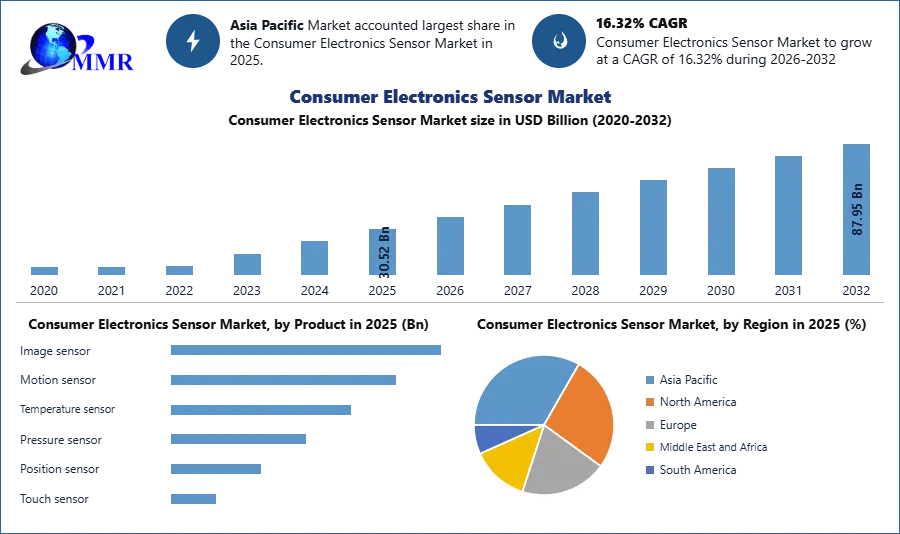
Dominant Segment: Motion Sensors
Motion sensors continue to represent a major segment within the consumer electronics sensor landscape due to their extensive use in smartphones, gaming systems, wearable devices, and smart consumer products.Fastest-Growing Segment: Image Sensors
Image sensors are emerging as one of the fastest-expanding opportunities as consumers demand enhanced photography, video capabilities, facial recognition, and AI-powered imaging applications.Technology Leadership: MEMS Sensors
MEMS-based technologies remain a critical driver of innovation because they enable miniaturization, precision, and integration across a wide range of consumer electronics applications.Application Opportunity: Wearables and Smart Devices
Connected wearables and smart consumer electronics continue creating new demand for compact, high-performance sensor solutions.
Regional Growth Story
Asia-Pacific remains the center of gravity for the Consumer Electronics Sensor Market. The region’s leadership is supported by extensive semiconductor manufacturing infrastructure, electronics production capacity, and strong consumer demand for connected technologies.
China continues to play a pivotal role because of its scale in consumer electronics manufacturing, smartphone production, and component supply chains. The country’s position within global electronics ecosystems provides significant advantages for sensor suppliers.
Taiwan remains strategically important due to its semiconductor manufacturing expertise and foundry leadership. As advanced sensors become increasingly integrated with AI processors and system-on-chip architectures, Taiwan’s role within the value chain becomes even more significant.
South Korea contributes through leadership in consumer electronics, semiconductor technologies, and display manufacturing. Sensor demand benefits directly from the country’s innovation capabilities across smartphones, wearables, and connected devices.
Japan continues to influence the market through precision manufacturing, advanced materials expertise, and sensor innovation. Its established position in high-performance electronics supports ongoing technology development.
India is emerging as a promising growth market due to increasing smartphone penetration, digital transformation initiatives, and expanding electronics manufacturing activity. As domestic production scales, sensor demand is expected to strengthen across multiple device categories.
North America and Europe remain important innovation centers, particularly for AI applications, semiconductor research, and next-generation consumer technology development.
Competitive Landscape
Competition in the Consumer Electronics Sensor Market increasingly centers on intelligence rather than sensing alone. Companies are competing to deliver sensors capable of supporting AI-driven functionality, edge computing applications, and connected-device ecosystems.
The most important strategic signal is the growing convergence between sensors, processors, software platforms, and cloud infrastructure. Sensor suppliers are no longer competing solely on hardware specifications. They are becoming participants in broader digital ecosystems where data quality and interoperability create competitive advantages.
Investment in MEMS technologies, advanced packaging, and sensor miniaturization demonstrates how manufacturers are preparing for increasingly sophisticated consumer devices. These investments also signal confidence in long-term demand growth driven by AI adoption and IoT expansion.
For semiconductor companies, sensor innovation represents an opportunity to increase value creation across the device architecture. Higher-performance sensing solutions can improve ecosystem control, strengthen OEM relationships, and support premium pricing strategies.
The competitive landscape also highlights increasing importance of supply-chain resilience. Companies capable of maintaining reliable production capacity while delivering technological innovation are likely to gain strategic advantages as electronics demand continues expanding.
Recent Developments
Increased adoption of AI-enabled sensing technologies across consumer electronics.
Growing deployment of MEMS sensors in smartphones, wearables, and connected devices.
Expansion of smart-home ecosystems driving additional sensor demand.
Continued miniaturization efforts to support compact device designs.
Rising investment in low-power sensor technologies and energy-efficient architectures.
Strategic Implication
For semiconductor manufacturers, sensors represent one of the most scalable opportunities within the broader AI-device ecosystem. Every connected device requires sensing capabilities, creating recurring demand across multiple product categories.
For electronics OEMs, sensor innovation offers pathways to product differentiation, improved user experiences, and ecosystem expansion. Advanced sensing capabilities increasingly influence purchasing decisions and brand loyalty.
For investors, the market provides exposure to several long-term technology trends simultaneously, including artificial intelligence, IoT adoption, smart devices, edge computing, and digital-health ecosystems.
Supply chains are also adapting. Manufacturers are prioritizing localized production, advanced packaging capabilities, and diversified sourcing strategies to improve resilience and support future demand growth.
Future Outlook
The next phase of the Consumer Electronics Sensor Market will be defined by intelligent sensing systems capable of enabling autonomous decision-making across billions of connected devices. As AI moves from the cloud to the edge, sensors will become increasingly critical to device functionality, user experience, and ecosystem value creation.
The companies that successfully combine advanced sensing technologies, semiconductor innovation, AI integration, and scalable manufacturing will shape the future of intelligent electronics, while those that remain dependent on legacy component strategies risk being excluded from the next generation of connected-device leadership.
Analyst Perspective
“Consumer electronics sensors are becoming a strategic enabler of artificial intelligence, IoT expansion, and next-generation user experiences. Organizations that invest in advanced sensing technologies, miniaturization, and ecosystem integration will be best positioned to capture long-term value as intelligent devices become increasingly pervasive.” — Rucha Deshpande, Analyst
About Maximize Market Research
Maximize Market Research Pvt. Ltd. (MMR) is a global market research and consulting company that provides reliable, data-focused, and practical business insights. The firm serves a wide range of industries, including healthcare, pharmaceuticals, technology, automotive, electronics, chemicals, personal care, and consumer goods. Through market forecasts, competitive analysis, strategic consulting, and industry impact assessments, MMR helps organizations understand changing market conditions, identify growth opportunities, and make informed business decisions for long-term success.
2nd Floor, Navale IT Park Phase 3
Pune Banglore Highway, Narhe
Pune, Maharashtra 411041, India
+91 9607365656
sales@maximizemarketresearch.com
