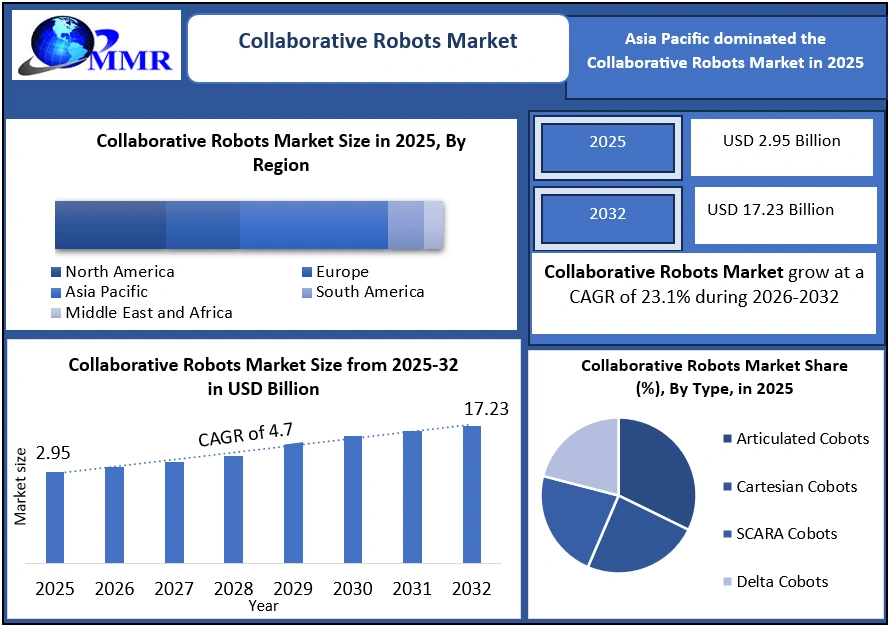
Market Overview
The Global Collaborative Robotics Market is evolving rapidly as organizations seek flexible automation solutions capable of adapting to increasingly complex manufacturing requirements. Unlike traditional industrial robots that typically operate within isolated environments, collaborative robots are designed to work safely alongside human workers.
What changed is the economics of automation. Manufacturers increasingly require systems that can be deployed quickly, reconfigured easily, and integrated into existing production environments without extensive infrastructure modifications.
Collaborative robots address these requirements by combining intelligent sensing, safety technologies, machine vision, and advanced software capabilities. Their flexibility allows organizations to automate a broader range of tasks while maintaining operational agility.
For semiconductor suppliers, this trend creates sustained demand across multiple technology categories. Collaborative robots require sensors, embedded processors, connectivity solutions, memory components, power management systems, and edge-computing capabilities to operate effectively.
The result is a market closely connected to broader developments in AI, industrial IoT, smart manufacturing, and next-generation automation technologies.
Key Trends Driving Growth
Artificial intelligence is fundamentally changing collaborative robotics capabilities. Modern systems increasingly use AI algorithms to improve perception, object recognition, motion planning, and adaptive decision-making. This evolution enables robots to operate more effectively within dynamic production environments.
Industry 4.0 adoption remains a major growth catalyst. Manufacturers are investing in connected factories where machines, software platforms, and production systems exchange information in real time. Collaborative robots serve as critical components within these digital manufacturing ecosystems.
Electronics manufacturing is becoming an important deployment area. The industry’s demand for precision, consistency, and scalability makes collaborative robots attractive for assembly, inspection, testing, and material-handling applications.
IoT integration is creating additional opportunities. Connected robots can share operational data, support predictive maintenance, and contribute to broader factory analytics initiatives. These capabilities improve productivity while reducing downtime.
Edge computing is further enhancing robotic performance. By processing data closer to the point of operation, collaborative robots can respond more quickly to environmental changes and operational requirements. This trend increases demand for advanced embedded processing technologies.
Labor market challenges are also accelerating adoption. Manufacturers worldwide face workforce shortages, rising labor costs, and increasing pressure to maintain productivity. Collaborative robots help organizations address these challenges without eliminating the need for skilled human workers.
Advances in machine vision and sensor technologies continue improving functionality. Enhanced perception capabilities enable robots to operate safely in shared environments while performing increasingly complex tasks.
Request a Free Sample Copy or View Report Summary: https://www.maximizemarketresearch.com/request-sample/15112/
Segment Insights
Dominant Segment: Manufacturing Applications
Manufacturing remains the largest application segment due to widespread adoption of collaborative robots across production, assembly, inspection, and material-handling operations.Fastest-Growing Segment: Electronics and Precision Manufacturing
Electronics manufacturing is emerging as one of the fastest-growing opportunities because of increasing requirements for accuracy, consistency, and operational flexibility.Technology Driver: AI-Enabled Collaborative Systems
Artificial intelligence is enhancing robotic adaptability, perception, and decision-making capabilities, enabling broader deployment across industrial environments.Emerging Opportunity: Smart Factory Integration
Integration with connected manufacturing ecosystems is expanding the strategic role of collaborative robots within digital production environments.
Regional Growth Story
Asia-Pacific remains the center of gravity for collaborative robotics adoption due to its strong manufacturing base, electronics production capacity, and industrial automation investments. The region’s leadership reflects the growing importance of advanced manufacturing technologies in maintaining global competitiveness.
China continues to play a pivotal role because of its extensive manufacturing ecosystem and commitment to industrial modernization. Investments in smart factories, automation technologies, and advanced manufacturing systems continue driving demand for collaborative robots.
Japan remains a global leader in robotics innovation. Its expertise in automation, precision engineering, and advanced manufacturing supports continued market development and technology advancement.
South Korea contributes through leadership in electronics manufacturing, semiconductor production, and industrial technology deployment. The country’s emphasis on smart manufacturing strengthens demand for intelligent robotic systems.
Taiwan’s role is increasingly important due to its position within global semiconductor and electronics supply chains. As collaborative robots become more common within electronics production environments, Taiwan’s manufacturing ecosystem benefits from increased automation investment.
India is emerging as a promising growth market. Expanding manufacturing activity, government-led industrial initiatives, and increasing interest in automation technologies are creating opportunities for collaborative robotics providers.
North America remains an innovation hub driven by advanced manufacturing initiatives, AI development, and industrial digitalization efforts. The United States continues investing in automation technologies designed to improve productivity and strengthen manufacturing resilience.
Europe also plays a significant role, particularly in automotive manufacturing, industrial automation, and Industry 4.0 deployment. Germany remains a major contributor due to its advanced engineering capabilities and commitment to smart factory development.
Competitive Landscape
Competition in the Global Collaborative Robotics Market increasingly revolves around intelligence rather than hardware alone. Manufacturers are investing heavily in AI capabilities, machine vision systems, advanced sensing technologies, and software platforms that improve robotic performance and usability.
This shift signals a broader transformation across industrial automation markets. The value of collaborative robots increasingly depends on their ability to operate as intelligent participants within connected manufacturing ecosystems rather than as standalone machines.
The competitive landscape also reflects growing convergence between robotics and semiconductor industries. Advances in embedded processing, edge computing, connectivity, and sensor technologies directly influence robotic capabilities and deployment potential.
Companies investing in AI integration and ecosystem interoperability are positioning themselves to capture greater long-term value. Their efforts indicate that future competition will focus on intelligent automation platforms rather than individual robotic units.
Supply-chain resilience is another strategic priority. Manufacturers increasingly seek automation partners capable of delivering reliable technology, scalable production capacity, and long-term support across global operations.
For semiconductor suppliers, collaborative robotics creates opportunities to participate in one of the most rapidly evolving segments of industrial technology. Every increase in robotic intelligence translates into additional demand for advanced electronic components.
Recent Developments
Increased deployment of AI-enabled collaborative robotics across manufacturing environments.
Growing adoption of collaborative robots within electronics production facilities.
Expansion of Industry 4.0 and smart factory initiatives worldwide.
Rising integration of IoT connectivity and edge-computing capabilities.
Continued advancements in machine vision, sensing technologies, and robotic safety systems.
Strategic Implications
For semiconductor manufacturers, collaborative robotics represents a long-term demand engine for processors, sensors, memory devices, connectivity modules, and power-management technologies.
For electronics OEMs, collaborative robots offer opportunities to improve production efficiency, product quality, and manufacturing flexibility while supporting digital transformation objectives.
For investors, the market provides exposure to multiple structural growth themes, including artificial intelligence, industrial automation, smart manufacturing, Industry 4.0, and industrial IoT.
Supply chains are also evolving. Manufacturers increasingly prioritize automation investments that improve resilience, reduce operational risk, and enhance responsiveness to changing market conditions.
Future Outlook
The next phase of the Global Collaborative Robotics Market will be defined by deeper integration between artificial intelligence, semiconductor innovation, industrial IoT, and smart manufacturing ecosystems. Collaborative robots will increasingly function as intelligent industrial agents capable of learning, adapting, and optimizing production processes in real time.
The companies that successfully combine AI-driven robotics, advanced semiconductor architectures, scalable automation platforms, and connected manufacturing ecosystems will lead the next era of industrial productivity, while those dependent on static automation models risk falling behind in the intelligent factory economy.
Analyst Perspective
“Collaborative robotics is transforming industrial automation by combining human expertise with machine intelligence. Organizations that invest in AI-enabled robotics, semiconductor innovation, and connected manufacturing ecosystems will be best positioned to capture value from the next generation of smart factory development,” — Rucha Deshpande, Analyst
About Maximize Market Research
Maximize Market Research Pvt. Ltd. (MMR) is a global market research and consulting company that provides reliable, data-focused, and practical business insights. The firm serves a wide range of industries, including healthcare, pharmaceuticals, technology, automotive, electronics, chemicals, personal care, and consumer goods. Through market forecasts, competitive analysis, strategic consulting, and industry impact assessments, MMR helps organizations understand changing market conditions, identify growth opportunities, and make informed business decisions for long-term success.
2nd Floor, Navale IT Park Phase 3
Pune Banglore Highway, Narhe
Pune, Maharashtra 411041, India
+91 9607365656
sales@maximizemarketresearch.com
