Market Overview
The Smartphone Sensors Market is evolving from a component-driven segment into a strategic pillar of the mobile semiconductor ecosystem. Sensors now influence nearly every aspect of smartphone performance, including photography, navigation, security, gaming, augmented reality, power management, and user interaction.
What changed is the growing intelligence of smartphones. Modern devices rely on multiple integrated sensors operating simultaneously to support real-time data collection and machine-learning applications. This transformation has significantly increased semiconductor content per device.
Smartphone manufacturers increasingly compete through differentiated user experiences. Sensor technologies enable many of those experiences by providing the raw data needed for AI-driven decision-making and contextual computing.
For semiconductor suppliers, this evolution creates sustained opportunities across imaging sensors, MEMS technologies, motion sensors, environmental sensors, proximity sensors, biometric components, and integrated sensing platforms.
As mobile devices become increasingly intelligent, sensors are transitioning from supporting components to core technology enablers.
Key Trends Driving Growth
Artificial intelligence remains one of the most influential forces shaping the smartphone sensors market. AI-enabled smartphones depend on sensor-generated data to support facial recognition, gesture control, computational photography, predictive functionality, and adaptive user experiences.
Camera innovation continues to be a major growth engine. Smartphone manufacturers increasingly compete on imaging performance, creating demand for advanced image sensors capable of supporting higher-quality photography and video applications. This trend directly benefits semiconductor companies focused on sensor technologies.
The expansion of 5G ecosystems is creating additional opportunities. Faster connectivity enables more sophisticated mobile applications, increasing the importance of sensors that support location awareness, motion detection, augmented reality, and intelligent device interaction.
Edge computing is becoming increasingly relevant. Rather than relying exclusively on cloud processing, smartphones now perform more AI workloads directly on-device. Sensor technologies provide critical data inputs that make real-time edge intelligence possible.
The growth of immersive digital experiences is further accelerating adoption. Applications involving gaming, augmented reality, virtual collaboration, and spatial computing require highly accurate sensing technologies capable of supporting real-time environmental interaction.
MEMS technology advancement is also strengthening the market. Improvements in miniaturization, energy efficiency, and integration are enabling manufacturers to incorporate more sensing capabilities without increasing device size or power consumption.
Consumer demand for health, fitness, and wellness functionality is creating additional momentum. Smartphones increasingly serve as personal monitoring and tracking devices, expanding the role of environmental and motion-related sensors.
The rise of smart-device ecosystems contributes another layer of demand. Smartphones increasingly function as central control hubs connecting wearables, smart-home devices, vehicles, and IoT platforms. Sensor intelligence supports seamless interaction across these connected environments.
Request a Free Sample Copy or View Report Summary: https://www.maximizemarketresearch.com/request-sample/62866/
Segment Insights
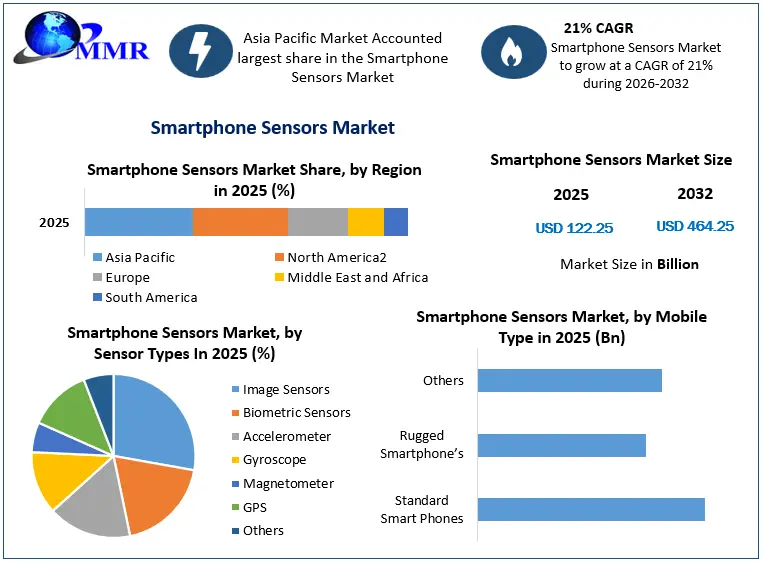
Dominant Segment: Image Sensors
Image sensors remain the dominant segment due to the growing importance of smartphone photography, video creation, and AI-enhanced imaging capabilities. Their role in device differentiation continues expanding across premium and mainstream smartphone categories.Fastest-Growing Segment: Biometric and Intelligent Sensing Technologies
Advanced biometric sensors are experiencing strong adoption as manufacturers prioritize security, authentication, and personalized user experiences.Technology Driver: AI-Integrated Sensor Platforms
Sensor technologies increasingly work alongside AI processors to enable real-time analysis, contextual awareness, and adaptive device behavior.Emerging Opportunity: Augmented Reality and Spatial Computing Applications
New immersive applications are creating demand for increasingly sophisticated sensing architectures capable of accurately understanding physical environments.
Regional Growth Story
Asia-Pacific remains the center of global smartphone sensor demand due to its dominant position in electronics manufacturing, smartphone production, and semiconductor supply chains.
China continues to influence market dynamics through large-scale smartphone manufacturing capabilities and growing investments in semiconductor technologies. The country’s consumer electronics ecosystem creates substantial demand for advanced sensor components.
South Korea plays a critical role through leadership in smartphone innovation, semiconductor manufacturing, and advanced display technologies. Its technology ecosystem supports continuous advancement in sensing capabilities.
Taiwan remains strategically important due to its position within the global semiconductor value chain. Foundry leadership and advanced manufacturing capabilities contribute directly to sensor production and innovation.
Japan continues to maintain significance through expertise in imaging technologies, precision electronics, and advanced sensor development. The country’s long-standing leadership in imaging systems supports market growth.
India is emerging as a major opportunity due to expanding smartphone adoption, electronics manufacturing initiatives, and growing domestic demand for connected devices. Increasing local manufacturing activity supports broader supply-chain diversification efforts.
North America remains an important innovation hub driven by AI development, semiconductor research, and premium smartphone demand. The United States continues influencing technology roadmaps through investments in advanced computing and intelligent mobile experiences.
Europe contributes through research activities, semiconductor innovation, and growing interest in AI-enabled consumer electronics technologies.
Competitive Landscape
Competition in the Smartphone Sensors Market increasingly revolves around intelligence, integration, and performance rather than standalone hardware specifications. Sensor manufacturers are investing heavily in AI compatibility, miniaturization, power efficiency, and multi-function sensing architectures.
This shift signals broader changes across the semiconductor industry. As AI becomes a core smartphone capability, sensors are becoming strategic assets that directly influence device differentiation and user experience quality.
Advanced packaging technologies are playing a larger role in competitiveness. Greater integration enables manufacturers to deliver enhanced functionality while maintaining compact device designs. This trend benefits semiconductor companies capable of combining sensing, processing, and connectivity technologies efficiently.
The market also reflects growing convergence between hardware and software ecosystems. Sensor value increasingly depends on how effectively data can be processed, interpreted, and transformed into meaningful user experiences.
Supply-chain resilience remains a priority. Smartphone manufacturers seek dependable access to advanced sensor technologies while reducing exposure to component shortages and geopolitical disruptions.
For semiconductor companies, sensor leadership increasingly translates into ecosystem influence, pricing power, and long-term participation in future AI-device platforms.
Recent Developments
Increased integration of AI-enabled sensing capabilities within smartphones.
Continued advancement of image sensor technologies for computational photography.
Expansion of biometric authentication features across smartphone categories.
Growing adoption of augmented reality and immersive mobile applications.
Enhanced focus on low-power, high-performance MEMS sensor technologies.
Strategic Implications
For semiconductor manufacturers, smartphone sensors represent one of the most scalable opportunities within the consumer electronics ecosystem. Growing sensor content per device supports demand for advanced fabrication, packaging, and integration technologies.
For smartphone OEMs, sensor innovation provides a pathway to product differentiation, premium positioning, and enhanced user engagement. Superior sensing capabilities increasingly influence purchasing decisions.
For investors, the market offers exposure to several long-term growth themes including artificial intelligence, edge computing, mobile semiconductor demand, augmented reality, and connected-device ecosystems.
Supply chains will continue adapting as manufacturers seek greater sensor performance, integration efficiency, and resilience across increasingly complex global production networks.
Future Outlook
The next phase of the Smartphone Sensors Market will be shaped by the convergence of artificial intelligence, advanced semiconductor architectures, edge computing, and immersive digital experiences. Sensors will increasingly function as the primary interface between physical environments and intelligent mobile systems.
The companies that successfully combine advanced sensing technologies, AI-ready semiconductor platforms, and scalable manufacturing ecosystems will define the next generation of mobile computing, while those that treat sensors as commodity components risk losing relevance in an AI-first smartphone economy.
Analyst Perspective
“Smartphone sensors have evolved from supporting components into strategic enablers of artificial intelligence, computational photography, and contextual mobile experiences. Companies that lead sensor innovation will play a decisive role in shaping the future of intelligent consumer electronics,” — Rucha Deshpande, Analyst
About Maximize Market Research
Maximize Market Research Pvt. Ltd. (MMR) is a global market research and consulting company that provides reliable, data-focused, and practical business insights. The firm serves a wide range of industries, including healthcare, pharmaceuticals, technology, automotive, electronics, chemicals, personal care, and consumer goods. Through market forecasts, competitive analysis, strategic consulting, and industry impact assessments, MMR helps organizations understand changing market conditions, identify growth opportunities, and make informed business decisions for long-term success.
2nd Floor, Navale IT Park Phase 3
Pune Banglore Highway, Narhe
Pune, Maharashtra 411041, India
+91 9607365656
sales@maximizemarketresearch.com
