AI-Powered Flight Operations Accelerate Growth in Electronic Flight Bag Market
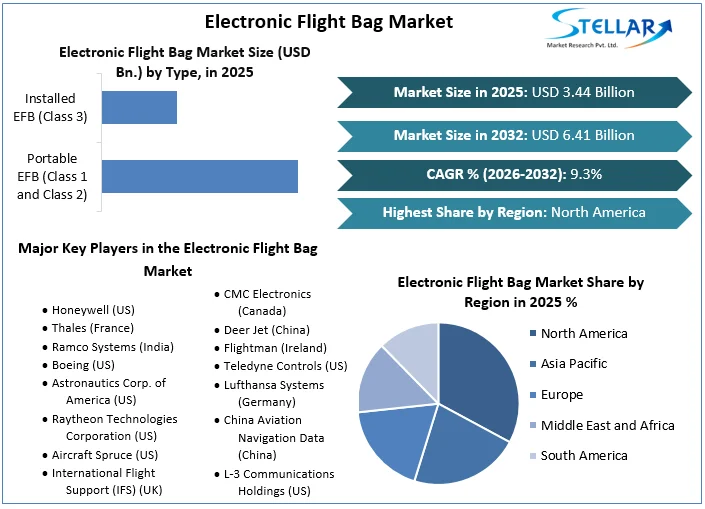
PUNE, India, June 25, 2026 – The Electronic Flight Bag Market is entering a new phase of growth as airlines accelerate digital cockpit transformation, operational efficiency initiatives, and paperless flight operations. According to the latest analysis by Stellar Market Research, the global Electronic Flight Bag (EFB) Market was valued at USD 3.44 billion in 2025 and is projected to reach nearly USD 6.41 billion by 2032, expanding at a CAGR of 9.3% during the forecast period of 2026–2032.
The market is benefiting from rising commercial aviation activity, fleet modernization programs, real-time operational data integration, and increasing regulatory acceptance of electronic documentation. As airlines seek to improve safety, reduce operating costs, and enhance pilot decision-making, EFB platforms are evolving from digital document repositories into intelligent flight operation ecosystems.
Market Opportunity Overview
Aviation is experiencing one of its most significant digital transitions since the introduction of glass cockpits. Airlines worldwide are replacing paper-based flight manuals, navigation charts, and operational documents with integrated EFB systems that combine flight planning, weather intelligence, performance calculations, route optimization, and operational communication into a single platform.
The next growth phase is being driven by cloud-based flight operations, AI-assisted analytics, connected aircraft ecosystems, and sustainability initiatives. Airlines are increasingly recognizing EFBs as strategic assets capable of reducing fuel consumption, improving operational efficiency, minimizing human error, and supporting regulatory compliance. As aviation operators seek greater operational resilience and data-driven decision-making, EFB adoption is becoming a core element of digital aviation strategies.
𝐃𝐨𝐰𝐧𝐥𝐨𝐚𝐝 𝐅𝐫𝐞𝐞 𝐏𝐃𝐅 𝐁𝐫𝐨𝐜𝐡𝐮𝐫𝐞: https://www.stellarmr.com/report/req_sample/Electronic-Flight-Bag-Market/2062
Key Findings from the Report
The Electronic Flight Bag Market was valued at USD 3.44 billion in 2025 and is expected to reach nearly USD 6.41 billion by 2032.
The market is forecast to grow at a CAGR of 9.3% between 2026 and 2032.
Portable EFB solutions continue to dominate adoption due to flexibility, lower implementation costs, and rapid deployment across airline fleets.
Commercial aviation represents the largest application segment as airlines prioritize operational efficiency and digital transformation.
Software platforms are emerging as the fastest-growing component segment as airlines invest in cloud-based operational intelligence.
North America remains the leading regional market due to advanced aviation infrastructure and high digital adoption rates.
Asia-Pacific is expected to be the fastest-growing region, supported by airline fleet expansion, rising passenger traffic, and aviation modernization initiatives.
Market Drivers and Restraints
Key Drivers
Airline Digital Transformation
Airlines are investing heavily in connected flight operations and paperless cockpit initiatives to improve operational efficiency and reduce administrative burden.
Growing Demand for Real-Time Flight Intelligence
Integration of weather data, performance calculations, navigation tools, and operational communications is strengthening the value proposition of modern EFB systems.
Regulatory Acceptance of Electronic Documentation
Aviation authorities globally continue to expand acceptance of digital flight records and electronic operational procedures, encouraging wider EFB deployment.
Key Restraints
High Integration and Deployment Costs
Implementing advanced EFB ecosystems often requires integration with avionics, airline IT infrastructure, and operational systems, increasing upfront investments.
Cybersecurity and Data Protection Risks
As EFB platforms become increasingly connected, operators face growing concerns regarding cybersecurity, data integrity, and system reliability.
Technology, Regulation, and Sustainability Trends
Artificial intelligence, predictive analytics, cloud computing, and real-time connectivity are reshaping EFB capabilities. Next-generation solutions are incorporating intelligent route optimization, predictive maintenance insights, automated compliance management, and enhanced situational awareness.
From a sustainability perspective, EFB adoption supports airlines’ environmental objectives by eliminating paper documentation, reducing aircraft weight, and improving fuel efficiency through optimized flight planning. Regulatory agencies are also encouraging digitization initiatives that improve safety, transparency, and operational consistency across commercial aviation networks.
Regional Insights
North America Leads Market Adoption
North America maintains market leadership due to the presence of major airlines, advanced aviation technology providers, mature regulatory frameworks, and strong investment in digital flight operations. The region continues to pioneer connected cockpit technologies and integrated flight management solutions.
Asia-Pacific Emerges as High-Growth Hub
Asia-Pacific is witnessing rapid EFB adoption as airlines expand fleets and modernize operations. Countries including India, China, Singapore, and Indonesia are investing significantly in aviation infrastructure and digital transformation initiatives. Growing passenger traffic and new aircraft deliveries are creating strong demand for advanced EFB platforms.
Europe Strengthens Digital Aviation Strategy
European carriers continue to invest in sustainable aviation initiatives, digital cockpit modernization, and operational efficiency programs, supporting long-term EFB adoption across commercial and business aviation segments.
Recent Industry Developments
Thales & IndiGo (2025): Thales signed a five-year agreement to extend its AvioBook Electronic Flight Bag platform across IndiGo’s entire fleet, supporting more than 650,000 flights annually and accelerating large-scale digital flight operations.
DextraData Aviation (2025): Introduced Project Apsara, a next-generation EFB platform designed to enhance operational efficiency, safety management, and airline collaboration through integrated digital tools.
DextraData Aviation & Keyvan Aviation (2026): Signed a long-term strategic partnership to integrate advanced navigation, charting, and safety datasets into the Talora next-generation EFB platform.
Fokker Services Group & SriLankan Airlines (2025): Announced fleet-wide deployment of upgraded EFB provisioning solutions across Airbus A320 and A330 aircraft to support next-generation pilot workflows.
AI-Enabled EFB Innovation (2025): Industry participants launched AI-powered EFB capabilities focused on fuel optimization, advanced analytics, and real-time operational intelligence, signaling a shift toward intelligent cockpit ecosystems.
Competitive Landscape
The Electronic Flight Bag Market features a mix of aviation technology providers, avionics manufacturers, software developers, and digital flight operations specialists. Market participants are competing through cloud-based platforms, AI-enabled analytics, strategic airline partnerships, product innovation, and integrated operational ecosystems.
Leading companies are emphasizing software innovation, connectivity solutions, cybersecurity enhancements, and fleet-wide deployment strategies to strengthen market positioning. Long-term airline contracts, platform interoperability, and regulatory compliance capabilities remain critical differentiators in the competitive landscape.
𝐃𝐨𝐰𝐧𝐥𝐨𝐚𝐝 𝐅𝐫𝐞𝐞 𝐏𝐃𝐅 𝐁𝐫𝐨𝐜𝐡𝐮𝐫𝐞: https://www.stellarmr.com/report/req_sample/Electronic-Flight-Bag-Market/2062
Analyst Commentary
“The Electronic Flight Bag market is evolving beyond digital documentation toward becoming the operational intelligence layer of modern aviation. Future growth will be driven by AI-enabled decision support, connected aircraft ecosystems, and airlines’ pursuit of greater efficiency, safety, and sustainability,” said a Senior Research Analyst at Stellar Market Research.
Future Outlook
Through 2032, the Electronic Flight Bag Market is expected to benefit from expanding airline fleets, increasing digitalization of flight operations, regulatory support for paperless aviation, and advancements in AI-driven cockpit technologies. The convergence of cloud computing, predictive analytics, real-time connectivity, and sustainability objectives will continue to reshape competitive dynamics and create new opportunities across commercial, military, and business aviation sectors.
About Stellar Market Research
Stellar Market Research is a global market research and consulting company delivering actionable business intelligence across multiple industries. The company provides comprehensive market forecasts, competitive benchmarking, strategic analysis, and customized consulting services designed to support informed business decisions. Through rigorous primary research, advanced analytics, and deep industry expertise, Stellar Market Research helps organizations identify growth opportunities, assess market risks, and develop sustainable competitive strategies. Its research portfolio spans aerospace, defense, healthcare, chemicals, technology, consumer goods, automotive, energy, and industrial sectors worldwide.
Media Contact
Stellar Market Research
Email: sales@stellarmr.com
