Digital Luxury and Premium Fashion Experiences Reshape Premium Apparel Market
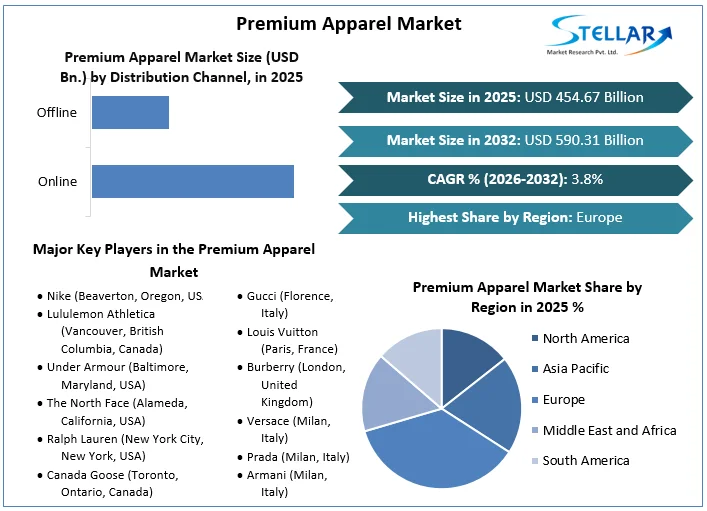
PUNE, India, June 25, 2026 – The Premium Apparel Market is experiencing a significant transformation as luxury fashion brands accelerate digital engagement, premiumization strategies, and direct-to-consumer expansion. According to the latest analysis by Stellar Market Research, the global Premium Apparel Market was valued at USD 454.67 billion in 2025 and is expected to reach nearly USD 590.31 billion by 2032, growing at a CAGR of 3.8% during the forecast period of 2026–2032.
Growing disposable incomes, evolving consumer preferences toward quality-focused fashion, and the increasing influence of social media and digital retail platforms are reshaping how premium apparel brands engage consumers worldwide. The market is witnessing a strategic shift from traditional luxury positioning toward digitally connected, experience-driven fashion ecosystems.
Market Opportunity Overview
The premium apparel industry is moving beyond conventional luxury retail toward a model centered on personalization, exclusivity, sustainability, and digital accessibility. Consumers increasingly view premium fashion as an extension of identity, lifestyle, and social expression rather than simply a status symbol.
Digital transformation has emerged as the defining force within the industry. Social commerce platforms, influencer-led marketing, virtual fashion experiences, AI-powered personalization, and omnichannel retail strategies are enabling premium apparel brands to expand their reach among younger demographics. This democratization of luxury is creating new growth opportunities while simultaneously challenging brands to maintain exclusivity and brand prestige.
Additionally, growing demand for sustainable materials, ethical sourcing, and premium athleisure collections is creating fresh opportunities for brands seeking long-term differentiation in an increasingly competitive global marketplace.
𝐃𝐨𝐰𝐧𝐥𝐨𝐚𝐝 𝐅𝐫𝐞𝐞 𝐏𝐃𝐅 𝐁𝐫𝐨𝐜𝐡𝐮𝐫𝐞: https://www.stellarmr.com/report/req_sample/Premium-Apparel-Market/1848
Key Findings from the Report
The Premium Apparel Market was valued at USD 454.67 billion in 2025 and is projected to reach USD 590.31 billion by 2032.
The market is forecast to expand at a CAGR of 3.8% between 2026 and 2032.
Clothing remains the dominant category segment, accounting for the largest share of premium apparel sales globally.
Online distribution channels are rapidly gaining market share due to social commerce, digital marketing, and direct-to-consumer strategies.
The women’s segment continues to represent the largest consumer base across premium fashion categories.
Europe remains the leading regional market supported by established luxury fashion houses and premium retail infrastructure.
Asia-Pacific is emerging as the fastest-growing market due to rising disposable income, urbanization, and increasing luxury consumption among younger consumers.
Market Drivers and Restraints
Key Drivers
Rising Global Disposable Income
Growing middle-class populations and increasing consumer spending power are driving demand for premium fashion products across both developed and emerging economies.
Digital Transformation of Luxury Retail
Premium apparel brands are leveraging social media, influencer marketing, e-commerce platforms, and AI-driven customer engagement tools to strengthen consumer relationships and expand market reach.
Growing Demand for Premium Lifestyle Products
Consumers increasingly prioritize quality, craftsmanship, exclusivity, and brand heritage, creating sustained demand for premium apparel across multiple demographic segments.
Key Restraints
Blurring Boundaries Between Luxury and Fast Fashion
Younger consumers increasingly mix premium apparel with mainstream fashion brands, creating challenges for traditional luxury positioning and exclusivity.
Economic Uncertainty and Consumer Spending Volatility
Macroeconomic fluctuations, inflationary pressures, and changing consumer priorities may affect discretionary spending on premium fashion products.
Technology, Regulation and Sustainability Trends
Technology is transforming the premium apparel sector through AI-powered personalization, predictive merchandising, virtual fitting rooms, augmented reality shopping experiences, and advanced customer analytics. These innovations are enhancing consumer engagement while improving inventory management and operational efficiency.
Sustainability has become a critical competitive factor. Premium fashion brands are investing in recycled materials, circular fashion programs, traceable supply chains, and environmentally responsible production methods. Consumers increasingly expect transparency regarding sourcing practices, labor standards, and environmental impact, prompting brands to strengthen ESG commitments.
Regulatory scrutiny regarding sustainability disclosures, supply chain transparency, and responsible sourcing practices is also shaping future industry strategies across key markets.
Regional Insights
Europe Leads Global Premium Fashion Consumption
Europe remains the dominant regional market due to its concentration of established luxury brands, strong fashion heritage, premium retail infrastructure, and affluent consumer base. Countries including France, Italy, the United Kingdom, and Germany continue to drive premium apparel demand.
Asia-Pacific Emerges as Growth Engine
Asia-Pacific is expected to register the fastest growth during the forecast period. China, India, South Korea, and Southeast Asian markets are witnessing increasing luxury consumption supported by urbanization, rising incomes, and expanding digital retail ecosystems.
North America Expands Through Digital Retail
North America continues to benefit from premium brand adoption, omnichannel retail innovation, and growing demand for luxury athleisure and lifestyle apparel categories.
Recent Industry Developments
LVMH (2025): Expanded AI-powered clienteling and digital luxury experiences across multiple fashion brands to strengthen consumer engagement and personalization initiatives.
Kering (2025): Increased investments in sustainable material innovation and circular fashion programs to support long-term ESG commitments and premium brand positioning.
Prada Group (2025): Accelerated omnichannel retail transformation through enhanced digital commerce capabilities and luxury customer experience initiatives.
Burberry (2025): Expanded premium outerwear and luxury lifestyle collections while strengthening direct-to-consumer sales channels and digital marketing strategies.
Ralph Lauren (2025): Introduced advanced digital personalization programs and premium lifestyle collections targeting younger affluent consumers across key global markets.
Competitive Landscape
The Premium Apparel Market remains highly competitive, with global fashion houses, luxury brands, and premium lifestyle companies competing through product innovation, brand heritage, digital engagement, sustainability initiatives, and customer experience differentiation.
Leading companies are increasingly focusing on direct-to-consumer strategies, omnichannel retail expansion, celebrity collaborations, social commerce integration, and sustainable product development. Strategic investments in digital transformation and premium customer experiences continue to shape competitive positioning across the market.
𝐃𝐨𝐰𝐧𝐥𝐨𝐚𝐝 𝐅𝐫𝐞𝐞 𝐏𝐃𝐅 𝐁𝐫𝐨𝐜𝐡𝐮𝐫𝐞: https://www.stellarmr.com/report/req_sample/Premium-Apparel-Market/1848
Analyst Commentary
“The future of premium apparel will be defined by brands that successfully combine craftsmanship, exclusivity, digital innovation, and sustainability. Consumers increasingly expect premium fashion to deliver not only quality products but also meaningful experiences, transparency, and personal relevance,” said a Senior Research Analyst at Stellar Market Research.
Future Outlook
Through 2032, the Premium Apparel Market is expected to benefit from rising global affluence, continued digital transformation, increasing demand for sustainable luxury products, and expanding premium consumption across emerging markets. AI-driven personalization, social commerce, circular fashion initiatives, and experiential retail strategies are likely to become central growth drivers. Brands capable of balancing exclusivity with accessibility while maintaining strong sustainability credentials are expected to achieve long-term competitive advantages.
About Stellar Market Research
Stellar Market Research is a global market research and consulting company providing actionable business intelligence across consumer goods, retail, technology, healthcare, automotive, industrial, and energy sectors. The company delivers comprehensive market forecasts, competitive analysis, strategic consulting, and customized research solutions that help organizations identify emerging opportunities, evaluate risks, and make informed business decisions. Through rigorous primary research, advanced analytics, and deep industry expertise, Stellar Market Research supports clients in navigating dynamic market environments and achieving sustainable business growth.
Media Contact
Stellar Market Research
Website: https://www.stellarmr.com
Email: sales@stellarmr.com
