AI-Powered Supply Chains and E-Commerce Expansion Transform FMCG Logistics Market
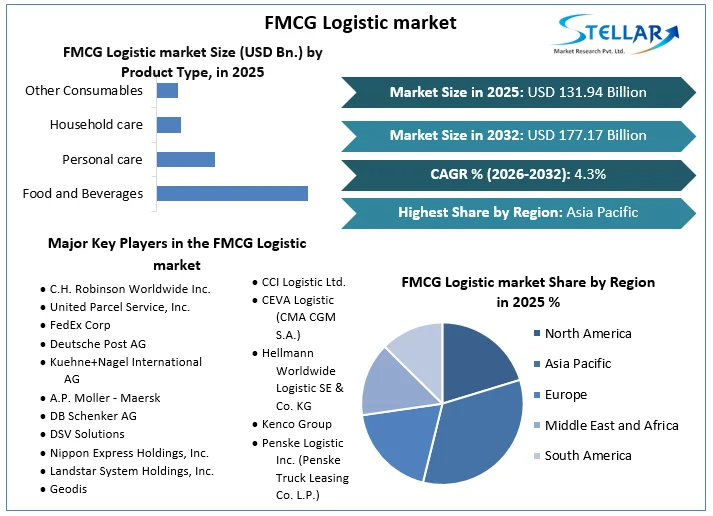
PUNE, India, June 25, 2026 – The FMCG Logistics Market is witnessing rapid transformation as consumer goods companies accelerate investments in digital supply chains, warehouse automation, and last-mile delivery capabilities. According to the latest analysis by Stellar Market Research, the global FMCG Logistics Market was valued at USD 1.12 trillion in 2025 and is projected to reach approximately USD 1.89 trillion by 2032, growing at a CAGR of 7.8% during the forecast period. The market is benefiting from rising e-commerce penetration, increasing consumer demand for faster deliveries, and growing adoption of AI-enabled logistics solutions across global supply networks.
As FMCG manufacturers and retailers navigate evolving consumer expectations and supply chain complexities, logistics providers are increasingly deploying automation, predictive analytics, and real-time visibility platforms to enhance operational efficiency and service reliability. The sector is emerging as a critical enabler of modern retail ecosystems, supporting inventory optimization, rapid replenishment, and seamless omnichannel fulfillment.
Market Opportunity Overview
The FMCG sector is undergoing a major supply chain transformation driven by digital commerce, urbanization, and changing consumer purchasing behavior. Traditional logistics models focused on bulk distribution are being replaced by agile, technology-enabled networks capable of managing high-volume, low-margin product flows with greater speed and accuracy.
The rise of direct-to-consumer business models, quick commerce platforms, and omnichannel retailing is creating substantial opportunities for logistics providers. Companies are investing in automated warehouses, smart transportation systems, AI-driven demand forecasting, and integrated supply chain visibility tools to reduce costs and improve service levels.
In addition, sustainability goals and increasing regulatory scrutiny are encouraging logistics operators to optimize transportation routes, reduce emissions, and invest in greener distribution infrastructure. These shifts are reshaping competitive dynamics and creating new growth avenues across warehousing, transportation, and distribution services.
𝐃𝐨𝐰𝐧𝐥𝐨𝐚𝐝 𝐅𝐫𝐞𝐞 𝐏𝐃𝐅 𝐁𝐫𝐨𝐜𝐡𝐮𝐫𝐞: https://www.stellarmr.com/report/req_sample/FMCG-Logistic-Market/2470
Key Findings from the Report
The FMCG Logistics Market was valued at USD 1.12 trillion in 2025 and is expected to reach approximately USD 1.89 trillion by 2032.
The market is forecast to grow at a CAGR of 7.8% during the forecast period.
Transportation services account for the largest share of market revenue due to extensive distribution requirements across FMCG supply chains.
Road transportation remains the dominant logistics mode because of its flexibility and extensive delivery network coverage.
Warehousing and fulfillment services are expected to witness significant growth as e-commerce volumes continue to increase.
Asia-Pacific holds the largest market share driven by strong FMCG consumption, urbanization, and manufacturing activity.
Emerging markets in Southeast Asia, Latin America, and Africa are creating new logistics investment opportunities.
Market Drivers and Restraints
Key Drivers
Rapid Growth of E-Commerce
The continued expansion of online retail platforms is increasing demand for efficient warehousing, inventory management, and last-mile delivery services. FMCG companies require highly responsive logistics networks to meet evolving customer expectations for speed and convenience.
Warehouse Automation and Digital Transformation
Investments in robotics, AI-powered inventory management systems, warehouse management software, and predictive analytics are improving supply chain efficiency while reducing operational costs.
Rising Urbanization and Consumer Demand
Growing urban populations and rising disposable incomes are driving FMCG consumption worldwide, increasing the need for scalable logistics infrastructure and distribution networks.
Key Restraints
Rising Transportation Costs
Fuel price volatility, labor shortages, and increasing transportation expenses continue to pressure logistics margins and operational profitability.
Supply Chain Disruptions
Geopolitical uncertainties, trade restrictions, infrastructure limitations, and global economic fluctuations can impact supply chain reliability and inventory availability.
Technology, Regulation and Sustainability Trends
Technology is becoming a central pillar of FMCG logistics operations. Artificial intelligence, machine learning, IoT sensors, digital twins, blockchain, and cloud-based supply chain platforms are enabling greater visibility, operational control, and forecasting accuracy across logistics networks.
Warehouse automation continues to gain momentum as companies deploy autonomous mobile robots, automated storage systems, and AI-driven order fulfillment technologies to improve efficiency and reduce labor dependency.
Sustainability has also become a strategic priority. FMCG logistics providers are increasingly investing in electric delivery fleets, route optimization software, alternative fuels, and environmentally friendly packaging solutions to reduce carbon emissions and support corporate ESG commitments.
Regulatory requirements related to emissions reduction, transportation safety, food handling standards, and supply chain transparency are further driving modernization initiatives throughout the logistics ecosystem.
Regional Insights
Asia-Pacific Leads Global FMCG Logistics Market
Asia-Pacific remains the largest regional market due to its massive consumer base, expanding e-commerce sector, strong manufacturing capabilities, and growing urban population. Countries such as China, India, Indonesia, and Vietnam continue to drive significant logistics demand.
North America Focuses on Supply Chain Innovation
North America is experiencing strong growth in logistics technology adoption, warehouse automation, and omnichannel fulfillment capabilities. Retailers and FMCG manufacturers are investing heavily in digital transformation initiatives to improve operational resilience and customer satisfaction.
Europe Accelerates Sustainable Logistics Adoption
European markets are increasingly focused on sustainability initiatives, low-emission transportation systems, and regulatory compliance. Green logistics strategies are becoming a major competitive differentiator across the region.
Emerging Markets Create New Opportunities
Latin America, Africa, and Southeast Asia are witnessing growing FMCG consumption and retail modernization, creating substantial opportunities for logistics infrastructure development and service expansion.
Recent Industry Developments
DHL Supply Chain (2025): Expanded warehouse automation investments and AI-enabled fulfillment capabilities to improve efficiency across consumer goods supply chains.
Maersk (2025): Strengthened integrated logistics services through digital supply chain solutions designed to enhance end-to-end visibility for FMCG customers.
Amazon Logistics (2025): Increased last-mile delivery infrastructure investments and fulfillment center expansion to support growing consumer goods volumes.
FedEx (2025): Advanced network optimization initiatives and data-driven logistics solutions to improve delivery performance and supply chain responsiveness.
UPS (2025): Expanded sustainability-focused logistics programs, including alternative-fuel transportation solutions and carbon reduction initiatives for FMCG distribution networks.
Competitive Landscape
The FMCG Logistics Market is highly competitive and includes global logistics providers, third-party logistics companies, transportation operators, warehousing specialists, and technology-enabled supply chain service providers.
Leading market participants are focusing on automation, digital transformation, strategic partnerships, warehouse expansion, sustainability initiatives, and customer-centric logistics solutions. Investments in AI-powered logistics platforms, predictive analytics, and integrated supply chain management capabilities are becoming key competitive differentiators.
As FMCG supply chains become increasingly complex and consumer expectations continue to evolve, logistics providers that deliver speed, flexibility, visibility, and sustainability are expected to gain long-term market advantages.
𝐃𝐨𝐰𝐧𝐥𝐨𝐚𝐝 𝐅𝐫𝐞𝐞 𝐏𝐃𝐅 𝐁𝐫𝐨𝐜𝐡𝐮𝐫𝐞: https://www.stellarmr.com/report/req_sample/FMCG-Logistic-Market/2470
Analyst Commentary
“The FMCG logistics sector is evolving from a transportation-centric industry into a technology-driven supply chain ecosystem. Companies that successfully combine automation, data intelligence, sustainability, and operational agility will be best positioned to capitalize on future growth opportunities and changing consumer expectations,” said a Senior Research Analyst at Stellar Market Research.
Future Outlook
Through 2032, the FMCG Logistics Market is expected to benefit from sustained growth in e-commerce, increasing demand for rapid fulfillment services, rising investments in supply chain digitalization, and continued expansion of global consumer goods consumption. AI-driven logistics optimization, warehouse automation, real-time visibility platforms, and sustainable transportation solutions will increasingly define competitive success.
As retailers and manufacturers prioritize supply chain resilience and customer experience, logistics providers are expected to play a more strategic role in enabling business growth, operational efficiency, and long-term market competitiveness.
About Stellar Market Research
Stellar Market Research is a global market research and consulting company providing actionable market intelligence, strategic insights, and customized research solutions across multiple industries. The company delivers comprehensive market forecasts, competitive assessments, industry analysis, and business consulting services that help organizations identify growth opportunities and make informed strategic decisions. Leveraging advanced research methodologies, primary interviews, and data-driven analytics, Stellar Market Research supports clients in navigating evolving market environments and achieving sustainable business growth.
Media Contact
Stellar Market Research
Website: https://www.stellarmr.com
Email: sales@stellarmr.com
