Market Overview
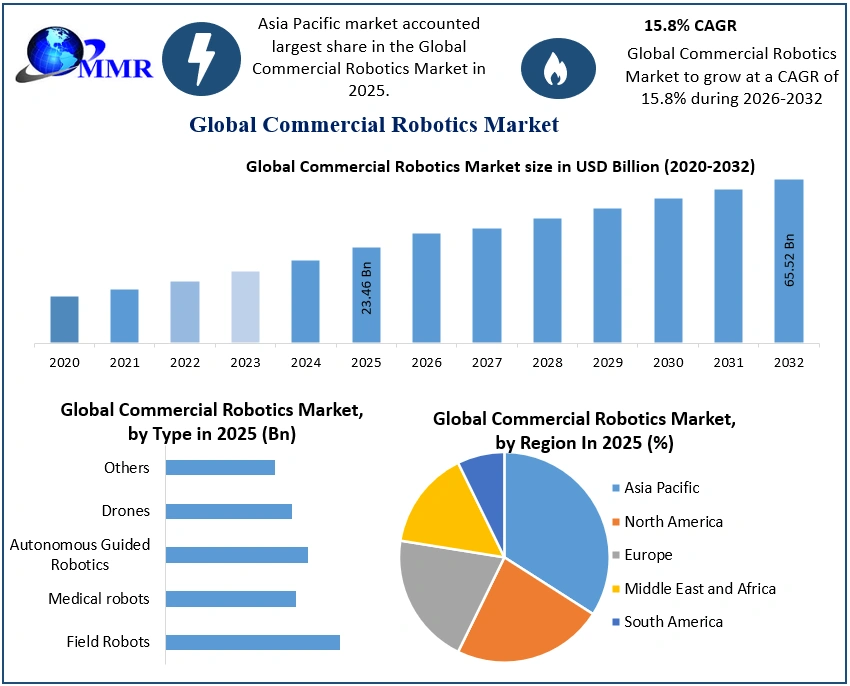
The Commercial Robotics Market is evolving rapidly as businesses deploy automation solutions to improve efficiency, reduce operating costs, address labor shortages, and enhance customer experiences.
What changed is the role robots play within commercial environments. Earlier systems performed predefined repetitive functions. Today’s robots increasingly combine artificial intelligence, advanced sensors, machine vision, and data analytics to support adaptive decision-making.
Commercial robots now operate across warehouses, hospitals, airports, retail environments, hospitality facilities, agricultural operations, and service sectors. Their expanding capabilities are broadening adoption beyond traditional industrial automation applications.
For semiconductor suppliers, this transformation creates a substantial opportunity. Robotics platforms require high-performance processors, embedded computing systems, imaging technologies, memory architectures, communications hardware, and power-management solutions.
As intelligent automation becomes a core business strategy, commercial robotics is emerging as one of the most important growth drivers within the broader electronics and semiconductor ecosystem.
Key Trends Driving Growth
Artificial intelligence remains the primary force reshaping commercial robotics. AI enables robots to interpret data, recognize objects, navigate environments, and make operational decisions in real time. This capability dramatically expands the range of tasks robots can perform.
Machine vision technology is another major catalyst. Advanced imaging systems allow robots to identify products, analyze surroundings, monitor operations, and interact more effectively with dynamic environments. Growing demand for vision-enabled robots directly benefits semiconductor companies specializing in image sensors and AI acceleration technologies.
Edge computing is becoming increasingly important. Commercial robots often operate in environments requiring immediate responses. Local processing capabilities reduce latency while enabling faster and more reliable decision-making.
Labor market challenges are also accelerating adoption. Many industries face workforce shortages, rising labor costs, and increasing productivity requirements. Commercial robotics offers organizations a scalable method for improving operational efficiency.
The growth of e-commerce continues to create demand for logistics automation. Warehousing, fulfillment, and inventory management operations increasingly rely on robotics platforms capable of supporting high-volume, high-speed activities.
Healthcare organizations are expanding robotic deployments as well. Robots support tasks ranging from logistics and facility operations to patient interaction and specialized service applications. Growing healthcare automation creates additional demand for sophisticated electronics and sensing technologies.
IoT integration further enhances robotics capabilities. Connected robots increasingly operate within broader digital ecosystems, sharing information with enterprise software, analytics platforms, and operational management systems.
5G deployment is creating another opportunity. Faster wireless connectivity improves communication, coordination, and real-time control capabilities for autonomous robotic systems operating in distributed environments.
Sustainability initiatives are influencing market strategies as organizations seek technologies capable of improving resource utilization, operational efficiency, and long-term environmental performance.
Request a Free Sample Copy or View Report Summary: https://www.maximizemarketresearch.com/request-sample/39675/
Segment Insights
Dominant Segment: Professional Service Robots
Professional service robots represent the dominant segment as organizations increasingly deploy automation technologies across healthcare, logistics, security, hospitality, and commercial operations.Fastest-Growing Segment: AI-Enabled Autonomous Robotics
Autonomous robotic platforms are experiencing strong adoption due to advances in artificial intelligence, machine learning, and edge-computing capabilities.Technology Driver: Machine Vision and Intelligent Sensing
Advanced sensors and imaging technologies continue expanding robotic perception and operational flexibility.Emerging Opportunity: Connected Robotics Ecosystems
Integration with IoT platforms, enterprise software, and cloud-based analytics is creating new business value across commercial deployments.
Regional Growth Story
North America remains a major center for commercial robotics innovation due to strong investment in artificial intelligence, automation technologies, and advanced semiconductor development. The United States continues driving adoption across logistics, healthcare, retail, and enterprise automation applications.
Asia-Pacific represents a critical growth region supported by electronics manufacturing leadership, robotics innovation, and digital transformation initiatives. The region benefits from extensive semiconductor production capabilities and large-scale automation investments.
China continues expanding its role through investments in robotics development, AI technologies, and advanced manufacturing capabilities. Increasing automation adoption across commercial industries supports long-term market growth.
Japan remains a global leader in robotics innovation. Its expertise in automation, precision engineering, and advanced electronics continues influencing next-generation robotics development.
South Korea contributes through strengths in semiconductors, AI technologies, and intelligent manufacturing systems. These capabilities support increasingly sophisticated commercial robotic platforms.
Taiwan plays a strategic role within the global semiconductor ecosystem. Advanced chip manufacturing capabilities help supply the processors and components required for modern robotics applications.
India is emerging as an attractive growth market due to increasing digital transformation initiatives, expanding service industries, and rising investment in automation technologies.
Europe remains important due to strong industrial automation capabilities, AI research activities, and growing demand for intelligent commercial solutions. Germany’s engineering leadership continues supporting robotics innovation and adoption.
Competitive Landscape
Competition within the Commercial Robotics Market increasingly centers on intelligence, autonomy, and ecosystem integration. Hardware remains important, but competitive differentiation increasingly depends on AI capabilities and software sophistication.
This signals a broader shift across technology markets. Robotics companies are evolving into AI platform providers rather than traditional equipment manufacturers. Organizations capable of delivering autonomous decision-making and continuous learning capabilities are gaining strategic advantages.
Semiconductor innovation is becoming a decisive factor in robotics competitiveness. Improvements in AI processors, edge-computing architectures, memory systems, and sensor technologies directly influence robotic performance.
Advanced packaging technologies are also becoming increasingly relevant. Greater component integration improves power efficiency, computational capability, and system reliability while supporting more compact robotic designs.
The market reflects growing convergence between artificial intelligence, semiconductors, cloud computing, and automation technologies. Success increasingly depends on ecosystem development rather than standalone product capabilities.
Supply-chain resilience remains critical. Reliable access to processors, sensors, memory devices, and communications technologies will influence future robotics deployment strategies.
Recent Developments
Increased deployment of AI-powered autonomous robotic systems.
Expansion of machine vision and intelligent sensing technologies.
Growing adoption of robotics in logistics and warehouse automation.
Enhanced integration between robotics platforms and IoT ecosystems.
Rising investment in edge-computing and AI-enabled robotics architectures.
Strategic Implications
For semiconductor manufacturers, commercial robotics represents a significant long-term growth opportunity. Every deployment increases demand for AI processors, imaging systems, sensors, memory devices, connectivity modules, and advanced packaging technologies.
For electronics OEMs, robotics creates opportunities to expand into intelligent automation platforms supporting diverse commercial applications.
For investors, the market offers exposure to several transformational themes including artificial intelligence, edge computing, digital automation, machine vision, and intelligent enterprise infrastructure.
Organizations that align product strategies with AI-enabled robotics adoption will likely benefit from expanding demand across multiple industries and geographic markets.
Future Outlook
The next phase of the Commercial Robotics Market will be defined by the convergence of artificial intelligence, edge computing, advanced sensing, autonomous decision-making, and semiconductor innovation. Robots will increasingly function as intelligent business platforms capable of executing complex tasks across dynamic commercial environments.
The companies that successfully combine AI leadership, semiconductor excellence, scalable robotics ecosystems, and autonomous intelligence will shape the next generation of commercial automation, while those limited to hardware-centric strategies risk falling behind in an economy increasingly powered by intelligent machines.
Analyst Perspective
“Commercial robotics is rapidly evolving into an AI-driven technology platform that connects automation, data intelligence, and semiconductor innovation. Organizations that invest early in intelligent robotics ecosystems will be best positioned to capture future productivity and competitiveness gains,” — Rucha Deshpande, Analyst
About Maximize Market Research
Maximize Market Research Pvt. Ltd. (MMR) is a global market research and consulting company that provides reliable, data-focused, and practical business insights. The firm serves a wide range of industries, including healthcare, pharmaceuticals, technology, automotive, electronics, chemicals, personal care, and consumer goods. Through market forecasts, competitive analysis, strategic consulting, and industry impact assessments, MMR helps organizations understand changing market conditions, identify growth opportunities, and make informed business decisions for long-term success.
2nd Floor, Navale IT Park Phase 3
Pune Banglore Highway, Narhe
Pune, Maharashtra 411041, India
+91 9607365656
sales@maximizemarketresearch.com
