Market Overview
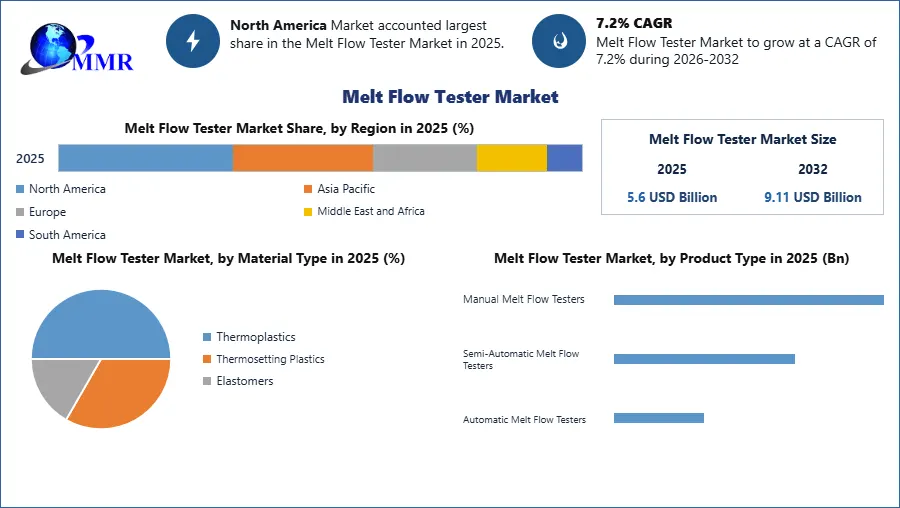
The Global Melt Flow Tester Market is evolving alongside broader transformations in manufacturing, automation, and materials science. According to Maximize Market Research, the market is expected to reach USD 9.11 billion by 2032, rising from USD 5.6 billion in 2025 at a CAGR of 7.2%.
The growth trajectory signals more than rising equipment sales. It reflects a structural shift toward data-driven quality assurance and advanced material characterization across multiple industries. Manufacturers increasingly require precise measurement systems capable of validating material performance before products enter production.
Melt flow testers evaluate the flow characteristics of thermoplastic materials under controlled conditions. The technology helps manufacturers assess consistency, optimize processing parameters, and maintain product quality standards. As industrial applications become more demanding, these systems are moving from quality-control departments into broader operational decision-making processes.
For electronics manufacturers, polymer consistency directly affects component reliability, thermal management, device durability, and assembly performance. The growing complexity of electronic products is therefore creating stronger demand for advanced testing infrastructure.
Key Trends Driving Growth
Automation is emerging as the most important transformation within the market. Manual testing processes are increasingly being replaced by semi-automatic and fully automatic systems that improve measurement accuracy, reduce human intervention, and accelerate throughput.
This trend aligns closely with Industry 4.0 initiatives. Manufacturers are integrating testing systems with digital production environments to create real-time quality monitoring capabilities. The result is faster identification of material deviations and more efficient production management.
Electronics manufacturing growth is creating another major demand catalyst. Modern smartphones, wearable devices, connected sensors, automotive electronics, and industrial IoT systems rely extensively on engineered plastics and advanced polymers. Each new product generation introduces stricter performance requirements that require more comprehensive material validation.
Research and development activities are also expanding testing requirements. Companies developing advanced polymers for electric vehicles, semiconductor packaging, healthcare applications, and industrial automation need reliable testing platforms to accelerate product qualification processes.
Sustainability goals are adding further momentum. Manufacturers increasingly incorporate recycled and alternative materials into production processes. Ensuring consistent performance from these materials requires extensive testing and validation, increasing the strategic importance of melt flow analysis.
Supply-chain diversification is another emerging driver. Manufacturers seeking resilience are qualifying materials from multiple suppliers, creating greater demand for testing systems capable of maintaining quality consistency across complex sourcing networks.
Request a Free Sample Copy or View Report Summary: https://www.maximizemarketresearch.com/request-sample/73025/
Segment Insights
Dominant Segment: Plastic industry applications represent the largest source of demand, reflecting the sector’s dependence on material consistency, process optimization, and quality assurance.
Fastest-Growing Segment: Electronics, automotive, healthcare, and research-driven applications are expanding rapidly as manufacturers require increasingly sophisticated material characterization capabilities.
By Product Type: Manual, semi-automatic, and automatic melt flow testers serve different operational requirements, with automation gaining momentum among large-scale manufacturers.
By Material Type: Thermoplastics, thermosetting plastics, and elastomers remain key testing categories as industries diversify material usage.
By End User: Plastic manufacturers, testing laboratories, chemical companies, educational institutions, and research organizations continue expanding investment in advanced testing systems.
Regional Growth Story
Asia-Pacific remains central to the market’s long-term growth outlook. The region’s expanding manufacturing base, electronics production capacity, and industrial modernization initiatives continue driving demand for materials testing equipment.
China’s position as a global manufacturing powerhouse supports extensive adoption of quality-control technologies. As manufacturers move toward higher-value production and advanced electronics assembly, precision testing systems are becoming increasingly important.
India is benefiting from growing industrialization, electronics manufacturing expansion, and increasing investment in research and development infrastructure. Government initiatives supporting domestic manufacturing are creating additional opportunities for quality-control equipment providers.
Japan, South Korea, and Taiwan continue to play critical roles in advanced electronics and semiconductor ecosystems. The need for highly reliable materials and manufacturing processes supports sustained demand for sophisticated testing solutions.
North America remains a major market due to strong investments in industrial automation, process optimization, and advanced manufacturing technologies. Companies across the United States and Canada continue prioritizing quality assurance as a tool for improving productivity and competitiveness.
Europe’s emphasis on precision engineering, automotive innovation, and industrial quality standards supports steady adoption of advanced testing systems. Germany, France, Italy, and the United Kingdom remain important centers for manufacturing excellence and materials research.
Competitive Landscape
Competition is increasingly focused on precision, automation, software integration, and workflow efficiency. Key market participants include Illinois Tool Works, ZwickRoell, AMETEK, Instron, Dynisco, Goettfert, Shimadzu Corporation, Anton Paar, and Malvern Panalytical.
The competitive landscape highlights a broader shift in industrial manufacturing. Equipment providers are no longer competing solely on measurement capability. They are competing on data integration, operational efficiency, and digital manufacturing compatibility.
For customers, this evolution creates opportunities to transform quality-control functions into strategic assets. Testing platforms capable of integrating with enterprise manufacturing systems can provide actionable production intelligence rather than simple measurement results.
The implications extend into semiconductor and electronics supply chains. As advanced packaging technologies, miniaturized components, and AI-enabled devices increase manufacturing complexity, material validation becomes increasingly critical to production success.
Companies capable of delivering automated, connected, and highly accurate testing solutions are likely to strengthen their competitive position as manufacturers continue investing in smart factory infrastructure.
Recent Developments
Growing adoption of automated and semi-automated melt flow testing systems.
Increased deployment of testing technologies across electronics manufacturing environments.
Rising investment in advanced polymer research and development programs.
Expanding focus on recycled-material qualification and sustainability-driven testing.
Greater integration of testing equipment into Industry 4.0 and smart manufacturing initiatives.
Strategic Implications
For semiconductor manufacturers, advanced polymer testing supports packaging innovation, thermal management development, and component reliability improvements. As packaging technologies become increasingly sophisticated, material consistency becomes a critical performance factor.
For electronics OEMs, melt flow testing contributes to product quality, manufacturing efficiency, and supply-chain flexibility. The ability to validate materials rapidly can shorten development cycles and reduce production risks.
For investors, the market offers exposure to a critical layer of manufacturing infrastructure. Growth is linked to long-term trends including automation, industrial digitization, electronics manufacturing expansion, advanced materials innovation, and sustainability initiatives.
For equipment suppliers, the opportunity extends beyond hardware sales. Software integration, predictive analytics, and digital manufacturing connectivity are emerging as important value drivers that can create stronger customer relationships and recurring revenue opportunities.
Future Outlook
The next generation of manufacturing competitiveness will depend on how effectively companies connect material science, automation, and digital intelligence. Melt flow testing is becoming an essential component of that transformation, enabling manufacturers to validate increasingly complex materials for advanced electronics, semiconductor packaging, electric vehicles, and industrial automation systems. The companies that integrate precision testing into AI-enabled manufacturing ecosystems will define future technology leadership, while those that rely on fragmented quality-control processes risk losing ground in a production environment where every material parameter can determine market success.
Analyst Perspective
“The Melt Flow Tester Market is increasingly becoming a strategic enabler of manufacturing quality, process optimization, and materials innovation. As industries adopt advanced materials and automated production systems, precision testing technologies will play a growing role in supporting competitiveness, reliability, and operational excellence,” said Rucha Deshpande, Analyst.
About Maximize Market Research
Maximize Market Research Pvt. Ltd. (MMR) is a global market research and consulting company that provides reliable, data-focused, and practical business insights. The firm serves a wide range of industries, including healthcare, pharmaceuticals, technology, automotive, electronics, chemicals, personal care, and consumer goods. Through market forecasts, competitive analysis, strategic consulting, and industry impact assessments, MMR helps organizations understand changing market conditions, identify growth opportunities, and make informed business decisions for long-term success.
2nd Floor, Navale IT Park Phase 3
Pune Banglore Highway, Narhe
Pune, Maharashtra 411041, India
+91 9607365656
sales@maximizemarketresearch.com
