Key Highlights
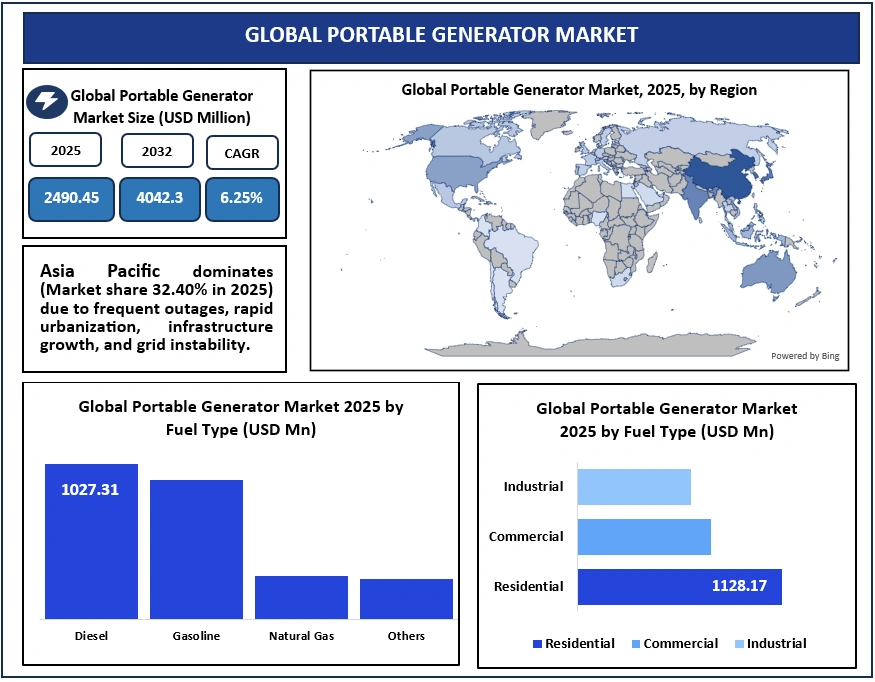
- Portable Generator Market is projected to grow from USD 2,490.45 million in 2025 to USD 4,042.38 million by 2032 at a 6.25% CAGR during 2026–2032.
- Rising grid instability and frequent power interruptions are strengthening long-term demand for portable backup power.
- Residential, commercial, outdoor recreation, construction, and emergency response remain the market’s primary demand centers.
- Infrastructure resilience and disaster preparedness are becoming central investment priorities across major economies.
- Manufacturers are focusing on efficiency, portability, emissions compliance, and digital monitoring capabilities to strengthen competitive positioning.
Why This Matters Now
Reliable electricity has become an economic necessity rather than a convenience. Utilities, businesses, governments, and households are increasingly investing in backup power as extreme weather events, aging grid infrastructure, and rising electricity demand expose vulnerabilities across energy systems.
The Portable Generator Market Size is expected to expand from USD 2,490.45 million in 2025 to USD 4,042.38 million by 2032, growing at a 6.25% CAGR. That trajectory signals more than equipment sales—it reflects a structural shift toward energy resilience, decentralized backup capacity, and greater preparedness for power disruptions across developed and emerging economies.
Market Overview
Energy security has emerged as one of the defining priorities for governments and businesses worldwide. While utilities continue investing in transmission expansion, renewable integration, and digital grid modernization, temporary power interruptions remain unavoidable during natural disasters, maintenance activities, and demand peaks.
Portable generators occupy an increasingly important position within this evolving energy landscape because they provide immediate, mobile, and independent electricity without requiring permanent installation. Residential users seek uninterrupted household operations during outages, while commercial facilities rely on portable systems to minimize operational downtime. Construction, outdoor events, emergency services, and remote industrial projects also continue to depend on mobile power solutions.
As electrification expands across industries and digital infrastructure becomes more critical, the financial cost of power interruptions continues to rise. This strengthens the business case for portable generation across multiple customer segments.
Key Trends Driving Growth
The biggest change is not simply growing electricity demand but changing expectations around reliability. Consumers and businesses increasingly expect continuous power availability regardless of weather conditions or grid performance.
Grid modernization initiatives are expanding globally, yet infrastructure upgrades require years of investment. During this transition, portable generators remain an essential resilience tool capable of providing immediate backup power when centralized networks fail.
Renewable energy deployment is also reshaping market dynamics. Higher penetration of intermittent solar and wind generation increases the importance of flexible backup solutions that support operational continuity during supply variability and maintenance activities.
Infrastructure investments further reinforce demand. Construction projects, transportation upgrades, industrial developments, and remote worksites require dependable temporary electricity before permanent grid connections become available.
Regulatory attention toward emissions and fuel efficiency is encouraging manufacturers to introduce cleaner, quieter, and more technologically advanced products. Digital monitoring, improved engine efficiency, and enhanced portability are becoming important competitive differentiators.
Download the report to explore key trends and growth insights.
Segment Insights
- Dominant Segment: The report identifies the leading market segment based on its analysis. Its leadership reflects broad adoption across established end-use applications where uninterrupted electricity remains operationally critical.
- Fastest-Growing Segment: The report identifies the fastest-growing segment, supported by expanding demand for flexible backup power solutions and increasing investment in resilient energy infrastructure.
- Residential demand continues to benefit from rising awareness of emergency preparedness and increasing weather-related outages.
- Commercial users prioritize operational continuity, protecting business productivity and reducing revenue losses associated with unexpected power failures.
- Industrial and construction applications continue expanding as infrastructure development increases the need for temporary mobile electricity supplies.
Regional Growth Story
The United States remains one of the most significant markets as utilities strengthen grid resilience while climate-related weather events continue highlighting the importance of emergency backup power. Residential adoption, disaster preparedness, and commercial continuity planning support long-term demand.
China continues investing heavily in infrastructure expansion, industrial development, and urbanization, creating sustained opportunities for temporary and portable power solutions throughout construction and manufacturing activities.
India’s rapid electrification, expanding infrastructure investment, and growing commercial sector strengthen demand for reliable backup electricity across urban and semi-urban markets.
Germany, the United Kingdom, Japan, and South Korea continue emphasizing energy security alongside renewable deployment. As these economies modernize electricity networks and integrate larger volumes of renewable generation, maintaining dependable backup capacity remains an important operational consideration for businesses and critical infrastructure.
Across global markets, the common priority is resilience rather than simple capacity expansion. Backup power increasingly complements broader investments in smarter, cleaner, and more reliable energy systems.
Competitive Landscape
Competition is increasingly shifting beyond generator hardware toward complete resilience solutions. Manufacturers are differentiating themselves through product efficiency, lower emissions, enhanced portability, digital connectivity, quieter operation, and broader distribution networks.
Competitive activity also signals a broader transition within the industry. Companies are strengthening product portfolios to address evolving customer requirements driven by stricter environmental regulations, higher performance expectations, and growing demand for dependable emergency power.
Technology investments indicate that future market leadership will depend not only on manufacturing scale but also on innovation, fuel efficiency, compliance capabilities, and customer service ecosystems. Businesses capable of aligning product development with changing energy security priorities are positioned to capture larger shares of future demand.
Recent Developments
- Manufacturers continue investing in improved fuel efficiency and operational reliability.
- Product innovation increasingly focuses on quieter operation and enhanced portability.
- Digital monitoring and user-friendly control technologies are becoming more common.
- Distribution network expansion is improving customer access across residential and commercial markets.
- Product development increasingly aligns with evolving environmental and emissions regulations.
Strategic Implications
For utilities, portable generators remain an important complement to long-term grid modernization strategies by providing temporary resilience during planned maintenance and unexpected disruptions.
Infrastructure developers benefit from mobile power that enables construction progress before permanent electrical connections become available.
Commercial enterprises increasingly view backup power as a risk management investment rather than emergency equipment. Operational continuity protects revenue, customer confidence, and supply chain performance.
Investors should recognize that demand is becoming increasingly linked to structural energy security priorities rather than isolated weather events. Growing electrification, digitalization, and infrastructure development continue expanding the market’s addressable opportunity.
Future Outlook
Portable generators are evolving from emergency products into strategic infrastructure assets supporting resilient electricity systems. As governments modernize grids, expand renewable generation, and strengthen disaster preparedness, mobile backup power will remain an essential component of energy security strategies.
The companies that combine cleaner technologies, operational efficiency, digital capabilities, and resilient supply chains will define the next phase of market leadership, while competitors focused solely on conventional equipment risk losing relevance as the global energy transition accelerates.
Analyst Perspective
“The Portable Generator Market is entering a new phase where energy resilience is becoming as important as energy generation. Growing investment in infrastructure, grid reliability, and emergency preparedness is creating durable opportunities for manufacturers capable of delivering efficient, reliable, and technologically advanced portable power solutions.” — Neha Nalawade
About Maximize Market Research
Maximize Market Research Pvt. Ltd. (MMR) is a global market research and consulting company that provides reliable, data-focused, and practical business insights. The firm serves a wide range of industries, including healthcare, pharmaceuticals, technology, automotive, electronics, chemicals, personal care, and consumer goods. Through market forecasts, competitive analysis, strategic consulting, and industry impact assessments, MMR helps organizations understand changing market conditions, identify growth opportunities, and make informed business decisions for long-term success.
Contact Us :
2nd Floor, Navale IT Park Phase 3
Pune Banglore Highway, Narhe
Pune, Maharashtra 411041, India
+91 9607365656
sales@maximizemarketresearch.com
