Key Highlights
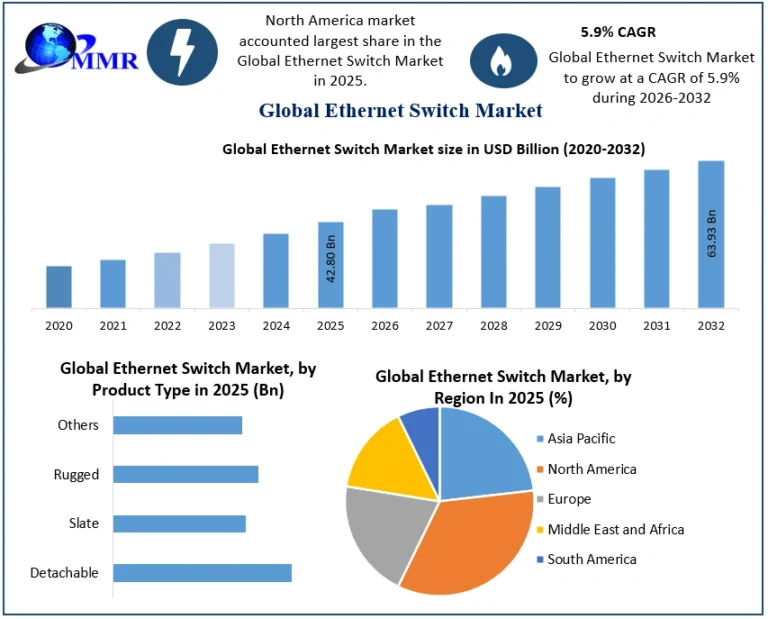
- Ethernet Switch Market valued at USD 42.80 Billion in 2025
- Market projected to reach USD 63.93 Billion by 2032
- Expected to grow at a CAGR of 5.9% during 2025–2032
- Enterprise digital transformation continues to accelerate switching infrastructure investments
- AI computing, cloud expansion, IoT deployment, and 5G networks are reshaping networking requirements
- Data centers remain major consumers of high-performance Ethernet switching solutions
Why This Matters Now
Artificial intelligence is transforming network architecture as rapidly as it is changing semiconductor demand. Every AI workload, cloud application, and connected device depends on fast, low-latency data movement, placing Ethernet switches at the center of digital infrastructure investment.
The Ethernet Switch Market was valued at USD 42.80 Billion in 2025 and is forecast to reach USD 63.93 Billion by 2032, expanding at a 5.9% CAGR. That growth signals sustained investment in enterprise networking, hyperscale cloud infrastructure, industrial automation, and next-generation digital connectivity rather than simply higher hardware shipments.
Market Overview
Networking has become a strategic technology investment instead of a supporting IT function. Organizations are modernizing network infrastructure to accommodate AI applications, cloud-native software, distributed workforces, industrial automation, and billions of connected devices.
Ethernet switches have evolved beyond traffic management. They now enable intelligent workload distribution, secure enterprise communications, edge computing, and high-speed connectivity required by data-intensive applications. Businesses are increasingly replacing legacy networking equipment with scalable switching platforms capable of supporting automation and future digital expansion.
Cloud service providers, telecom operators, enterprises, manufacturing facilities, healthcare organizations, and government agencies continue expanding network capacity to support rising bandwidth requirements. This broad demand base strengthens long-term market resilience.
Key Trends Driving Growth
Artificial intelligence is increasing east-west traffic inside data centers, requiring switching infrastructure capable of handling larger data volumes with lower latency. As AI clusters expand, network performance becomes as critical as computing performance.
Cloud providers continue investing in larger and more efficient data centers. Enterprise migration toward hybrid cloud environments is increasing demand for high-capacity switching platforms that simplify traffic management while improving scalability.
Industrial digitalization is creating another major opportunity. Manufacturers deploying Industrial IoT, automation systems, and smart factories require reliable Ethernet connectivity capable of supporting real-time operations across production environments.
Edge computing is also changing deployment strategies. Instead of routing every workload through centralized facilities, organizations increasingly process information closer to users and devices. This shift expands demand for distributed switching infrastructure across enterprise campuses, factories, healthcare facilities, and transportation networks.
The global rollout of 5G networks further increases switching requirements by supporting higher device density, faster communications, and new digital services that generate greater network traffic.
Download a Sample Report Featuring Emerging Technologies and Trends
Segment Insights
- Dominant Segment: The report identifies the leading market segment by revenue, supported by widespread enterprise and data center adoption.
- Fastest-Growing Segment: The report highlights the fastest-growing segment driven by expanding cloud infrastructure, AI-enabled applications, and increasing enterprise network modernization.
- Managed Ethernet switches continue attracting organizations seeking improved network visibility, automation, and security.
- Data center deployments remain among the strongest demand generators due to continuous cloud expansion.
- Industrial networking applications benefit from accelerating factory automation and connected manufacturing initiatives.
Regional Growth Story
North America continues benefiting from extensive investments in hyperscale cloud infrastructure, enterprise digital transformation, and AI deployment. Technology companies continue modernizing networking infrastructure to support expanding computational workloads.
Asia-Pacific remains a major manufacturing and technology hub. Rising industrial automation, expanding cloud adoption, electronics manufacturing, and digital infrastructure investments continue supporting market expansion across the region.
China continues strengthening digital infrastructure alongside enterprise modernization initiatives. Japan and South Korea maintain leadership in advanced electronics manufacturing and high-speed communication technologies.
India is emerging as an important digital economy supported by expanding data center investments, enterprise cloud adoption, government-led digital initiatives, and increasing deployment of connected infrastructure.
Europe continues investing in industrial automation, digital manufacturing, and secure enterprise networking. Countries including Germany prioritize Industry 4.0 implementation, strengthening demand for industrial Ethernet solutions.
Competitive Landscape
Competition is shifting beyond hardware specifications toward complete networking ecosystems. Vendors are increasingly integrating software intelligence, network automation, cybersecurity, and cloud management capabilities into Ethernet switching platforms.
Technology leadership now depends on delivering scalable architectures capable of supporting AI workloads, cloud-native applications, and distributed enterprise operations. Companies investing in software-defined networking, intelligent network management, and high-performance switching gain stronger competitive positioning as enterprises prioritize operational efficiency.
Strategic partnerships with cloud providers, telecom operators, and enterprise customers strengthen long-term market presence while expanding ecosystem integration. Product innovation increasingly focuses on higher bandwidth, lower latency, improved energy efficiency, and simplified network management.
Competition also reflects broader semiconductor and electronics industry trends, where networking hardware increasingly complements AI computing infrastructure, cloud services, and edge intelligence rather than functioning as standalone equipment.
Recent Developments
- Enterprise network modernization continues increasing adoption of advanced Ethernet switching technologies.
- AI-driven data center expansion is accelerating investments in high-capacity switching infrastructure.
- Cloud computing growth continues driving deployment of scalable enterprise networking solutions.
- Industrial automation initiatives are expanding demand for industrial Ethernet applications.
- Digital transformation strategies across multiple industries continue supporting network infrastructure upgrades.
Strategic Implications
The market’s steady expansion reflects the growing strategic importance of network infrastructure within the broader electronics ecosystem. As enterprises accelerate AI adoption, every computing investment requires corresponding improvements in network capacity and reliability.
Equipment manufacturers that integrate intelligent management, automation capabilities, enhanced cybersecurity, and energy-efficient designs will strengthen competitive differentiation. Organizations capable of supporting hybrid cloud environments, distributed computing, and industrial digitalization will capture broader customer opportunities.
For investors, Ethernet switching represents a foundational technology enabling AI, cloud computing, IoT, and digital transformation rather than a mature hardware segment with limited innovation potential.
For semiconductor suppliers and electronics manufacturers, increasing switching performance requirements translate into higher demand for advanced networking silicon, processors, memory technologies, and supporting electronic components.
Future Outlook
The Ethernet Switch Market is expected to grow from USD 42.80 Billion in 2025 to USD 63.93 Billion by 2032, registering a 5.9% CAGR. Future competition will increasingly revolve around intelligent networking platforms capable of supporting AI infrastructure, cloud-native applications, industrial automation, and edge computing at scale.
The companies that combine high-performance networking with software intelligence, automation, and scalable digital infrastructure will define the next generation of enterprise connectivity, while slower innovators risk losing relevance as AI reshapes global network architecture.
Analyst Perspective
“The Ethernet Switch Market is entering a new phase where enterprise networking is becoming a strategic enabler of AI, cloud computing, industrial automation, and digital transformation. Organizations investing in scalable, intelligent, and high-performance networking infrastructure will be better positioned to support future technology innovation and business growth.” — Rucha Deshpande
About Maximize Market Research
Maximize Market Research Pvt. Ltd. (MMR) is a global market research and consulting company that provides reliable, data-focused, and practical business insights. The firm serves a wide range of industries, including healthcare, pharmaceuticals, technology, automotive, electronics, chemicals, personal care, and consumer goods. Through market forecasts, competitive analysis, strategic consulting, and industry impact assessments, MMR helps organizations understand changing market conditions, identify growth opportunities, and make informed business decisions for long-term success.
Contact Us
2nd Floor, Navale IT Park Phase 3
Pune Banglore Highway, Narhe
Pune, Maharashtra 411041, India
+91 9607365656
sales@maximizemarketresearch.com
