Key Highlights
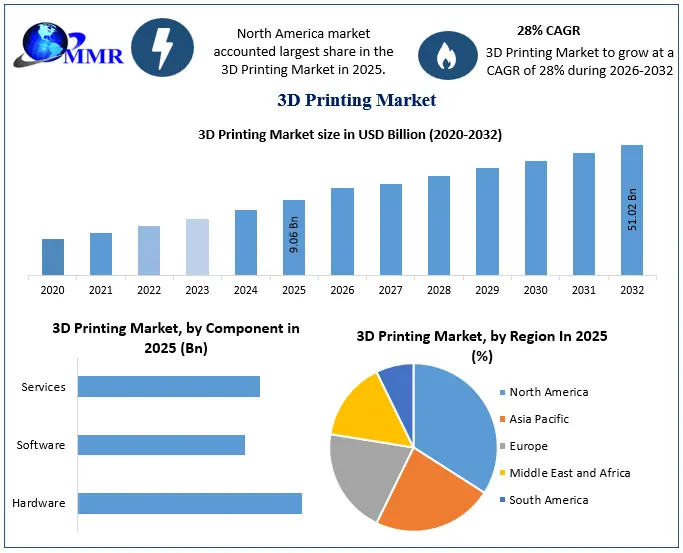
- The 3D Printing Market was valued at USD 9.06 Billion in 2025.
- The market is projected to reach nearly USD 51.02 Billion by 2032.
- Revenue is expected to grow at a CAGR of 28% from 2026 to 2032.
- Semiconductor manufacturing and electronics production are accelerating additive manufacturing adoption.
- AI-driven product development is increasing investment in digital manufacturing technologies.
- Smart factories and sustainable production are expanding commercial opportunities across global manufacturing.
Why This Matters Now
Artificial intelligence is changing how chips are designed, manufactured, and delivered. As semiconductor companies race to support AI infrastructure, conventional production methods alone can no longer provide the flexibility required for faster innovation cycles, customized manufacturing, and resilient supply chains.
The 3D Printing Market, valued at USD 9.06 Billion in 2025 and expected to reach nearly USD 51.02 Billion by 2032 at a 28% CAGR, signals one of the fastest expansions across advanced manufacturing technologies. That growth reflects increasing investments by semiconductor manufacturers, electronics OEMs, industrial manufacturers, and technology companies seeking faster product development and greater manufacturing agility.
Market Overview
Additive manufacturing has evolved from a rapid prototyping solution into a strategic production technology across semiconductor manufacturing, electronics, aerospace, healthcare, automotive, and industrial automation. Manufacturers increasingly use 3D printing to reduce development timelines, improve product customization, optimize production efficiency, and strengthen operational resilience.
Within the electronics and semiconductor industry, additive manufacturing supports tooling, production fixtures, engineering validation, specialized components, and low-volume precision manufacturing. As chip architectures become more complex and electronics products continue shrinking, manufacturing flexibility becomes increasingly valuable.
Digital manufacturing strategies are also reshaping global production networks. Organizations are reducing dependence on extended supply chains while investing in localized production capabilities that improve responsiveness and reduce inventory costs.
Key Trends Driving Growth
Artificial intelligence has significantly increased demand for advanced computing platforms, high-performance processors, and sophisticated semiconductor devices. Faster innovation cycles require manufacturing technologies capable of supporting rapid design iterations without sacrificing engineering precision.
Semiconductor manufacturing expansion continues driving broader adoption of additive manufacturing technologies. Production facilities increasingly use 3D printing to accelerate equipment development, optimize tooling, improve maintenance efficiency, and support customized manufacturing requirements.
Advanced packaging technologies and chiplet architectures are increasing manufacturing complexity throughout semiconductor production. Additive manufacturing enables engineers to develop intricate geometries, shorten design validation cycles, and improve manufacturing flexibility while supporting continuous technology innovation.
Electronics manufacturing services providers are integrating 3D printing into smart factory initiatives that combine automation, artificial intelligence, industrial IoT, and digital quality control. The result is greater production efficiency alongside improved responsiveness to changing customer requirements.
Sustainability objectives also encourage wider adoption. Additive manufacturing reduces material waste, supports localized production, minimizes excess inventory, and enables more efficient use of manufacturing resources compared with many traditional production techniques.
𝐃𝐨𝐰𝐧𝐥𝐨𝐚𝐝 𝐏𝐃𝐅 𝐁𝐫𝐨𝐜𝐡𝐮𝐫𝐞 @https://www.maximizemarketresearch.com/request-sample/15042/
Segment Insights
- Dominant Segment: Information available in the supplied Maximize Market Research report.
- Fastest-Growing Segment: Information available in the supplied Maximize Market Research report.
- Industrial applications continue expanding across semiconductor manufacturing and electronics production.
- Advanced additive manufacturing supports rapid prototyping, production tooling, precision engineering, and customized manufacturing workflows.
Regional Growth Story
The United States continues strengthening advanced manufacturing through investments in semiconductor fabrication, AI infrastructure, and industrial innovation. Additive manufacturing plays an increasingly important role by enabling faster engineering development and greater manufacturing flexibility.
Taiwan remains central to global semiconductor production, creating sustained opportunities for advanced manufacturing technologies that improve productivity and accelerate engineering innovation. South Korea supports market expansion through continued investments in semiconductor manufacturing, memory technologies, and advanced electronics production.
China continues expanding electronics manufacturing capacity while strengthening domestic industrial capabilities through digital manufacturing investments. Japan remains an important contributor through advanced engineering, robotics, precision manufacturing, and industrial technology leadership.
India continues expanding electronics manufacturing through government-supported industrial initiatives, increasing domestic production capacity, and stronger participation in global technology supply chains. Germany supports European competitiveness through advanced manufacturing, industrial automation, and engineering excellence.
Competitive Landscape
Competition is shifting beyond printer performance toward complete manufacturing ecosystems. Technology providers increasingly compete by integrating hardware, software, materials, automation, cloud platforms, and AI-powered production optimization into unified industrial solutions.
For semiconductor manufacturers, additive manufacturing provides greater production agility and faster engineering validation. Companies investing in integrated digital manufacturing capabilities strengthen their competitiveness by reducing development timelines and improving manufacturing efficiency.
Collaboration has become another defining competitive factor. Printer manufacturers, material suppliers, semiconductor companies, industrial automation providers, and software developers are building interconnected ecosystems that improve scalability while accelerating commercial adoption.
Manufacturers capable of combining additive manufacturing with AI analytics, digital twins, predictive maintenance, and automated quality assurance are likely to strengthen long-term pricing power and ecosystem leadership.
Recent Developments
- Semiconductor manufacturers continue increasing adoption of additive manufacturing technologies.
- AI-driven engineering workflows are accelerating digital manufacturing investments.
- Smart factory initiatives are integrating 3D printing into automated production systems.
- Sustainability strategies continue promoting material-efficient manufacturing processes.
- Electronics manufacturers are expanding additive manufacturing applications throughout product development.
- Supply-chain diversification is increasing localized manufacturing investment across multiple industries.
Strategic Implications
Additive manufacturing is becoming an essential capability for advanced electronics production rather than a specialized engineering tool. Companies that successfully integrate 3D printing into semiconductor manufacturing, industrial automation, and digital production strategies gain measurable advantages in flexibility, innovation speed, and supply-chain resilience.
For OEMs, additive manufacturing enables faster product launches, customized production, reduced inventory requirements, and more efficient engineering validation. Investors should increasingly evaluate companies based on digital manufacturing maturity, ecosystem partnerships, AI integration, and long-term manufacturing scalability rather than hardware sales alone.
The industry’s next phase will depend on how effectively organizations combine additive manufacturing with AI-driven design, industrial automation, advanced materials, and semiconductor production expansion.
Future Outlook
The 3D Printing Market is entering a transformative phase where additive manufacturing becomes a foundational technology for semiconductor production, AI hardware development, and advanced electronics manufacturing. As digital factories, intelligent automation, and next-generation computing reshape industrial production, organizations that integrate additive manufacturing into their core manufacturing strategy will define future technology leadership, while those relying solely on conventional production models risk losing competitiveness in speed, efficiency, and innovation.
Analyst Perspective
“The 3D Printing Market demonstrates how additive manufacturing is becoming a strategic production platform for semiconductor manufacturing and advanced electronics. Companies investing in digital manufacturing, AI-enabled production, and advanced additive technologies will be better positioned to lead the next generation of industrial innovation.” — Rucha Deshpande, Analyst
About Maximize Market Research
Maximize Market Research Pvt. Ltd. (MMR) is a global market research and consulting company that provides reliable, data-focused, and practical business insights. The firm serves a wide range of industries, including healthcare, pharmaceuticals, technology, automotive, electronics, chemicals, personal care, and consumer goods. Through market forecasts, competitive analysis, strategic consulting, and industry impact assessments, MMR helps organizations understand changing market conditions, identify growth opportunities, and make informed business decisions for long-term success.
2nd Floor, Navale IT Park Phase 3
Pune Banglore Highway, Narhe
Pune, Maharashtra 411041, India
+91 9607365656
sales@maximizemarketresearch.com
