Key Highlights
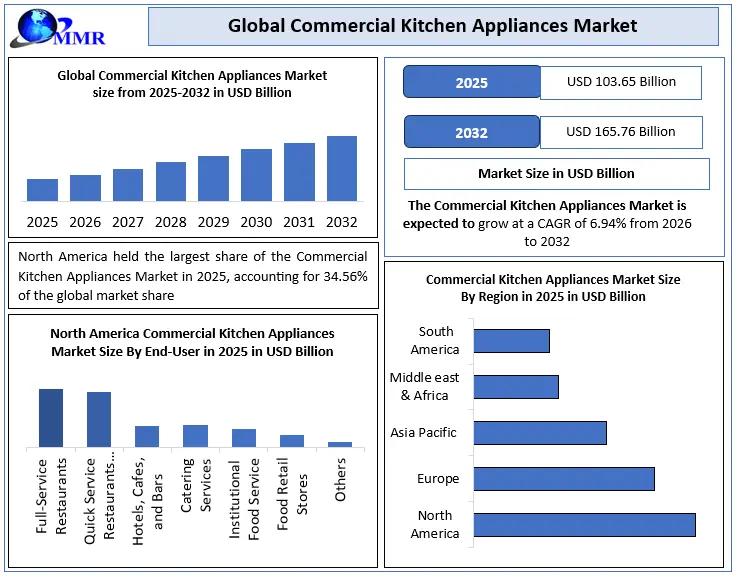
- The Commercial Kitchen Appliances Market was valued at USD 103.65 billion in 2025.
- The market is projected to reach USD 165.76 billion by 2032.
- The market is expected to expand at a CAGR of 6.94% during the forecast period.
- Rising investments in smart kitchens are reshaping commercial food preparation.
- Energy-efficient equipment continues to influence purchasing decisions across foodservice operators.
- Automation and digital kitchen management are improving operational productivity.
- Growth in hotels, restaurants, institutional kitchens, and cloud kitchens continues to strengthen equipment demand.
Why This Matters Now
Commercial kitchens are becoming technology-driven operating centers rather than conventional food preparation spaces. Restaurant chains, hospitality operators, institutional food providers, and cloud kitchens are investing in connected appliances, automation, and energy-efficient equipment to improve productivity while reducing operating costs.
The Commercial Kitchen Appliances Market, valued at USD 103.65 billion in 2025, reflects this structural shift across global foodservice. With the market forecast to reach USD 165.76 billion by 2032 at a 6.94% CAGR, manufacturers are increasingly competing through intelligent product design, digital connectivity, sustainability, and operational efficiency instead of equipment capacity alone.
Market Overview
The Commercial Kitchen Appliances Market have become strategic assets for modern foodservice businesses. Restaurants, hotels, hospitals, educational institutions, catering companies, and cloud kitchens require equipment capable of supporting higher throughput, improved food consistency, reduced labor dependence, and better energy management.
The growing emphasis on operational efficiency has accelerated adoption of advanced cooking systems, refrigeration equipment, food preparation machines, dishwashing solutions, and intelligent kitchen management technologies. Businesses are increasingly replacing conventional equipment with solutions that offer automation, predictive maintenance capabilities, and lower energy consumption.
Manufacturers are simultaneously responding to stricter environmental regulations and customer expectations by introducing sustainable equipment designed to reduce water usage, electricity consumption, and food waste.
Key Trends Driving Growth
Digital transformation is becoming one of the most significant forces influencing commercial kitchen investments. Connected appliances equipped with IoT technologies allow operators to monitor equipment performance remotely, schedule preventive maintenance, and optimize kitchen workflows through centralized management systems.
Automation is also changing food preparation processes. Advanced cooking equipment reduces manual intervention while improving consistency, enabling restaurants to manage labor shortages more effectively without compromising food quality.
Energy efficiency continues to influence purchasing strategies. Commercial operators increasingly prioritize appliances designed to lower operating expenses through reduced electricity, water, and gas consumption. These investments support both cost optimization and corporate sustainability goals.
Cloud kitchens and delivery-focused foodservice models are creating additional demand for compact, high-capacity, and multifunctional kitchen equipment. Operators require flexible appliance configurations capable of supporting continuous production with limited physical space.
Access an Exclusive Sample Report Covering Key Industry Insights
Segment Insights
- Dominant Segment: The report identifies the leading market segment based on its assessment of commercial kitchen appliance demand.
- Fastest-Growing Segment: The report highlights the fastest-growing segment driven by changing foodservice operations and increasing technology adoption.
- Smart cooking equipment continues to gain attention as operators pursue automation and improved workflow efficiency.
- Commercial refrigeration remains essential for food safety, inventory management, and regulatory compliance.
- Food preparation equipment supports productivity improvements across high-volume commercial kitchens.
- Dishwashing systems increasingly incorporate water-saving and energy-efficient technologies to reduce operational costs.
Regional Growth Story
Commercial kitchen investments continue to expand across developed and emerging foodservice markets. Mature economies maintain steady equipment replacement demand driven by modernization initiatives and sustainability regulations.
Rapid urbanization, hospitality expansion, organized foodservice growth, and increasing restaurant investments are creating significant opportunities across developing economies. The expansion of international restaurant brands and quick-service restaurant chains is accelerating demand for standardized commercial kitchen infrastructure.
Institutional foodservice—including healthcare facilities, educational institutions, and corporate cafeterias—also contributes to long-term equipment demand by prioritizing operational efficiency, food safety, and automated kitchen management.
Competitive Landscape
Competition within the Commercial Kitchen Appliances Market increasingly centers on technological innovation rather than traditional manufacturing scale. Leading manufacturers are investing in smart appliances capable of integrating with digital kitchen ecosystems that improve equipment monitoring, predictive maintenance, and operational efficiency.
Product innovation increasingly focuses on automation, connected devices, energy-efficient operation, and multifunctional equipment capable of maximizing productivity in limited kitchen space. These strategies strengthen customer retention while creating long-term service opportunities through software-enabled equipment management.
Manufacturers are also expanding sustainable product portfolios designed to reduce energy consumption, water usage, and environmental impact. Sustainability has evolved from a regulatory requirement into a competitive differentiator influencing purchasing decisions among large restaurant chains and hospitality operators.
Strategic partnerships with distributors, hospitality companies, foodservice operators, and technology providers continue to strengthen market reach while accelerating product commercialization across international markets.
Recent Developments
- Manufacturers continue expanding smart commercial kitchen equipment portfolios.
- Product innovation increasingly emphasizes connected appliances and digital monitoring capabilities.
- Energy-efficient appliance development remains a major investment priority.
- Automation technologies continue improving commercial food preparation efficiency.
- Sustainability initiatives focus on reducing operating costs through lower resource consumption.
- Digital kitchen management solutions continue supporting predictive maintenance and workflow optimization.
Strategic Implications
Commercial kitchen equipment is evolving into an integrated operational platform rather than standalone hardware. Businesses investing in intelligent appliances gain measurable advantages through improved productivity, lower maintenance costs, reduced utility expenses, and stronger food quality consistency.
Equipment manufacturers capable of combining digital connectivity, automation, sustainability, and operational intelligence are positioned to strengthen long-term competitive differentiation. Foodservice operators increasingly evaluate total lifecycle value instead of initial equipment cost, encouraging continued investment in premium commercial kitchen technologies.
Growing demand from restaurants, hospitality providers, institutional kitchens, and cloud kitchens creates opportunities for manufacturers offering scalable, connected, and energy-efficient appliance ecosystems.
Future Outlook
The Commercial Kitchen Appliances Market, valued at USD 103.65 billion in 2025 and projected to reach USD 165.76 billion by 2032 at a 6.94% CAGR, is entering a new phase of technology-led competition. Digital connectivity, automation, intelligent energy management, and sustainable equipment design are becoming the primary drivers of purchasing decisions across global foodservice operations.
Manufacturers that accelerate innovation in smart kitchen ecosystems, connected equipment, and operational intelligence will define the next generation of commercial foodservice, while companies relying solely on conventional appliance manufacturing risk losing competitive relevance in an increasingly digital kitchen economy.
Analyst Perspective
“The Commercial Kitchen Appliances Market is transitioning from traditional equipment manufacturing toward intelligent, connected, and energy-efficient kitchen ecosystems. Businesses that prioritize automation, sustainability, and digital operations will be best positioned to capitalize on the market’s projected expansion from USD 103.65 billion in 2025 to USD 165.76 billion by 2032.” — Rucha Deshpande
About Maximize Market Research
Maximize Market Research Pvt. Ltd. (MMR) is a global market research and consulting company that provides reliable, data-focused, and practical business insights. The firm serves a wide range of industries, including healthcare, pharmaceuticals, technology, automotive, electronics, chemicals, personal care, and consumer goods. Through market forecasts, competitive analysis, strategic consulting, and industry impact assessments, MMR helps organizations understand changing market conditions, identify growth opportunities, and make informed business decisions for long-term success.
Contact Us
2nd Floor, Navale IT Park Phase 3
Pune Banglore Highway, Narhe
Pune, Maharashtra 411041, India
+91 9607365656
sales@maximizemarketresearch.com
