Key Highlights
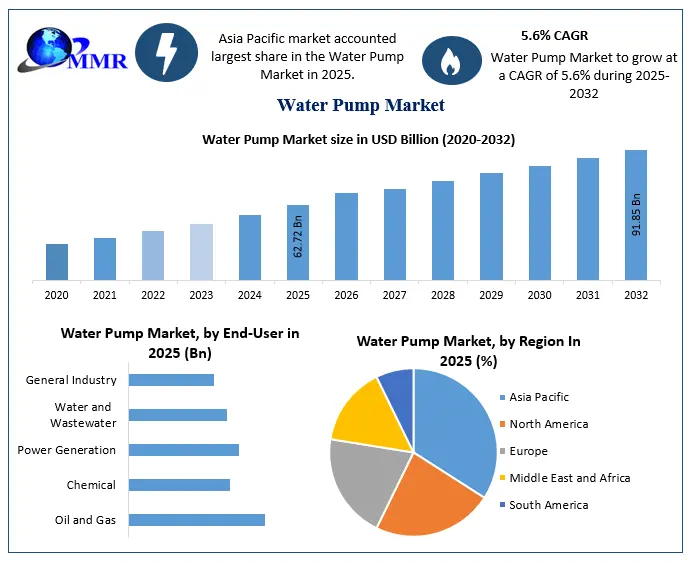
- Water pump market valued at USD 62.72 Billion in 2025
- Expected to reach USD 91.85 Billion by 2032
- CAGR projected at 5.6% from 2026 to 2032
- Rising demand from agriculture, utilities, and industrial sectors
- Increasing adoption in water treatment and wastewater infrastructure
- Growth supported by urbanization and infrastructure modernization
Why This Matters Now
Water infrastructure is under increasing strain from rising urban demand, industrial expansion, and climate variability. Pumping systems sit at the center of this challenge, enabling distribution, treatment, and recycling of water across critical sectors.
The market size of USD 62.72 Billion in 2025 signals strong capital deployment into water infrastructure modernization. The projected growth to USD 91.85 Billion by 2032 reflects long-term investment cycles in utilities, agriculture efficiency, and industrial water management systems.
Market Overview
The water pump market Size operates as a foundational layer of global infrastructure. Pumps are used across municipal water supply, irrigation networks, industrial processing, and wastewater treatment systems.
Demand is closely tied to urbanization trends and infrastructure expansion. Rapid population growth in emerging economies is increasing pressure on municipal water systems, requiring large-scale upgrades in pumping capacity and efficiency.
Industrial expansion is also driving adoption. Manufacturing, chemicals, power generation, and mining sectors rely heavily on pumping systems for fluid handling, cooling, and process control.
Key Trends Driving Growth
Urban infrastructure modernization is a primary growth driver. Governments are investing in water supply expansion, leakage reduction, and wastewater treatment upgrades, increasing demand for efficient pumping systems.
Agricultural irrigation modernization is accelerating adoption of high-efficiency pumps. Water scarcity concerns are pushing farmers toward energy-efficient and precision irrigation systems.
Industrial water reuse and recycling systems are expanding. Regulatory pressure on wastewater discharge is increasing demand for advanced pump-driven treatment systems.
Energy efficiency requirements are reshaping procurement decisions. Utilities and industries are prioritizing low-energy consumption pumps to reduce operational costs and emissions.
Digitalization and smart monitoring are gaining traction. Pump systems integrated with sensors and automation platforms are improving predictive maintenance and operational efficiency.
Explore detailed analysis, insights, and growth opportunities
Segment Insights
- Dominant Segment: Not specified in the provided source
- Fastest-Growing Segment: Not specified in the provided source
The absence of segment-level disclosure indicates a mature but continuously evolving market structure. Demand is broadly distributed across centrifugal, positive displacement, and specialized industrial pump categories without a clearly defined fastest-growth segmentation in the provided dataset.
Regional Growth Story
Asia Pacific is the leading demand center, driven by China and India. Rapid urbanization, industrial expansion, and agricultural dependency on irrigation systems are driving large-scale pump installations.
North America shows stable growth supported by infrastructure renewal programs and industrial water management upgrades. The United States is focusing on wastewater treatment modernization and smart water infrastructure systems.
Europe is driven by strict environmental regulations and sustainability mandates. Germany, the United Kingdom, and other EU countries are investing in energy-efficient pumping systems and advanced water recycling infrastructure.
Middle Eastern countries are investing in desalination and water distribution infrastructure. Pump systems play a critical role in managing scarce water resources and supporting urban expansion.
Competitive Landscape
The competitive environment is shaped by engineering capability, energy efficiency innovation, and system integration rather than standalone product competition.
Manufacturers are focusing on high-efficiency pump designs to meet rising energy cost pressures and regulatory efficiency standards. This signals a shift toward lifecycle cost optimization rather than upfront pricing competition.
Strategic partnerships with infrastructure developers and utilities are increasing. These collaborations indicate a long-term integration of pump systems into smart water infrastructure projects.
Digital pump monitoring systems are emerging as a competitive differentiator. Companies integrating IoT-enabled diagnostics and predictive maintenance are strengthening long-term service revenue models.
Market structure is consolidating around players capable of offering integrated pumping solutions across municipal, industrial, and agricultural applications, while smaller firms face margin pressure from commoditization.
Recent Developments
- Expansion of municipal water infrastructure projects across Asia and North America
- Increased deployment of energy-efficient pumping systems in industrial facilities
- Growth in wastewater treatment plant modernization programs globally
- Rising adoption of smart monitoring and predictive maintenance technologies
Strategic Implications
Water pumps are becoming strategic infrastructure assets rather than basic mechanical components. Their role in energy efficiency, water security, and industrial productivity is expanding.
For utilities, upgrading pumping systems is central to reducing leakage and improving distribution efficiency. This directly impacts operational costs and service reliability.
For industries, efficient pumping systems reduce energy consumption and improve process stability. This is increasingly important as energy prices and sustainability requirements rise.
For agriculture, pump modernization determines water use efficiency and crop productivity in water-stressed regions.
For governments, water pump infrastructure is now tied to climate resilience strategies, urban planning, and food security policies.
Future Outlook
The water pump market will shift from mechanical infrastructure expansion to intelligent, energy-optimized water management systems, and future leaders will be those who integrate digital control, efficiency engineering, and system-level water intelligence while laggards remain tied to conventional high-consumption pumping technologies.
Analyst Perspective
“The water pump market is evolving from traditional mechanical systems into digitally enabled infrastructure components that are central to water security and energy efficiency strategies,” said Neha Nalawade, Analyst.
About Maximize Market Research
Maximize Market Research Pvt. Ltd. (MMR) is a global market research and consulting company that provides reliable, data-focused, and practical business insights. The firm serves a wide range of industries, including healthcare, pharmaceuticals, technology, automotive, electronics, chemicals, personal care, and consumer goods. Through market forecasts, competitive analysis, strategic consulting, and industry impact assessments, MMR helps organizations understand changing market conditions, identify growth opportunities, and make informed business decisions for long-term success.
Contact Us :
2nd Floor, Navale IT Park Phase 3
Pune Banglore Highway, Narhe
Pune, Maharashtra 411041, India
+91 9607365656
sales@maximizemarketresearch.com
