Key Highlights
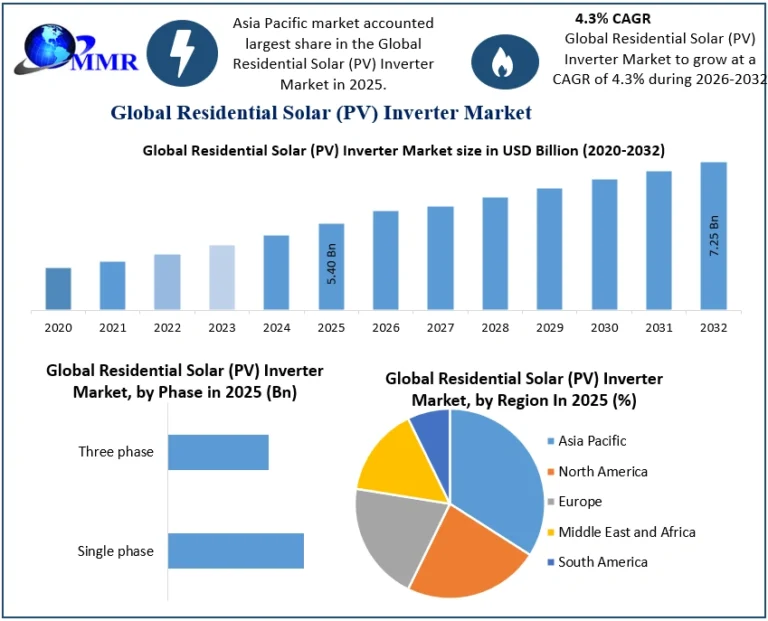
- Residential solar PV inverter market valued at USD 5.40 Billion in 2025
- Expected to reach USD 7.25 Billion by 2032
- CAGR of 4.3% from 2026 to 2032
- Rising adoption of rooftop solar systems across residential sectors
- Growth supported by energy security and electrification trends
- Increasing integration with smart grids and battery storage systems
Why This Matters Now
Residential energy systems are undergoing structural decentralization. Households are shifting from passive electricity consumption to active generation and grid participation through rooftop solar installations.
The market value of USD 5.40 Billion in 2025 signals steady penetration of distributed solar infrastructure. The projected rise to USD 7.25 Billion by 2032 reflects continued adoption of residential solar systems, supported by policy incentives, falling installation costs, and rising electricity prices.
Market Overview
The Residential solar PV inverter market Size sits at the core of distributed solar energy systems. Inverters convert DC power generated by rooftop solar panels into usable AC electricity for household consumption and grid export.
Demand is closely tied to rooftop solar penetration and residential electrification trends. As households adopt solar-plus-storage systems, inverter functionality is expanding beyond conversion to include energy management and grid interaction.
The market is also influenced by policy frameworks promoting clean energy adoption. Net-zero targets and residential solar subsidies across major economies are accelerating household-level renewable deployment.
Key Trends Driving Growth
Rooftop solar expansion is the primary demand driver. Residential consumers are increasingly installing solar systems to reduce electricity bills and gain energy independence from grid fluctuations.
Energy storage integration is reshaping inverter functionality. Hybrid inverters capable of managing solar and battery systems are becoming standard in new residential installations.
Grid modernization initiatives are increasing demand for smart inverters. Utilities are requiring advanced inverter capabilities such as voltage regulation, frequency support, and remote monitoring.
Rising electricity prices are accelerating payback economics for residential solar systems. This is improving adoption rates in both developed and emerging markets.
Electrification of households, including EV charging and electric heating, is increasing residential electricity demand, further strengthening solar adoption economics.
Explore detailed analysis, insights, and growth opportunities
Segment Insights
- Dominant Segment: Not specified in the provided source
- Fastest-Growing Segment: Not specified in the provided source
The lack of segmentation data reflects a market primarily defined by system-level adoption rather than fragmented product categories. Growth is being driven by overall residential solar penetration rather than distinct inverter sub-segment dominance.
Regional Growth Story
Asia Pacific leads global adoption, driven by China and India. Rapid urbanization, rising electricity demand, and government-backed rooftop solar programs are expanding residential solar deployment.
North America shows strong growth supported by federal tax incentives and net metering policies. The United States continues to expand residential solar installations across suburban and urban households.
Europe remains a key market driven by high electricity prices and strong decarbonization mandates. Germany and the United Kingdom are leading residential solar adoption through aggressive renewable energy policies.
Australia is also a high-penetration market due to favorable solar irradiation and strong household adoption of rooftop solar systems.
Competitive Landscape
The residential solar inverter market is evolving toward technology-driven differentiation rather than hardware commoditization. Manufacturers are competing on efficiency, smart grid compatibility, and hybrid system integration.
The rise of hybrid and smart inverters signals a shift toward energy management platforms. This is transforming inverter companies from component suppliers into energy technology providers.
Strategic partnerships between inverter manufacturers, battery providers, and solar installers are increasing. This reflects a shift toward integrated residential energy ecosystems rather than standalone product sales.
Market consolidation is emerging as larger players acquire smaller inverter manufacturers to expand technology portfolios and geographic reach.
Competitive advantage is increasingly tied to software capabilities, including monitoring platforms, predictive maintenance, and AI-driven energy optimization.
Recent Developments
- Expansion of residential rooftop solar programs across Asia and North America
- Increasing adoption of hybrid inverter systems integrated with battery storage
- Utility mandates for smart inverter functionality in new solar installations
- Growth in residential solar financing and leasing models
Strategic Implications
Residential solar PV inverters are becoming critical nodes in decentralized energy systems. Their role is expanding from power conversion to grid interaction and energy intelligence.
For utilities, smart inverters introduce both opportunities and challenges. They improve grid visibility but require updated regulatory and technical frameworks.
For homeowners, advanced inverters enhance energy independence and reduce long-term electricity costs. This is accelerating distributed energy adoption.
For manufacturers, software integration and ecosystem partnerships are becoming essential for long-term competitiveness.
For governments, residential solar deployment supports decarbonization goals while reducing pressure on centralized power infrastructure.
Future Outlook
The residential solar PV inverter market will evolve from hardware-centric systems to intelligent energy management platforms, and future leaders will be those who control integrated solar-storage-grid software ecosystems while laggards remain confined to basic power conversion technologies in a rapidly decentralizing energy system.
Analyst Perspective
“The residential solar PV inverter market is transitioning from simple power conversion hardware to intelligent energy control systems that will play a central role in distributed energy and grid modernization,” said Neha Nalawade, Analyst.
About Maximize Market Research
Maximize Market Research Pvt. Ltd. (MMR) is a global market research and consulting company that provides reliable, data-focused, and practical business insights. The firm serves a wide range of industries, including healthcare, pharmaceuticals, technology, automotive, electronics, chemicals, personal care, and consumer goods. Through market forecasts, competitive analysis, strategic consulting, and industry impact assessments, MMR helps organizations understand changing market conditions, identify growth opportunities, and make informed business decisions for long-term success.
Contact Us :
2nd Floor, Navale IT Park Phase 3
Pune Banglore Highway, Narhe
Pune, Maharashtra 411041, India
+91 9607365656
sales@maximizemarketresearch.com
