Key Highlights
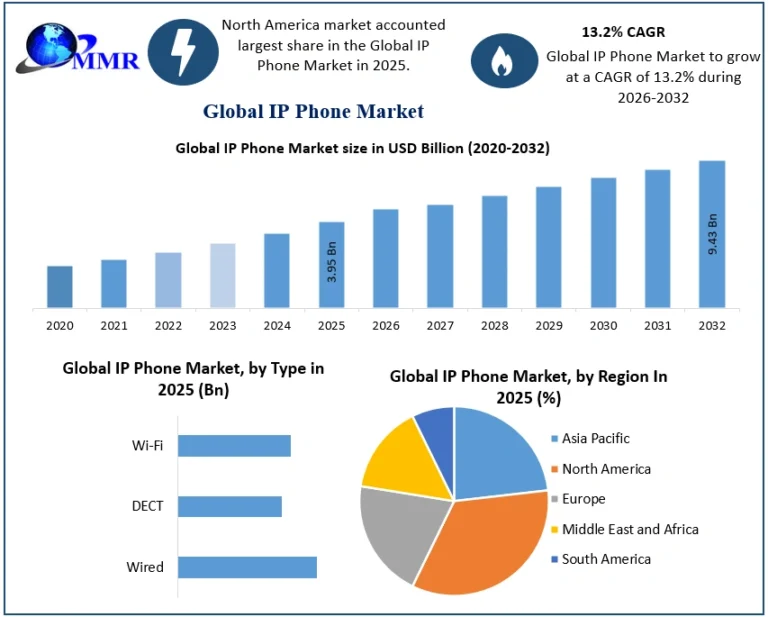
- The IP Phone Market was valued at USD 3.95 Billion in 2025.
- The market is projected to reach USD 9.43 Billion by 2032.
- The market is expected to grow at a CAGR of 13.2% from 2025 to 2032.
- Enterprise migration toward cloud-based communication platforms continues to accelerate demand.
- Hybrid work models are increasing investment in unified communications infrastructure.
- AI-enabled collaboration features are reshaping enterprise communication strategies.
- North America remains the leading regional market.
Why This Matters Now
Enterprise communications are entering another transformation cycle. Organizations are replacing legacy PBX infrastructure with cloud-native communication systems that integrate voice, video, messaging, analytics, and AI-driven productivity tools.
For technology vendors, OEMs, network equipment suppliers, and enterprise IT decision-makers, this transition is creating sustained demand for next-generation IP phones that deliver secure connectivity, seamless collaboration, and compatibility with evolving unified communication ecosystems. The IP Phone Market, valued at USD 3.95 Billion in 2025, is expected to reach USD 9.43 Billion by 2032, growing at a 13.2% CAGR. That growth signals expanding investment across enterprise digital infrastructure rather than incremental hardware replacement.
Market Overview
The IP Phone Market have evolved from simple VoIP devices into intelligent communication endpoints supporting unified communications, cloud telephony, video conferencing, and enterprise collaboration. Businesses are increasingly prioritizing flexible communication platforms capable of supporting distributed workforces without compromising security or operational efficiency.
The ongoing shift toward digital workplaces has significantly increased enterprise investment in IP-based communication infrastructure. Organizations are modernizing communication networks to improve scalability, reduce operating costs, and integrate voice services with business applications. This transition is also encouraging enterprises to replace aging communication systems with cloud-compatible IP phones capable of supporting advanced collaboration features.
As organizations continue digital transformation initiatives, communication technology is becoming a strategic business asset rather than a supporting utility. Companies now evaluate communication platforms based on integration capabilities, cybersecurity, productivity improvements, and long-term operational flexibility.
Key Trends Driving Growth
Cloud communications continue to reshape enterprise purchasing decisions. Organizations increasingly prefer subscription-based unified communication platforms that simplify deployment while enabling centralized management across multiple office locations.
Hybrid work has permanently altered communication requirements. Employees expect seamless connectivity between office, home, and mobile environments, driving demand for IP phones that integrate with collaboration platforms and cloud communication services.
Artificial intelligence is expanding beyond software into communication workflows. AI-assisted call routing, intelligent meeting management, voice recognition, transcription, and analytics are improving productivity while reducing administrative workloads. These capabilities are increasing the value proposition of enterprise communication platforms.
The growing adoption of Internet Protocol infrastructure across businesses is also supporting broader deployment of IP phones. Organizations benefit from simplified network management, reduced maintenance costs, and improved communication reliability through unified IP-based systems.
Security has become another major purchasing factor. Enterprises increasingly prioritize encrypted communications, secure authentication, and centralized device management as cyber risks continue to evolve.
Request Your Sample Report to Explore Future Industry Potential
Segment Insights
- Dominant Segment: Business IP Phones
- Fastest-Growing Segment: Cloud-based IP Phone Solutions
- Enterprise customers remain the primary revenue contributors due to ongoing digital workplace investments.
- Unified communications integration continues to strengthen adoption across large organizations.
- Cloud deployment models are gaining momentum as businesses seek greater scalability and operational flexibility.
- Increasing demand from hybrid work environments continues to expand enterprise deployment opportunities.
Regional Growth Story
North America maintains its leadership position in the global IP Phone Market due to early enterprise adoption of cloud communications, advanced IT infrastructure, and significant investments in digital workplace technologies. Organizations across the region continue replacing conventional communication systems with integrated unified communication platforms.
Asia-Pacific is emerging as a major growth engine as enterprises accelerate digital transformation initiatives and expand cloud infrastructure investments. Rising business connectivity requirements, expanding enterprise IT spending, and rapid modernization of communication networks are creating favorable market conditions.
Europe continues strengthening enterprise collaboration capabilities through digital transformation programs focused on workplace modernization and secure business communications. Organizations are increasingly adopting cloud communication platforms to improve workforce flexibility while supporting long-term operational efficiency.
Developing markets are also witnessing growing demand as businesses modernize telecommunications infrastructure and expand enterprise connectivity to support digital business operations.
Competitive Landscape
Competition is increasingly shifting from hardware differentiation toward complete communication ecosystems. Vendors are strengthening their portfolios by integrating IP phones with cloud collaboration platforms, unified communications software, enterprise security solutions, and intelligent management capabilities.
Technology leadership now depends on ecosystem compatibility rather than standalone devices. Manufacturers capable of delivering seamless interoperability with enterprise collaboration platforms are strengthening long-term customer relationships while increasing recurring software and service revenues.
Product innovation increasingly focuses on AI-assisted communication, touchscreen interfaces, improved audio quality, simplified deployment, enhanced cybersecurity, and centralized device management. These developments position vendors to compete on enterprise productivity rather than hardware specifications alone.
As cloud communications continue expanding, competitive advantage will increasingly depend on software integration, user experience, enterprise security, and platform scalability rather than traditional telephony capabilities.
Recent Developments
- Continued enterprise migration toward cloud-based unified communication platforms.
- Increasing integration of AI-enabled collaboration capabilities into communication systems.
- Growing adoption of hybrid workplace communication infrastructure.
- Expansion of secure enterprise VoIP deployments.
- Greater focus on interoperability across business collaboration ecosystems.
- Ongoing innovation in intelligent enterprise communication devices.
Strategic Implications
The IP Phone Market is becoming part of a broader enterprise digital transformation strategy rather than an isolated communications market. Organizations increasingly evaluate communication investments based on productivity gains, workforce flexibility, cybersecurity, and long-term operational efficiency.
Technology providers capable of combining intelligent hardware with cloud-native communication platforms are positioned to capture higher-value enterprise opportunities. Software integration, AI functionality, centralized management, and ecosystem compatibility are becoming stronger competitive differentiators than traditional voice capabilities.
For enterprise IT leaders, communication infrastructure is evolving into a foundation for digital collaboration. Investments made today will influence organizational agility, employee productivity, customer engagement, and business resilience over the coming decade.
Future Outlook
The IP Phone Market is expected to grow from USD 3.95 Billion in 2025 to USD 9.43 Billion by 2032, expanding at a 13.2% CAGR. Future market expansion will be driven by cloud communications, unified collaboration platforms, enterprise digital transformation, AI-enabled communication tools, and expanding hybrid work environments.
The next competitive divide will not be determined by who manufactures communication hardware—it will be defined by who builds the most intelligent, secure, AI-enabled communication ecosystems that seamlessly connect the modern digital enterprise.
Analyst Perspective
“Organizations are redefining enterprise communications through cloud-first strategies, unified collaboration platforms, and intelligent digital workplace technologies. As enterprises accelerate modernization, IP phones are evolving into integrated collaboration endpoints that support productivity, flexibility, and long-term business transformation.” — **Rucha Deshpande, Analyst
About Maximize Market Research
Maximize Market Research Pvt. Ltd. (MMR) is a global market research and consulting company that provides reliable, data-focused, and practical business insights. The firm serves a wide range of industries, including healthcare, pharmaceuticals, technology, automotive, electronics, chemicals, personal care, and consumer goods. Through market forecasts, competitive analysis, strategic consulting, and industry impact assessments, MMR helps organizations understand changing market conditions, identify growth opportunities, and make informed business decisions for long-term success.
Contact Us
2nd Floor, Navale IT Park Phase 3
Pune Banglore Highway, Narhe
Pune, Maharashtra 411041, India
+91 9607365656
sales@maximizemarketresearch.com
