Key Highlights
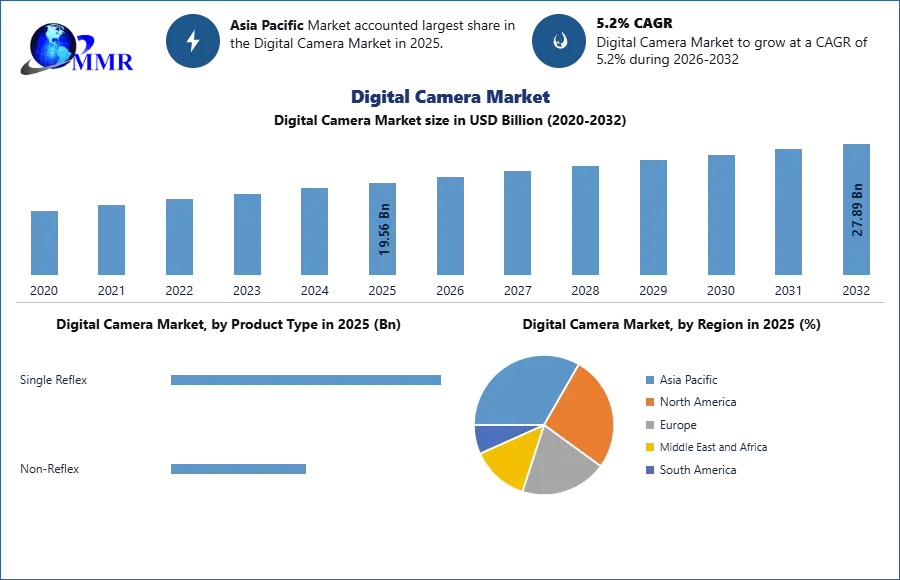
- The Digital Camera Market was valued at USD 19.56 Billion in 2025.
- The market is projected to reach nearly USD 27.89 Billion by 2032.
- Revenue is expected to grow at a CAGR of 5.2% from 2026 to 2032.
- AI-powered imaging technologies are increasing demand for advanced semiconductor components.
- Image sensor innovation continues driving product differentiation across professional and consumer markets.
- Electronics manufacturers are investing in intelligent imaging ecosystems and high-performance camera technologies.
Why This Matters Now
Artificial intelligence is redefining digital imaging. Cameras are evolving from optical devices into intelligent computing platforms capable of real-time scene recognition, computational photography, autofocus optimization, and advanced image processing powered by increasingly sophisticated semiconductor technologies.
The Digital Camera Market, valued at USD 19.56 Billion in 2025 and expected to reach nearly USD 27.89 Billion by 2032 at a 5.2% CAGR, reflects continued investment in premium imaging technologies. The market expansion creates opportunities for semiconductor manufacturers, image sensor suppliers, electronics OEMs, optical technology companies, and investors focused on advanced imaging innovation.
Market Overview
Digital cameras continue to occupy an important position within the broader consumer electronics ecosystem despite rapid smartphone camera improvements. Professional content creation, commercial photography, filmmaking, industrial inspection, scientific imaging, security applications, and specialized imaging continue driving demand for dedicated digital camera systems.
The market is increasingly shaped by semiconductor innovation rather than optics alone. Modern digital cameras rely on high-performance processors, advanced CMOS image sensors, AI accelerators, memory technologies, and intelligent software to deliver superior imaging performance.
This convergence of optics, computing, and artificial intelligence is transforming cameras into sophisticated edge-computing platforms capable of processing enormous volumes of visual data in real time.
Key Trends Driving Growth
Artificial intelligence has become a defining competitive differentiator across digital imaging. AI-powered autofocus, object recognition, scene optimization, noise reduction, computational photography, and intelligent video processing continue improving user experiences while increasing demand for specialized semiconductor architectures.
Semiconductor manufacturers continue advancing CMOS image sensor technologies, image signal processors, and dedicated AI processing units. These innovations improve image quality, low-light performance, processing speed, and energy efficiency across both consumer and professional camera systems.
Edge computing is expanding camera functionality beyond photography. Cameras increasingly perform real-time image analysis without relying exclusively on cloud computing, creating new opportunities across industrial automation, security, healthcare, scientific research, and intelligent transportation systems.
Display innovation also contributes to product differentiation. Higher-resolution electronic viewfinders, advanced touchscreen interfaces, and improved display technologies enhance usability while supporting increasingly sophisticated camera functionality.
Electronics manufacturing services providers continue modernizing production through automation, digital quality control, and intelligent manufacturing systems that improve production efficiency while maintaining precision standards required for advanced optical products.
Sustainability remains an important strategic priority. Manufacturers increasingly emphasize energy-efficient components, recyclable materials, longer product lifecycles, repairability, and responsible manufacturing practices as environmental expectations influence purchasing decisions.
𝐃𝐨𝐰𝐧𝐥𝐨𝐚𝐝 𝐏𝐃𝐅 𝐁𝐫𝐨𝐜𝐡𝐮𝐫𝐞 @https://www.maximizemarketresearch.com/request-sample/54990/
Segment Insights
- Dominant Segment: Information available in the supplied Maximize Market Research report.
- Fastest-Growing Segment: Information available in the supplied Maximize Market Research report.
- AI-powered imaging technologies continue increasing semiconductor content across digital camera systems.
- Professional imaging, content creation, industrial inspection, and intelligent vision applications continue supporting long-term market expansion.
Regional Growth Story
The United States continues driving demand through professional media production, technology innovation, AI software development, and advanced imaging applications across commercial and industrial sectors.
Japan remains a global leader in optical engineering, precision manufacturing, image sensor innovation, and camera technology development. Continued investment in semiconductor-enabled imaging strengthens its competitive position within the global electronics industry.
Taiwan supports the market through advanced semiconductor manufacturing capabilities, while South Korea contributes through memory technologies, display innovation, and semiconductor production supporting digital imaging devices.
China continues expanding electronics manufacturing capacity while strengthening domestic imaging technology capabilities and supply-chain integration. India is emerging as an important electronics manufacturing destination supported by increasing domestic demand and industrial policy initiatives.
Germany contributes through precision engineering, industrial imaging applications, automotive vision systems, and advanced manufacturing technologies that increasingly depend on sophisticated digital imaging solutions.
Government support for semiconductor manufacturing, electronics production, digital infrastructure, and advanced technology development continues strengthening long-term competitiveness across major global markets.
Competitive Landscape
Competition has shifted from megapixel counts to intelligent imaging ecosystems. Manufacturers increasingly compete through AI integration, proprietary image processing technologies, sensor innovation, software capabilities, and seamless connectivity across broader digital platforms.
Semiconductor technology has become central to competitive positioning. Companies capable of combining advanced image sensors, AI processors, memory technologies, and computational photography capabilities strengthen product differentiation while improving long-term pricing power.
Technology leadership increasingly depends on ecosystem collaboration among semiconductor manufacturers, optics companies, software developers, electronics manufacturers, and AI technology providers. Integrated innovation enables faster product development while supporting increasingly sophisticated imaging applications.
Manufacturers investing in intelligent imaging, advanced semiconductor integration, sustainable manufacturing, and resilient supply chains are likely to strengthen customer loyalty and maintain competitive leadership in an increasingly technology-driven market.
Recent Developments
- AI-powered imaging capabilities continue expanding across professional and consumer digital cameras.
- Semiconductor innovation is improving image sensor performance and processing efficiency.
- Electronics manufacturers are integrating advanced computational photography technologies into camera systems.
- Intelligent manufacturing initiatives continue strengthening production quality and operational efficiency.
- Sustainability strategies are encouraging more energy-efficient camera designs and responsible manufacturing practices.
- Supply-chain diversification remains a strategic priority for global electronics and semiconductor manufacturers.
Strategic Implications
Digital cameras are becoming intelligent imaging platforms rather than standalone photography devices. Organizations that successfully integrate advanced semiconductor technologies, AI-powered image processing, and connected digital ecosystems will gain stronger competitive advantages across professional imaging, industrial vision, healthcare, and scientific applications.
For OEMs, future competitiveness depends on combining optics with semiconductor innovation, AI software, advanced manufacturing, and intelligent connectivity. Investors should increasingly evaluate imaging companies based on technology integration, semiconductor partnerships, AI capabilities, and ecosystem development instead of traditional hardware performance metrics.
The convergence of AI computing, advanced image sensors, and edge processing will continue expanding the commercial relevance of dedicated digital imaging systems across multiple industries.
Future Outlook
The Digital Camera Market is entering a new era where artificial intelligence, semiconductor innovation, computational imaging, and edge computing converge to redefine visual technology. As intelligent imaging becomes essential across consumer electronics, industrial automation, healthcare, and smart infrastructure, companies that lead in AI-enabled camera platforms and advanced semiconductor integration will shape the future of digital imaging, while those relying solely on traditional hardware differentiation risk losing technological leadership.
Analyst Perspective
“The Digital Camera Market is evolving beyond photography into intelligent imaging powered by semiconductor innovation and artificial intelligence. Companies that integrate advanced image sensors, AI processing, and connected digital ecosystems will be best positioned to capture the industry’s next phase of technology-driven growth.” — Rucha Deshpande, Analyst
About Maximize Market Research
Maximize Market Research Pvt. Ltd. (MMR) is a global market research and consulting company that provides reliable, data-focused, and practical business insights. The firm serves a wide range of industries, including healthcare, pharmaceuticals, technology, automotive, electronics, chemicals, personal care, and consumer goods. Through market forecasts, competitive analysis, strategic consulting, and industry impact assessments, MMR helps organizations understand changing market conditions, identify growth opportunities, and make informed business decisions for long-term success.
2nd Floor, Navale IT Park Phase 3
Pune Banglore Highway, Narhe
Pune, Maharashtra 411041, India
+91 9607365656
sales@maximizemarketresearch.com
