Key Highlights
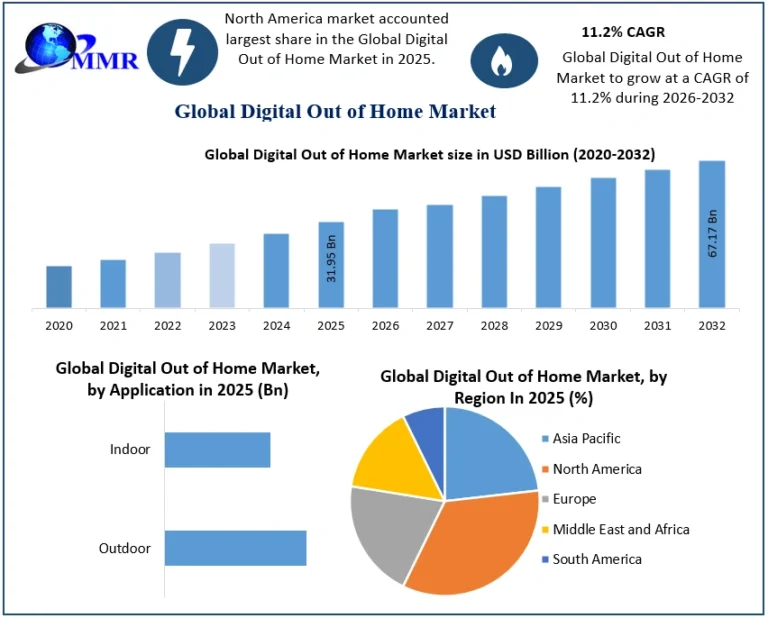
- Digital Out of Home Market size: USD 31.95 Billion (2025)
- Projected market value: USD 67.17 Billion (2032)
- CAGR: 11.2% (2025–2032)
- Growth anchored in AI-driven programmatic advertising and smart display infrastructure
- Semiconductor-enabled LED, sensor, and edge computing integration accelerating deployments
- Expansion of smart city and transit-based digital signage ecosystems
- Rising demand for real-time content delivery and data-driven advertising optimization
Why This Matters Now
Digital Out of Home networks are no longer passive advertising surfaces. They are becoming semiconductor-powered computing endpoints embedded in transport hubs, retail corridors, and urban infrastructure. The shift is immediate. Advertising inventory is being redefined by AI-enabled content engines, real-time bidding systems, and sensor-integrated displays that require advanced chips, low-power processors, and high-efficiency memory architectures.
At USD 31.95 Billion in 2025, the Digital Out of Home Market signals a structural transition from static media to connected digital infrastructure. The projected rise to USD 67.17 Billion by 2032 reflects not just advertising expansion, but deep integration with semiconductor-driven smart city systems.
Market Overview
The Digital Out of Home (DOOH) Market refers to digital advertising screens deployed in public environments including transit stations, highways, malls, airports, and urban centers. Unlike traditional signage, DOOH systems rely on semiconductor-intensive components such as LED driver ICs, embedded processors, GPUs for content rendering, and connectivity modules enabling cloud-based content management.
The market’s expansion to USD 67.17 Billion by 2032, growing at a CAGR of 11.2%, reflects accelerating convergence between advertising technology and semiconductor innovation. Every deployed screen now functions as a distributed computing node, integrating real-time data streams, audience analytics, and AI-based content scheduling.
This transition positions DOOH as part of the broader electronics and semiconductor ecosystem, where display hardware, edge computing chips, and IoT connectivity define performance and scalability.
Key Trends Driving Growth
AI-driven programmatic advertising is reshaping how DOOH inventory is bought and sold. Semiconductor-enabled edge processors allow real-time decisioning, enabling content adaptation based on traffic density, weather, and demographic signals.
The expansion of smart city infrastructure is a second critical driver. Governments are investing in digitized urban environments where DOOH systems are integrated with traffic monitoring, public safety systems, and data analytics platforms. These deployments depend heavily on low-power semiconductors, high-brightness LED chips, and embedded AI accelerators.
Another structural shift is the rise of high-efficiency display semiconductors. Advanced LED driver ICs and energy-efficient chips are reducing operational costs while increasing screen brightness and resolution. This enables DOOH expansion into outdoor, high-light environments such as highways and stadiums.
Edge computing adoption is also accelerating. DOOH networks increasingly rely on localized processing rather than centralized cloud rendering, reducing latency and bandwidth load while increasing dependency on compact, high-performance semiconductor architectures.
Get a Sample Report Featuring Industry Growth and Revenue Forecasts
Segment Insights
- Dominant Segment: Not specified in the provided dataset
- Fastest-Growing Segment: Not specified in the provided dataset
Despite the absence of explicit segmentation data, industry deployment patterns indicate that programmatic and transit-based DOOH networks are emerging as high-utilization categories due to their reliance on real-time data processing and continuous audience analytics.
Regional Growth Story
North America leads early adoption due to mature programmatic advertising ecosystems and strong investment in smart infrastructure. The region’s demand is reinforced by high penetration of AI-based media buying platforms and widespread deployment of connected display networks.
Asia Pacific is emerging as the fastest expansion zone, driven by large-scale urbanization, smart city investments, and aggressive deployment of digital infrastructure across China, India, and Southeast Asia. Semiconductor manufacturing strength in Taiwan, South Korea, and China supports local supply chains for display panels and embedded electronics.
Europe continues to invest in energy-efficient digital signage systems, particularly in Germany and the UK, where sustainability regulations are pushing adoption of low-power semiconductor display technologies.
India is rapidly scaling DOOH installations across metro rail systems, airports, and urban highways, supported by expanding digital infrastructure and rising advertising digitization.
Competitive Landscape
Competition in the DOOH market is increasingly defined by technological capability rather than media reach alone. Companies are investing in AI-driven content platforms, edge computing hardware, and semiconductor-integrated display systems to differentiate offerings.
Hardware suppliers focusing on LED modules and driver IC innovation are gaining strategic importance as display efficiency becomes a competitive factor. Firms integrating cloud-based content management systems with embedded semiconductor architectures are positioning themselves as full-stack digital infrastructure providers rather than traditional media vendors.
This shift signals consolidation toward technology-led ecosystems where advertising firms must align with semiconductor suppliers, IoT platform providers, and edge computing vendors. Control over hardware-software integration increasingly determines pricing power and scalability.
The competitive frontier is moving toward AI-native DOOH networks capable of autonomous content optimization. This elevates demand for GPUs, NPUs, and low-power inference chips embedded directly into display units.
Recent Developments
- Expansion of programmatic DOOH platforms integrating real-time bidding engines
- Increased deployment of AI-powered audience measurement systems using embedded sensors
- Rising adoption of low-power LED driver ICs for energy-efficient signage networks
- Growth in edge computing integration within transit and retail display systems
- Strategic partnerships between display manufacturers and cloud AI providers
- Deployment of smart city infrastructure incorporating digital signage and IoT connectivity
Strategic Implications
The DOOH market is becoming a semiconductor-dependent digital infrastructure layer. Every expansion cycle increases demand for AI chips, embedded processors, and high-efficiency display semiconductors.
Foundries and chip designers benefit indirectly through rising demand for LED driver ICs, connectivity modules, and edge inference chips embedded in display networks. Electronics OEMs integrating DOOH systems are transitioning toward vertically integrated architectures combining hardware, software, and data analytics.
For advertisers, control over AI-driven content delivery systems becomes a strategic advantage. For semiconductor firms, DOOH represents a distributed edge computing use case requiring scalable, low-power, high-performance chip design.
The market is also reshaping supply chain strategies. Manufacturers are prioritizing localized semiconductor sourcing and diversified fabrication to reduce dependency on single-region supply constraints.
Future Outlook
By 2032, DOOH networks will operate as autonomous, AI-orchestrated computing surfaces embedded across urban environments, and the gap between semiconductor leaders and laggards will determine who controls the next generation of digital infrastructure value chains.
Analyst Perspective
“The Digital Out of Home Market is evolving into a semiconductor-enabled computing layer within urban infrastructure. Growth to USD 67.17 Billion by 2032 reflects the convergence of AI, edge computing, and advanced display technologies reshaping advertising systems globally.”
— Rucha Deshpande
About Maximize Market Research
Maximize Market Research Pvt. Ltd. (MMR) is a global market research and consulting company that provides reliable, data-focused, and practical business insights. The firm serves a wide range of industries, including healthcare, pharmaceuticals, technology, automotive, electronics, chemicals, personal care, and consumer goods. Through market forecasts, competitive analysis, strategic consulting, and industry impact assessments, MMR helps organizations understand changing market conditions, identify growth opportunities, and make informed business decisions for long-term success.
Contact Us
2nd Floor, Navale IT Park Phase 3
Pune Banglore Highway, Narhe
Pune, Maharashtra 411041, India
+91 9607365656
sales@maximizemarketresearch.com
