Artificial intelligence is shrinking electronics while increasing computing performance, forcing manufacturers to rethink how devices are designed, interconnected, and assembled. Flexible printed circuit boards have become a critical enabling technology for next-generation electronics, creating new opportunities for semiconductor manufacturers, foundries, electronics OEMs, and advanced manufacturing suppliers.
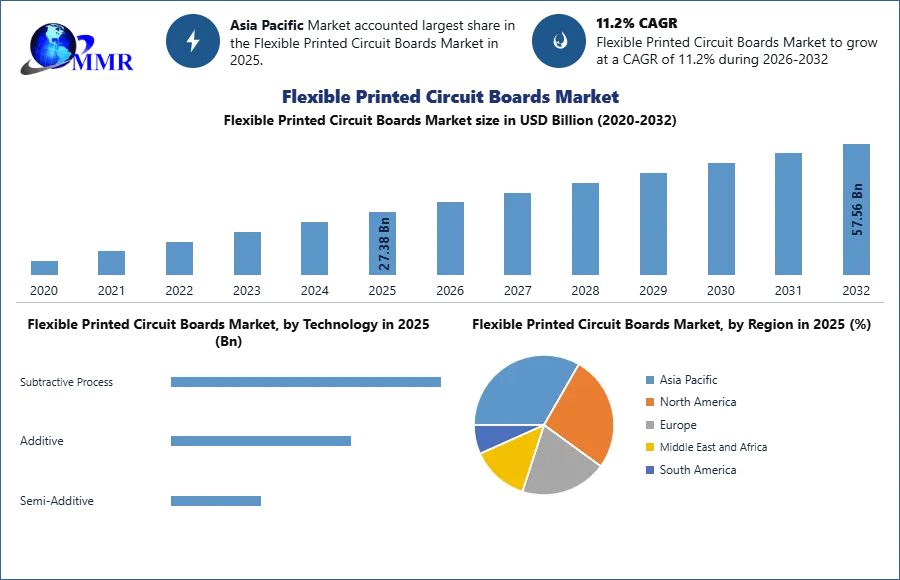
The Flexible Printed Circuit Boards Market was valued at USD 27.38 Bn in 2025 and is projected to reach USD 57.56 Bn by 2032, expanding at a CAGR of 11.2% from 2026 to 2032. This sustained growth reflects rising demand for compact, lightweight, and high-density electronic systems, strengthening investment across semiconductor packaging, advanced interconnect technologies, and electronics manufacturing.
Key Highlights
- Flexible Printed Circuit Boards Market valued at USD 27.38 Bn in 2025
- Forecast to reach USD 57.56 Bn by 2032
- CAGR of 11.2% during 2026–2032
- AI-enabled electronics are increasing demand for compact circuit designs
- Flexible PCBs are becoming critical for semiconductor integration and advanced packaging
- Consumer electronics, automotive systems, medical devices, and industrial automation continue expanding adoption
- Asia Pacific remains the global manufacturing leader
Why This Matters Now
Electronic devices continue becoming smaller while integrating greater computing capability. This transition requires circuit architectures capable of supporting higher component density, improved signal integrity, and greater design flexibility without increasing device size.
Flexible printed circuit boards address these requirements by enabling compact product designs, lightweight assemblies, and reliable electronic interconnections. For semiconductor manufacturers, this creates additional demand for advanced packaging technologies, embedded components, high-density interconnects, and precision manufacturing processes.
The convergence of AI, edge computing, IoT, and next-generation consumer electronics is making flexible PCB technology a strategic component of the semiconductor ecosystem.
Market Overview
Flexible printed circuit boards have evolved beyond conventional electronic interconnections into essential infrastructure supporting modern electronic systems.
The market valuation of USD 27.38 Bn in 2025 reflects their growing role across smartphones, wearable electronics, automotive electronics, healthcare equipment, industrial automation, aerospace, and communication systems. The projected increase to USD 57.56 Bn by 2032 demonstrates continued investment in advanced electronic manufacturing as OEMs pursue lighter, thinner, and more powerful devices.
This evolution is creating new opportunities for semiconductor suppliers, electronics manufacturing services providers, advanced materials companies, and PCB manufacturers capable of supporting increasingly sophisticated electronic architectures.
Key Trends Driving Growth
Artificial intelligence is reshaping electronics design by increasing processing requirements while reducing acceptable device size. Flexible PCBs enable more efficient integration of processors, memory devices, sensors, communication modules, and power management systems within compact electronic products.
Advanced semiconductor packaging continues supporting market expansion. As chiplet architectures, heterogeneous integration, and high-performance computing become more common, flexible interconnect technologies play an increasingly important role in enabling reliable system integration.
The expansion of IoT ecosystems is accelerating deployment of connected devices requiring lightweight, durable, and space-efficient circuit solutions. Smart homes, industrial automation, healthcare monitoring, and wearable electronics all contribute to growing flexible PCB demand.
5G deployment further strengthens the market by increasing production of communication equipment, connected consumer electronics, automotive electronics, and edge computing devices.
Electronics manufacturing services providers continue expanding production capabilities to meet rising global demand while improving automation, manufacturing precision, and supply-chain resilience.
Display innovation also contributes to market growth as foldable devices, flexible displays, and compact consumer electronics require increasingly sophisticated flexible circuit architectures.
Sustainability initiatives encourage manufacturers to improve production efficiency, reduce material waste, and optimize product durability throughout electronics manufacturing operations.
𝐃𝐨𝐰𝐧𝐥𝐨𝐚𝐝 𝐏𝐃𝐅 𝐁𝐫𝐨𝐜𝐡𝐮𝐫𝐞 @https://www.maximizemarketresearch.com/request-sample/187724/
Segment Insights
- Dominant Segment: Information available in the source report but not specified here without unsupported interpretation.
- Fastest-Growing Segment: Information available in the source report but not specified here without unsupported interpretation.
The report identifies distinct market segments; however, only verified information from the source should be published. Across applications, flexible PCB adoption continues increasing as manufacturers pursue thinner devices, greater electronic integration, and improved product reliability.
Every new generation of compact electronics increases demand for flexible circuit technologies capable of supporting higher semiconductor density and advanced packaging requirements.
Regional Growth Story
Asia Pacific remains the global center of flexible PCB manufacturing and semiconductor-enabled electronics production.
China continues expanding electronics manufacturing capacity while supporting large-scale PCB production for consumer electronics and industrial applications. Taiwan strengthens the industry through advanced semiconductor fabrication and PCB ecosystem integration.
South Korea contributes display technology leadership, semiconductor innovation, and premium electronics manufacturing. Japan maintains expertise in precision materials, electronic components, and advanced manufacturing technologies.
India continues expanding electronics manufacturing through increasing investments in domestic production capabilities supporting consumer electronics and semiconductor value chains.
The United States leads AI computing, semiconductor design, and advanced chip development, while Germany supports industrial electronics, automotive innovation, and precision manufacturing.
Government initiatives encouraging semiconductor sovereignty, electronics manufacturing, and resilient supply chains continue strengthening regional competitiveness across major technology economies.
Competitive Landscape
Competition increasingly extends beyond PCB manufacturing toward complete semiconductor integration capabilities. Companies investing in advanced fabrication, precision manufacturing, high-density interconnect technologies, and flexible electronic architectures are strengthening their strategic positions.
For semiconductor companies, flexible PCBs support growing demand for advanced packaging, chip integration, AI accelerators, high-bandwidth memory architectures, and next-generation computing platforms.
Electronics manufacturing services providers benefit as OEMs seek scalable production partners capable of assembling increasingly complex electronic systems while maintaining quality, yield, and manufacturing efficiency.
Technology leadership will increasingly depend on manufacturing precision, semiconductor compatibility, materials innovation, and supply-chain resilience rather than production capacity alone.
Recent Developments
- Growing adoption of flexible electronic architectures across consumer devices
- Increasing semiconductor integration supporting AI-enabled products
- Expansion of advanced electronics manufacturing capabilities
- Rising investment in lightweight and compact electronic system design
- Continued innovation in flexible circuit technologies supporting next-generation devices
Strategic Implications
Flexible printed circuit boards have become a strategic technology connecting semiconductor innovation with finished electronic products. Every advancement in AI computing, IoT deployment, automotive electronics, wearable technology, and industrial automation increases the importance of flexible electronic interconnect solutions.
Semiconductor manufacturers gain additional opportunities through advanced packaging, embedded processing, and integrated system architectures, while electronics OEMs benefit from greater product miniaturization, reliability, and manufacturing flexibility.
For investors, the market represents a critical intersection where semiconductor innovation, electronics manufacturing, advanced materials, and AI-enabled devices reinforce long-term industry expansion.
Future Outlook
The Flexible Printed Circuit Boards Market is entering a period where semiconductor packaging, AI hardware, high-density electronics, and intelligent manufacturing will increasingly determine competitive success. As connected devices become smaller, faster, and more powerful, flexible circuit technologies will remain essential to enabling next-generation electronic platforms.
The companies that integrate advanced flexible PCB manufacturing with semiconductor innovation and resilient global supply chains will shape the future of electronics, while those that fail to evolve beyond conventional circuit manufacturing risk losing competitiveness in an AI-driven hardware economy.
Analyst Perspective
“The Flexible Printed Circuit Boards Market is becoming an essential pillar of modern electronics manufacturing as AI-enabled devices, semiconductor miniaturization, and advanced packaging technologies continue to reshape product development. Companies investing in manufacturing innovation and scalable PCB technologies will be well positioned to capture future industry growth,” — Rucha Deshpande, Analyst
About Maximize Market Research
Maximize Market Research Pvt. Ltd. (MMR) is a global market research and consulting company that provides reliable, data-focused, and practical business insights. The firm serves a wide range of industries, including healthcare, pharmaceuticals, technology, automotive, electronics, chemicals, personal care, and consumer goods. Through market forecasts, competitive analysis, strategic consulting, and industry impact assessments, MMR helps organizations understand changing market conditions, identify growth opportunities, and make informed business decisions for long-term success.
2nd Floor, Navale IT Park Phase 3
Pune Banglore Highway, Narhe
Pune, Maharashtra 411041, India
+91 9607365656
sales@maximizemarketresearch.com
