Wearable Health Devices and Remote Monitoring Drive Biomedical Temperature Sensor Market Growth
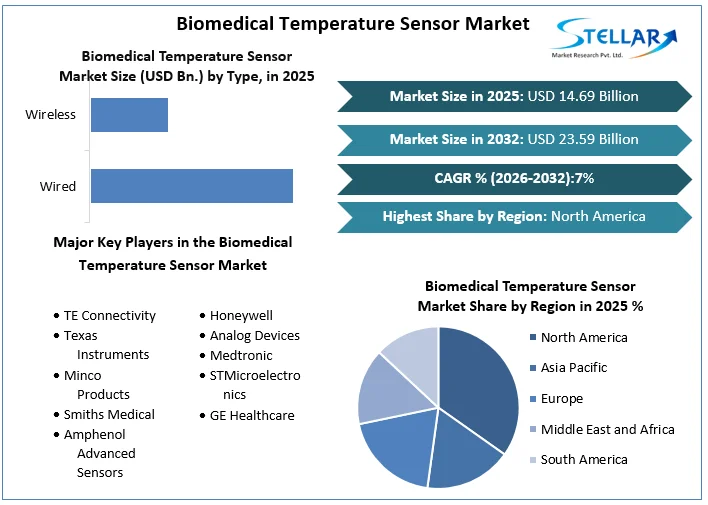
PUNE, India, June 26, 2026 – The Biomedical Temperature Sensor Market is gaining strong momentum as healthcare providers increasingly adopt wearable medical devices, remote patient monitoring solutions, and precision diagnostic technologies. According to Stellar Market Research, the global Biomedical Temperature Sensor Market was valued at USD 14.69 billion in 2025 and is projected to reach USD 23.59 billion by 2032, registering a CAGR of 7% during the forecast period. Rising chronic disease prevalence, aging populations, and expanding telemedicine adoption are accelerating demand for advanced biomedical sensing technologies.
Healthcare systems worldwide are integrating wireless biomedical temperature sensors into clinical diagnostics, intensive care monitoring, wearable devices, and home healthcare applications to improve patient outcomes while enabling continuous real-time health monitoring.
Market Opportunity Overview
The biomedical temperature sensor industry is transitioning from conventional hospital-based monitoring toward connected, intelligent, and patient-centric healthcare ecosystems. Wireless sensors integrated with artificial intelligence, cloud computing, and Internet of Things (IoT) platforms are enabling continuous monitoring of patient temperature across hospitals, ambulatory care, and home healthcare environments.
Growing demand for personalized medicine, remote patient monitoring, and wearable health technologies is creating substantial opportunities for sensor manufacturers. Miniaturization, improved accuracy, lower power consumption, and enhanced wireless connectivity are enabling biomedical temperature sensors to become critical components in next-generation medical devices and digital healthcare platforms.
𝐃𝐨𝐰𝐧𝐥𝐨𝐚𝐝 𝐅𝐫𝐞𝐞 𝐏𝐃𝐅 𝐁𝐫𝐨𝐜𝐡𝐮𝐫𝐞: https://www.stellarmr.com/report/req_sample/Biomedical-Temperature-Sensor-Market/1449
Key Findings from the Report
The Biomedical Temperature Sensor Market was valued at USD 14.69 billion in 2025.
The market is projected to reach USD 23.59 billion by 2032.
The industry is expected to expand at a 7% CAGR during 2026–2032.
Wireless sensors represent the fastest-growing technology segment.
Non-invasive sensors dominate the product segment due to increasing patient comfort and broader clinical adoption.
Medical diagnostics account for the largest application share, while personal healthcare is projected to register the fastest growth.
North America leads the global market, supported by advanced healthcare infrastructure and high medical technology adoption.
Market Drivers and Restraints
Key Drivers
Rapid Growth of Remote Patient Monitoring
Healthcare providers continue expanding remote monitoring programs to improve chronic disease management, elderly care, and post-operative recovery.
Increasing Adoption of Wearable Medical Devices
Smart wearables capable of continuously monitoring body temperature and other vital signs are driving demand for highly accurate biomedical sensors.
Expansion of Digital Healthcare Infrastructure
Artificial intelligence, telemedicine, IoT-enabled medical devices, and electronic health records are accelerating deployment of advanced biomedical sensing technologies.
Key Restraints
High Development and Regulatory Compliance Costs
Medical-grade sensor development requires extensive validation, certification, and regulatory approval, increasing commercialization costs.
Connectivity and Integration Challenges
Integrating wireless biomedical sensors into complex healthcare IT environments while ensuring cybersecurity and interoperability remains a significant challenge.
Technology, Regulation, and Sustainability Trends
Advancements in MEMS technology, flexible electronics, AI-powered diagnostics, and IoT connectivity are improving the performance of biomedical temperature sensors. Manufacturers are increasingly developing ultra-miniaturized wireless sensors capable of continuous monitoring with enhanced battery efficiency.
Healthcare regulators continue strengthening medical device quality standards, cybersecurity requirements, and patient safety regulations, encouraging innovation in highly reliable temperature sensing technologies. Sustainability initiatives focusing on low-power electronics, recyclable medical components, and longer device lifecycles are also gaining importance across the medical technology industry.
Regional Insights
North America Leads Global Market
North America remains the largest Biomedical Temperature Sensor Market owing to advanced healthcare infrastructure, strong medical device innovation, growing telemedicine adoption, and substantial healthcare expenditure.
Asia-Pacific Emerges as the Fastest-Growing Region
China, India, Japan, and South Korea continue expanding investments in healthcare infrastructure, wearable medical technologies, and digital health platforms, supporting rapid market growth.
Europe Strengthens Digital Healthcare
European healthcare providers are increasingly adopting connected patient monitoring systems while complying with stringent medical device regulations.
Middle East and Latin America Expand Healthcare Investments
Growing healthcare modernization programs and increasing investments in hospital infrastructure continue creating new opportunities for biomedical sensor manufacturers.
Recent Industry Developments
Medtronic (2025): Expanded remote patient monitoring solutions integrating wireless biomedical sensors to improve chronic disease management.
Honeywell (2025): Introduced advanced medical-grade temperature sensing technologies designed for wearable healthcare devices and clinical monitoring.
Texas Instruments (2025): Expanded low-power precision temperature sensor portfolio supporting next-generation portable medical equipment.
STMicroelectronics (2025): Advanced MEMS-based biomedical sensing technologies enabling smaller and more energy-efficient wearable medical devices.
Analog Devices (2025): Enhanced precision healthcare sensor platforms supporting AI-enabled diagnostics and continuous patient monitoring.
Competitive Landscape
The Biomedical Temperature Sensor Market remains highly competitive with major participants including STMicroelectronics, Analog Devices, Texas Instruments, Honeywell, TE Connectivity, Maxim Integrated, Omega Engineering, Amphenol Advanced Sensors, and Medtronic. Companies are investing in wireless sensing technologies, AI-enabled diagnostics, wearable healthcare platforms, miniaturized electronics, and strategic partnerships to strengthen competitive positioning.
𝐃𝐨𝐰𝐧𝐥𝐨𝐚𝐝 𝐅𝐫𝐞𝐞 𝐏𝐃𝐅 𝐁𝐫𝐨𝐜𝐡𝐮𝐫𝐞: https://www.stellarmr.com/report/req_sample/Biomedical-Temperature-Sensor-Market/1449
Analyst Commentary
“Biomedical temperature sensing is becoming an essential component of connected healthcare ecosystems. As wearable devices, telemedicine, and AI-powered diagnostics continue expanding, demand for highly accurate, low-power, and wireless biomedical sensors will accelerate across hospitals, home healthcare, and personalized medicine applications,” said a Senior Research Analyst at Stellar Market Research.
Future Outlook
Through 2032, the Biomedical Temperature Sensor Market is expected to experience steady expansion driven by remote patient monitoring, wearable healthcare technologies, AI-enabled diagnostics, and digital healthcare transformation. Continuous innovation in wireless connectivity, sensor miniaturization, and intelligent medical devices will improve patient care while creating significant growth opportunities for medical technology manufacturers.
About Stellar Market Research
Stellar Market Research is a global market research and business consulting firm delivering comprehensive market intelligence, competitive benchmarking, strategic consulting, and industry forecasting services. Through extensive primary research, advanced analytics, and deep sector expertise, the company helps organizations identify emerging opportunities, evaluate competitive dynamics, and make informed business decisions across healthcare, technology, manufacturing, automotive, chemicals, energy, and consumer industries.
Media Contact
Stellar Market Research
Website: https://www.stellarmr.com
Email: sales@stellarmr.com
