Key Highlights
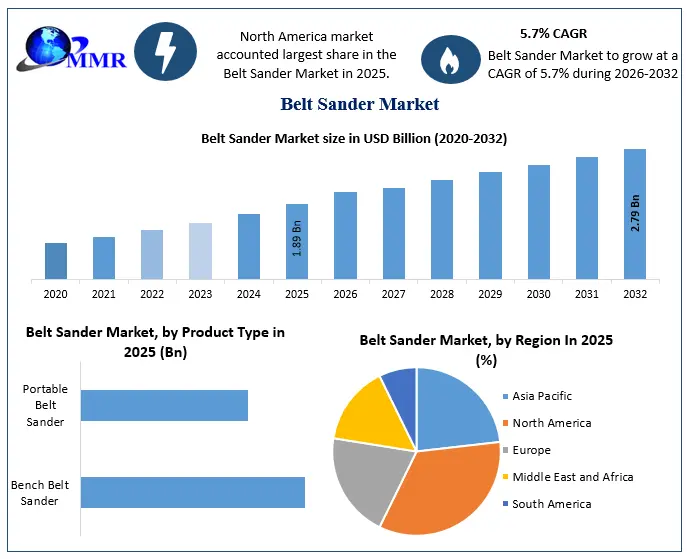
The global belt sander market was valued at USD 1.70 Billion in 2023 and is projected to reach USD 2.50 Billion by 2030, growing at a compound annual growth rate (CAGR) of 5.7%.
The electric belt sander segment held the dominant market position in 2023, while cordless battery-powered configurations represent the fastest-growing technology segment.
North America led global consumption by securing a 33% market share in 2023, closely followed by Europe with a 24% share.
China remains the premier global manufacturing and export powerhouse, shipping 10.2 million belt sanders valued at USD 1.3 billion, representing a 10% volume and 15% value increase over 2021 numbers.
Volatility in raw material inputs has created structural headwinds, with the cost of primary tool manufacturing components increasing by an average of 5% annually in recent cycles.
Why This Matters Now The structural modernization of global energy infrastructure demands an unprecedented volume of localized component manufacturing, turning industrial equipment efficiency into a critical bottleneck for project deployment timelines. Industrial facilities, wind turbine blade fabricators, and solar racking manufacturers are facing strict mandates to optimize energy efficiency, lower site emissions, and enforce advanced workplace safety standards. This regulatory shift transforms standard shop floor machinery from simple capital assets into indicators of operational decarbonization and workforce protection.
For utility executives, power sector infrastructure investors, and industrial developers, tool supply chains directly impact project cost structures and execution speeds. The move toward zero-emission construction sites accelerates the retirement of pneumatic or inefficient legacy power tools. Embracing next-generation, energy-efficient tool platforms allows large-scale infrastructure operations to mitigate grid connection bottlenecks on-site, protect workers from hazardous particulate matter, and maintain regulatory compliance across strict jurisdictions.
Market Overview The global belt sander market Size is entering a phase of steady capital investment, shifting from generic manual wood processing tools into highly engineered, digitally managed surface preparation assets. Historically known as strip sanders, these systems play an essential role in leveling, smoothing, and precise material removal across diversified industrial substrates. The global market, valued at USD 1.70 Billion in 2023, is on track to hit USD 2.50 Billion by 2030, showing a steady 5.7% CAGR. This growth is heavily supported by massive global spending on urban infrastructure, renewable energy installations, and commercial power asset upgrades.
What changed is the fundamental deployment profile of these tools across high-value industrial sectors. Industrial sanders are no longer confined to isolated commercial woodworking shops; they are deeply integrated into manufacturing lines for specialized composite materials, wind turbine nacelles, electrical equipment housing, and clean-energy automotive components. To accommodate this range of demands, the industry relies on two structural form factors: portable belt sanders optimized for large surfaces and wide stock processing, and bench-mounted configurations engineered for the high-precision refinement of smaller, critical components.
Key Trends Driving Growth Workplace safety regulations are acting as a major driver for market expansion, compelling industrial operations to replace legacy machinery with systems that feature advanced dust collection and localized environmental controls. Modern regulatory frameworks enforce strict ambient air quality standards to shield workers from airborne particulates and toxic composite dust. Tool manufacturers are responding by integrating advanced cyclone technology, multi-stage air filtration, and automated dust extraction mechanisms directly into sander assemblies. These safety additions optimize air quality, minimize cleanup downtime, and lower compliance risks for heavy manufacturing facilities.
Concurrently, the integration of the Internet of Things (IoT) is modernizing industrial power tools, turning separate devices into data nodes for smart factory networks. Modern belt sanders feature embedded sensors that continuously track operating temperatures, structural vibration patterns, and real-time mechanical component wear. This data is transmitted instantly to cloud-hosted maintenance dashboards, enabling predictive maintenance strategies that prevent sudden tool failure on active assembly lines. For instance, Festool has deployed IoT-enabled sanders linked to mobile apps, giving operators direct visibility into asset status and operational health. Furthermore, companies are combining artificial intelligence (AI) algorithms with augmented reality (AR) to optimize material removal paths and automate operator training.
𝐃𝐨𝐰𝐧𝐥𝐨𝐚𝐝 𝐏𝐃𝐅 𝐁𝐫𝐨𝐜𝐡𝐮𝐫𝐞 @ https://www.maximizemarketresearch.com/request-sample/216221/
Segment Insights
Electric Belt Sander (Dominant Power Source Segment): Holding the largest market share in 2023, this segment remains standard in high-volume industrial environments due to its continuous power delivery, high torque reliability, and superior material removal rates.
Cordless Belt Sander (Fastest-Growing Power Source Segment): Spurred by major advancements in lithium-ion and solid-state battery technologies, this segment is growing rapidly among both professional infrastructure installation crews and DIY users seeking high portability without site emission footprints.
Construction Industry (Dominant End-Use Segment): This sector led global demand in 2023, driven by rapid urbanization, substantial utility infrastructure deployments, and global investments in energy-efficient commercial buildings.
Woodworking Industry (Major End-Use Segment): Capturing a major share of the global market in 2023, this segment expands through specialized architectural projects, advanced timber construction, and a strong global consumer hobbyist culture.
Regional Growth Story North America holds the leading position in the global belt sander landscape, controlling 33% of total market value in 2023. This dominance is sustained by deep capital deployment in infrastructure modernization, massive commercial real estate expansions, and a mature advanced manufacturing ecosystem. The region’s extensive wind energy and automotive fabrication sectors rely heavily on precise, high-performance surface treatment tools to maintain strict quality standards across heavy component manufacturing lines.
Europe secures the second-largest position, capturing 24% of the global market share in 2023. The European market operates under strict energy efficiency mandates and circular economy principles, prompting regional tool manufacturers to focus on lightweight, ergonomic designs that consume less power and lower environmental impacts. In contrast, the Asia-Pacific region represents the primary engine of volume growth and export capacity. China stands as the dominant global manufacturing hub, exporting 10.2 million belt sanders valued at USD 1.3 billion, which marks a 10% volume increase and a 15% value expansion over 2021 benchmarks. This massive manufacturing scale supports growing infrastructure and renewable energy programs across emerging economies in India, Japan, and Australia.
Competitive Landscape The competitive landscape of the belt sander market is consolidating around advanced battery platforms, motor optimization, and proprietary electronic architectures. Escalating raw material costs present a structural challenge for suppliers, with base manufacturing inputs rising at an average of 5% annually. The sharp price volatility of critical materials like aluminum oxide, aluminum housings, and zirconia components has compressed margins, forcing manufacturers to optimize their production processes and secure long-term component supply chains.
To protect market share, top-tier tool developers are aggressively investing in electrification technologies that eliminate the need for corded connections without compromising industrial performance. In 2023, Milwaukee Tool introduced its M18 Fuel Belt Sander, utilizing a proprietary brushless PowerState motor to match corded performance and maximize operational runtime on infrastructure sites. Simultaneously, Metabo HPT launched its 36V Belt Sander as a high-voltage solution designed to replace heavy corded equipment on demanding construction projects. These developments show a strategic shift toward tool ecosystems where proprietary battery compatibility and long-term durability determine market position.
Recent Developments
Leading tool brands are standardizing brushless motor technologies across their portable sander lineups, significantly reducing energy losses from friction and increasing total tool lifespans.
Manufacturers are forming partnerships with digital safety platforms to connect tool dust-extraction systems with smart workshop HVAC infrastructure.
Top developers have launched multi-voltage battery packs that seamlessly power heavy bench-mounted sanders and portable field tools on a single battery platform.
Supply chain investments have pivoted toward securing stable access to aluminum and premium abrasives to counter raw material inflation and maintain price competitiveness.
Strategic Implications The evolution of tool technologies requires industrial facilities and infrastructure developers to reconsider their capital asset procurement strategies. Power tools can no longer be evaluated solely on upfront acquisition costs. Operations must analyze total lifecycle performance, energy consumption profiles, battery ecosystem cross-compatibility, and the value of integrated IoT data features.
Furthermore, the rapid rise of high-capacity cordless platforms allows project managers to decouple site operations from localized grid connections during early infrastructure phases. This autonomy eliminates diesel generator dependencies, lowers the carbon footprint of construction operations, and prevents installation delays caused by power distribution bottlenecks.
Future Outlook The global belt sander market will see a clear technological division as advanced manufacturing hubs fully integrate smart, low-emission power tools. The phase-out of legacy, high-emission, and pneumatically driven sanding machinery will accelerate as national safety regulators tighten workplace dust exposure and energy efficiency standards. High-value infrastructure projects will increasingly require the use of digitally tracked, zero-emission tool fleets to satisfy strict ESG criteria and corporate net-zero commitments.
Ultimately, this market will create a sharp divide based on technology integration and supply chain resilience. Future market leaders will be the companies that master high-voltage battery electronics, protect their margins against raw material inflation, and deliver seamless IoT data tracking for industrial operations. Conversely, manufacturers that continue to rely on basic, unmonitored corded designs will be pushed out of primary industrial supply chains, leaving them exposed to declining margins in commoditized retail sectors.
Analyst Perspective “The rapid rollout of high-voltage cordless tools and embedded IoT sensors is transforming the belt sander from a basic mechanical tool into an intelligent data node,” states Gaurav Deshmukh, Research Analyst at Maximize Market Research. “As global infrastructure projects place greater emphasis on workplace safety compliance and site electrification, tool manufacturers must prioritize smart dust mitigation and high-efficiency motor designs to secure long-term industrial supply contracts.”
About Maximize Market Research
Maximize Market Research Pvt. Ltd. (MMR) is a global market research and consulting company that provides reliable, data-focused, and practical business insights. The firm serves a wide range of industries, including healthcare, pharmaceuticals, technology, automotive, electronics, chemicals, personal care, and consumer goods. Through market forecasts, competitive analysis, strategic consulting, and industry impact assessments, MMR helps organizations understand changing market conditions, identify growth opportunities, and make informed business decisions for long-term success.
2nd Floor, Navale IT Park Phase 3
Pune Banglore Highway, Narhe
Pune, Maharashtra 411041, India
+91 9607365656
sales@maximizemarketresearch.com
