Key Highlights
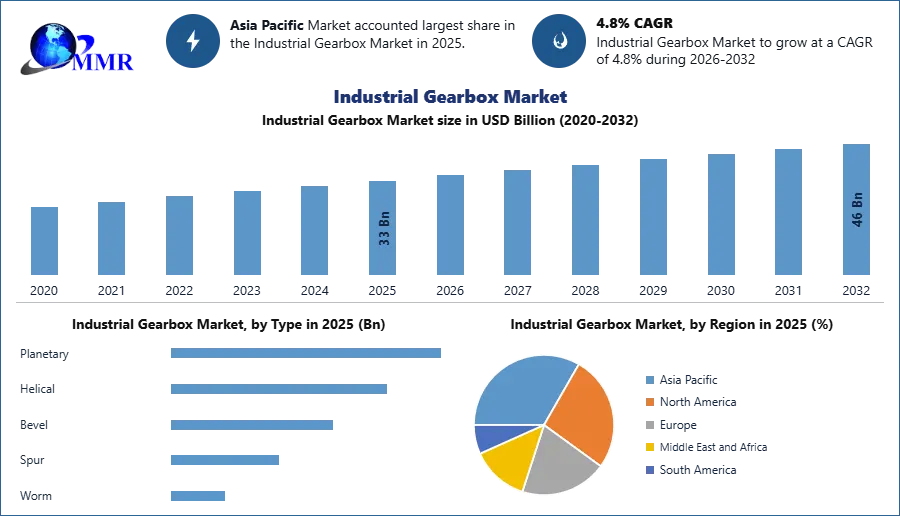
- Industrial Gearbox Market reached USD 33 Billion in 2025.
- Market is forecast to reach nearly USD 46 Billion by 2032.
- Expected CAGR stands at 4.8% during 2026–2032.
- Industrial automation continues reshaping gearbox purchasing decisions.
- Predictive maintenance and IIoT monitoring increase demand for intelligent drivetrain solutions.
- Manufacturing modernization remains a major investment priority across global industrial economies.
Why This Matters Now
Manufacturers are no longer buying industrial gearboxes simply to transmit power. They are investing in assets that support digital factories, predictive maintenance strategies, and higher production reliability. Every hour of unplanned downtime now carries a measurable financial impact, making drivetrain reliability a board-level operational priority.
Industry 4.0 has also changed purchasing criteria. Automation projects increasingly require gearboxes capable of supporting robotics, automated material handling, intelligent production lines, and connected manufacturing systems. This shift transforms industrial gearboxes from mechanical components into strategic productivity enablers.
Market Overview
The Industrial Gearbox Market was valued at USD 33 Billion in 2025 and is expected to reach nearly USD 46 Billion by 2032, expanding at a CAGR of 4.8%. The steady growth signals continued investment in manufacturing modernization rather than cyclical replacement demand.
Industrial gearboxes remain essential across mining, cement, metals, energy, chemicals, food processing, material handling, and discrete manufacturing. As factories pursue greater automation, higher throughput, and lower maintenance costs, demand increasingly favors high-performance gear systems capable of operating under continuous industrial workloads.
The market’s evolution is closely aligned with smart manufacturing initiatives. Modern production facilities require drivetrain systems that integrate with condition monitoring platforms, predictive maintenance software, and industrial asset management solutions, creating new value beyond traditional mechanical performance.
Key Trends Driving Growth
Factory digitization continues redefining industrial equipment requirements. Manufacturers increasingly deploy Industrial Internet of Things (IIoT) sensors to monitor gearbox temperature, vibration, lubrication quality, and operating efficiency in real time. These capabilities reduce unexpected failures while extending equipment life.
Predictive maintenance has become a major operational strategy. Instead of following fixed maintenance schedules, industrial operators now use data analytics to identify component wear before failures occur. This approach improves plant availability while lowering maintenance expenditure.
Robotics integration is also expanding gearbox applications. Automated production cells, packaging systems, warehouse automation, and material handling equipment require compact, highly efficient gear systems capable of supporting continuous precision movement.
Artificial intelligence further strengthens maintenance decision-making by analyzing operational data collected through connected industrial assets. Combined with edge computing, AI enables faster diagnostics without relying entirely on centralized cloud infrastructure.
Digital twin technologies are gradually influencing equipment lifecycle management. Virtual equipment models help manufacturers simulate operating conditions, optimize maintenance schedules, and improve drivetrain performance before physical interventions occur.
Growing deployment of PLC, SCADA, DCS, and Manufacturing Execution Systems (MES) also increases the importance of reliable mechanical power transmission. As automation architectures become more interconnected, gearbox reliability directly influences overall production efficiency.
Explore detailed analysis, insights, and growth opportunities
Segment Insights
- Dominant Segment: The report identifies the leading market segment as the dominant revenue contributor, supported by widespread industrial deployment across major manufacturing industries.
- Fastest-Growing Segment: The report highlights the fastest-growing segment benefiting from expanding automation investments and increasing demand for higher operational efficiency.
- Industrial applications increasingly prioritize energy-efficient gearbox designs to reduce operating costs.
- Heavy industries continue driving significant demand due to continuous-process operations and high torque requirements.
- Automation-intensive industries increasingly favor gear systems compatible with predictive maintenance platforms.
Regional Growth Story
Asia-Pacific continues leading industrial manufacturing investments as countries accelerate factory modernization, industrial capacity expansion, and automation deployment. Large-scale manufacturing ecosystems support sustained demand for industrial power transmission equipment across multiple end-use industries.
China remains central to global manufacturing output, encouraging continued investments in automation technologies, robotics, and smart factories. India also strengthens its manufacturing capabilities through industrial expansion and modernization initiatives supporting advanced production infrastructure.
Germany continues setting benchmarks for Industry 4.0 implementation. Its emphasis on engineering excellence, digital manufacturing, and intelligent production systems reinforces demand for premium industrial gearbox technologies capable of supporting advanced automated operations.
The United States maintains strong demand through manufacturing modernization, industrial productivity initiatives, and continued investments in automated production environments. Process industries increasingly adopt predictive maintenance strategies to maximize equipment availability.
Japan and South Korea continue emphasizing robotics, precision manufacturing, and advanced industrial automation. Their highly automated manufacturing environments create sustained opportunities for reliable, high-performance gearbox solutions designed for continuous operation.
Competitive Landscape
Competition increasingly centers on technological capability rather than mechanical specifications alone. Manufacturers are investing in gearbox designs that support predictive maintenance, higher efficiency, lower lifecycle costs, and seamless integration into digital manufacturing ecosystems.
Automation compatibility has become an important differentiator. Suppliers capable of integrating intelligent monitoring capabilities with traditional drivetrain performance strengthen their long-term competitive positioning as customers prioritize connected industrial operations.
Manufacturing investments increasingly focus on operational resilience. Product innovation, production capacity expansion, engineering improvements, and digital service offerings indicate that market leaders are positioning themselves as long-term industrial productivity partners rather than component suppliers.
The competitive landscape also reflects broader industrial digitization. Companies expanding automation partnerships, enhancing engineering capabilities, and supporting smart factory initiatives are better positioned to capture future demand created by Industry 4.0 investments.
Recent Developments
- Continued investments in manufacturing modernization support gearbox demand.
- Industrial automation projects increase deployment of advanced drivetrain technologies.
- Predictive maintenance adoption expands across process industries.
- Smart factory implementation strengthens demand for connected mechanical systems.
- Digital manufacturing initiatives encourage integration of intelligent monitoring solutions.
- Industrial productivity programs continue driving equipment upgrades.
Strategic Implications
Industrial gearboxes are becoming strategic assets within digitally connected factories. Their value increasingly depends on reliability, lifecycle performance, monitoring capability, and compatibility with intelligent maintenance platforms.
Automation suppliers, system integrators, and manufacturing technology providers benefit from this transition by offering integrated solutions rather than standalone mechanical products. Equipment buyers increasingly evaluate total operating cost instead of initial purchase price.
Investors should also view the market through the lens of industrial digital transformation. Companies capable of combining engineering expertise with digital capabilities are likely to strengthen competitive positioning as manufacturing becomes increasingly data driven.
Future Outlook
The Industrial Gearbox Market is moving beyond mechanical power transmission toward digitally enabled industrial infrastructure. Industry 4.0, AI-assisted maintenance, robotics integration, and connected manufacturing will continue influencing purchasing decisions across global industries.
As manufacturers pursue greater efficiency, lower downtime, and higher operational resilience, intelligent drivetrain technologies will become integral to factory modernization strategies. Future market leadership will depend less on producing stronger gearboxes and more on delivering connected, data-enabled industrial performance.
The companies that successfully integrate mechanical engineering with digital intelligence will define the next generation of smart factories, while those that remain focused solely on conventional hardware risk falling behind in the era of autonomous industrial operations.
Analyst Perspective
“Industrial manufacturers are increasingly viewing gearbox investments through the broader lens of automation, operational efficiency, and digital transformation. As Industry 4.0 adoption expands, gearbox technologies that improve reliability, predictive maintenance, and factory productivity will play an increasingly strategic role in industrial competitiveness.” — Gaurav Deshmukh, Analyst
About Maximize Market Research:
Maximize Market Research is one of the fastest-growing market research and business consulting firms serving clients globally. Our revenue impact and focused growth-driven research initiatives make us a proud partner of majority of the Fortune 500 companies. We have a diversified portfolio and serve a variety of industries such as IT & telecom, chemical, food & beverage, aerospace & defense, healthcare and others.
Contact Maximize Market Research:
MAXIMIZE MARKET RESEARCH PVT. LTD.
⮝ 3rd Floor, Navale IT park Phase 2,
Pune Banglore Highway, Narhe
Pune, Maharashtra 411041, India.
✆ +91 9607365656
🖂 sales@maximizemarketresearch.com
