Key Highlights
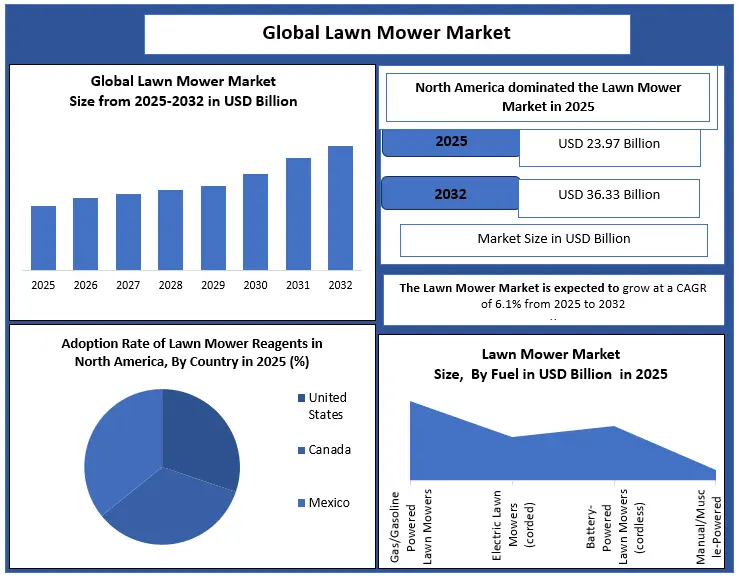
- Market valued at USD 23.97 Billion in 2025
- Expected to reach USD 36.33 Billion by 2032
- Forecast CAGR of 6.1% (2026–2032)
- Robotic and battery-powered lawn mowers continue gaining market attention
- Smart connectivity is becoming a competitive differentiator
- Sustainability regulations encourage electric equipment adoption
- Automation technologies are improving manufacturing efficiency
- Digital monitoring enhances equipment maintenance and fleet management
Why This Matters Now
Manufacturers are facing rising labor shortages, increasing sustainability expectations, and stronger consumer demand for intelligent outdoor equipment. These pressures are accelerating investment in automation throughout both manufacturing facilities and finished products.
Industry 4.0 technologies are helping equipment manufacturers improve productivity while reducing production costs. Digital manufacturing systems, robotics, machine vision, and Industrial IoT platforms enable higher quality control and shorter product development cycles.
At the same time, landscaping professionals and homeowners increasingly expect connected products that require less manual intervention. This demand is encouraging manufacturers to integrate sensors, wireless connectivity, AI-assisted navigation, and predictive maintenance capabilities into next-generation lawn mowers.
Market Overview
The Lawn Mower Market is evolving beyond conventional mechanical equipment into a technology-driven industry focused on automation, energy efficiency, and intelligent operation.
Electrification continues replacing conventional fuel-powered systems in many applications. Battery improvements, lower maintenance requirements, and environmental regulations are encouraging manufacturers to expand electric product portfolios while reducing emissions.
Manufacturing investments are also shifting toward digital production environments. Smart factories equipped with industrial robots, automated assembly lines, Manufacturing Execution Systems (MES), and real-time quality monitoring enable faster production while supporting greater product customization.
The growing adoption of Industrial Internet of Things (IIoT) technologies further enables manufacturers to collect production data, optimize workflows, and reduce equipment downtime through predictive maintenance strategies.
Key Trends Driving Growth
Artificial intelligence is becoming increasingly important across robotic lawn mower development. Navigation algorithms, obstacle detection, autonomous route planning, and adaptive cutting systems are improving operational efficiency while reducing user intervention.
Battery innovation remains another major industry driver. Higher energy density, faster charging capability, and improved battery management systems continue expanding the commercial viability of electric lawn equipment.
Manufacturers are also embracing Industry 4.0 initiatives through robotics integration, automated inspection systems, PLC-controlled manufacturing cells, and advanced production analytics. These technologies improve operational consistency while lowering manufacturing costs.
Digital twins and simulation technologies are supporting faster product development by enabling engineers to optimize equipment performance before physical production begins. Combined with edge computing and AI-powered analytics, these capabilities reduce engineering time while improving product reliability.
Industrial cybersecurity is receiving greater attention as connected outdoor equipment becomes part of broader digital ecosystems. Secure connectivity, software updates, and cloud-based equipment monitoring are becoming integral elements of product development strategies.
Explore detailed analysis, insights, and growth opportunities
Segment Insights
- Dominant Segment: As identified in the Maximize Market Research report.
- Fastest-Growing Segment: As identified in the Maximize Market Research report.
- Battery-powered equipment continues supporting long-term market transformation.
- Robotic lawn mowers are driving innovation through autonomous operation and intelligent navigation.
- Commercial landscaping applications increasingly adopt connected fleet management solutions.
- Residential customers continue shifting toward low-maintenance and environmentally friendly equipment.
Regional Growth Story
North America continues representing an important market due to high landscaping expenditure, widespread residential lawn ownership, and continuous product innovation. Equipment manufacturers are expanding smart outdoor power portfolios while investing in advanced manufacturing technologies to improve competitiveness.
Europe remains a significant innovation center, particularly with increasing demand for sustainable outdoor equipment and robotic lawn care solutions. Germany continues supporting advanced manufacturing through Industry 4.0 initiatives, digital factory investments, and automation technologies.
China, Japan, South Korea, and India are strengthening manufacturing capabilities through factory modernization, robotics deployment, and expanding battery production ecosystems. These developments improve supply chain resilience while supporting higher production efficiency.
Growing urbanization and rising household income across emerging economies are also creating opportunities for premium electric and autonomous lawn equipment.
Competitive Landscape
Competition is increasingly shifting from mechanical engineering toward software capability, battery technology, intelligent automation, and connected services.
Manufacturers investing in robotic technologies are positioning themselves for long-term leadership as autonomous operation becomes a key purchasing factor. AI-powered navigation, connected mobile applications, and predictive maintenance capabilities are creating competitive differentiation beyond traditional cutting performance.
Automation within manufacturing operations is equally important. Companies deploying robotics, machine vision inspection, Industrial IoT monitoring, and digital production management can reduce operational costs while improving product consistency and accelerating product launches.
Strategic partnerships involving battery technology, software platforms, automation providers, and digital service ecosystems indicate that future competitive advantage will increasingly depend on integrated technology capabilities rather than standalone equipment manufacturing.
Recent Developments
- Manufacturers continue expanding robotic lawn mower portfolios.
- Battery-powered product investments remain a major strategic priority.
- Smart connectivity features are becoming increasingly common across premium equipment.
- Automation technologies continue improving manufacturing productivity.
- Digital monitoring solutions support predictive equipment maintenance and lifecycle management.
Strategic Implications
For manufacturers, competitive success increasingly depends on integrating automation across both production facilities and finished products. Investments in robotics, AI, Industrial IoT, and digital manufacturing improve efficiency while enabling faster response to changing customer requirements.
Automation suppliers benefit from expanding opportunities across manufacturing modernization projects, including PLC systems, SCADA platforms, industrial robotics, machine vision, and predictive maintenance software.
Investors should monitor companies accelerating electrification, software integration, and autonomous product development, as these capabilities are becoming stronger indicators of long-term competitive positioning.
Future Outlook
The Lawn Mower Market is steadily transitioning toward intelligent outdoor equipment powered by automation, connectivity, and sustainable energy technologies. Smart manufacturing investments will continue improving production flexibility, while AI-enabled robotic products redefine customer expectations across residential and commercial landscaping.
The next competitive divide will not be determined by cutting performance alone—it will belong to manufacturers that successfully combine Industry 4.0 production, intelligent automation, connected products, and digital service ecosystems while competitors remain tied to conventional equipment models.
Analyst Perspective
“The Lawn Mower Market is entering a technology-driven phase where automation, electrification, and intelligent connectivity are becoming central competitive advantages. Manufacturers investing in smart production systems alongside innovative outdoor equipment will be better positioned to capture long-term market opportunities,” said Gaurav Deshmukh, Analyst, Maximize Market Research.
About Maximize Market Research:
Maximize Market Research is one of the fastest-growing market research and business consulting firms serving clients globally. Our revenue impact and focused growth-driven research initiatives make us a proud partner of majority of the Fortune 500 companies. We have a diversified portfolio and serve a variety of industries such as IT & telecom, chemical, food & beverage, aerospace & defense, healthcare and others.
Contact Maximize Market Research:
MAXIMIZE MARKET RESEARCH PVT. LTD.
⮝ 3rd Floor, Navale IT park Phase 2,
Pune Banglore Highway, Narhe
Pune, Maharashtra 411041, India.
✆ +91 9607365656
🖂 sales@maximizemarketresearch.com
